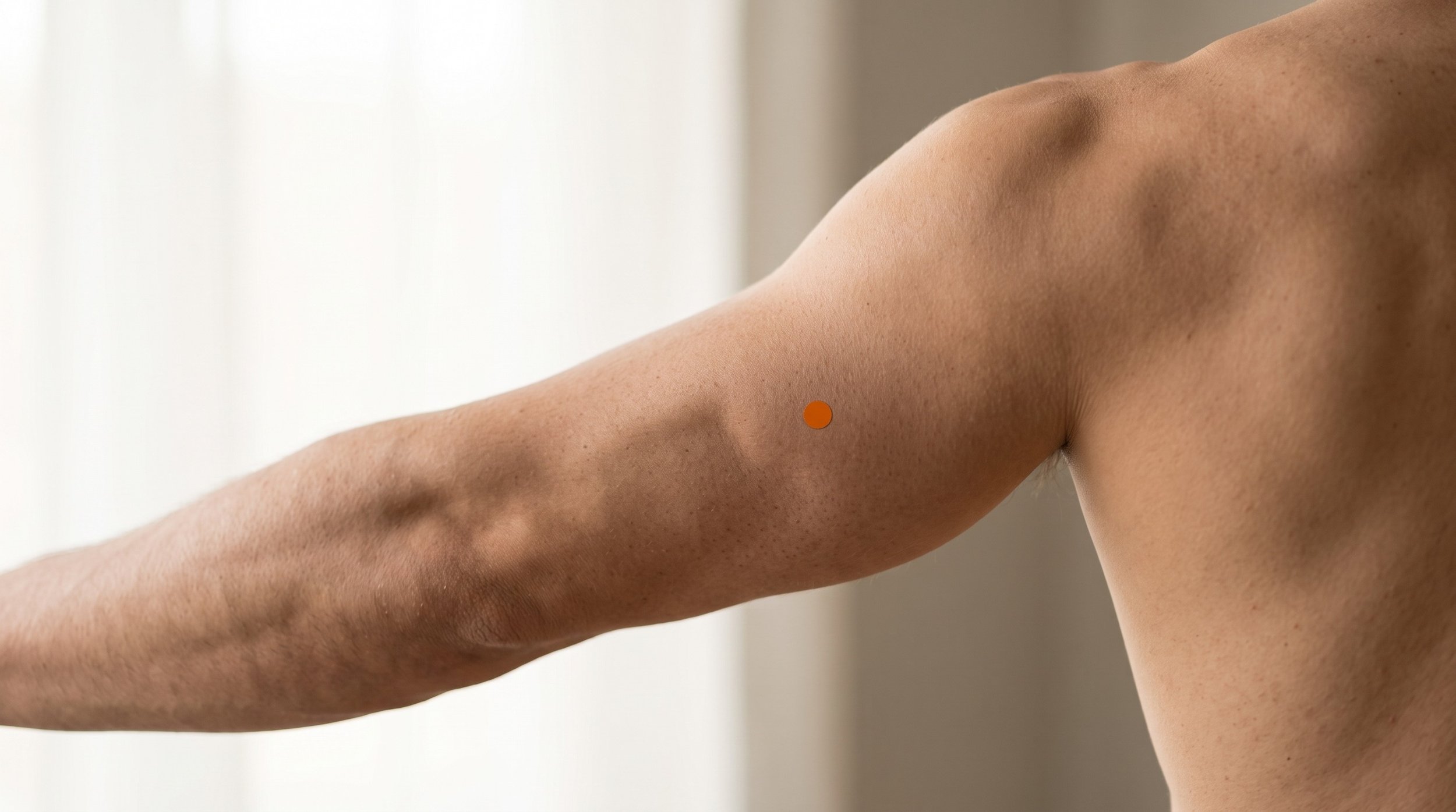
SJ12 Acupuncture Point (Xiaoluo)
Dispersing Luo River in the Triceps: Anatomy, Mechanism, and Why This Quiet Upper Arm Point Belongs in Neck and Shoulder Treatment
SJ12 (Xiaoluo, often translated as Dispersing Luo River), also written TE12, sits on the back of the upper arm, buried in the groove between the long and lateral heads of the triceps behind the shaft of the humerus. You find it on the line running from SJ10 at the elbow up to SJ14 at the shoulder, about 4 cun above the elbow point, roughly a thumb's width past the midpoint of that line.
It is not a famous point, and that is exactly why it gets overlooked: the te12 acupuncture point sits in dense arm muscle that quietly loads every time you carry a bag, press up out of a chair, or hold a mouse for eight hours, and the classical literature ties it directly to neck stiffness, upper back tension, and shoulder and arm pain rather than to anything happening locally in the elbow.
- Location and layers: SJ12 lies on the posterior upper arm on the SJ10 to SJ14 line, 4 cun proximal to SJ10, in the depression between the long and lateral heads of the triceps just behind the humerus (Deadman et al., 2007). The needle passes skin, subcutaneous fat, and the triceps aponeurosis before reaching muscle.
- Traditional attribution: classical sources credit SJ12 with activating the channel and relieving pain, and list stiffness and pain of the nape and upper back with difficulty turning the head, shoulder and arm pain, and wind painful obstruction, along with headache, dizziness, toothache, and febrile presentations (Deadman et al., 2007; Cunningham, 2000).
- Nerve geography: the region is supplied by the posterior brachial cutaneous nerve and muscular branches of the radial nerve, with the radial nerve itself running its spiral course deeper against the humerus, which places SJ12 within a C5 to C8 neural territory shared with the lower neck and shoulder girdle (Cheng, 1987).
- Mechanism: needling here recruits small diameter afferents that feed dorsal horn segments overlapping cervical and upper thoracic input, and engages brainstem descending inhibitory pathways using opioid, serotonergic, and noradrenergic signaling (Zhao, 2008).
- Research picture: no trial has isolated SJ12, so the evidence comes from multi-point protocols for neck and shoulder pain and from large pooled analyses of chronic pain, which suggest modest but durable benefit over sham and no-acupuncture controls (Vickers et al., 2018; Trinh et al., 2016).
- De qi at SJ12 is typically a deep, heavy, spreading ache within the triceps that can travel toward the shoulder or down toward the elbow. That radiating quality is expected, is not a sign of nerve injury, and usually settles within seconds of the needle being still.
Neck That Will Not Turn and a Shoulder That Will Not Settle?
When a patient tells us they cannot check their blind spot without turning the whole torso, we look past the neck itself and examine the posterior shoulder and upper arm. SJ12 gives us access to the triceps and the posterior arm compartment that so often stays tight when the neck is guarded. We combine it with local cervical points, gentle range of motion work, and dry needling of the muscles that actually reproduce your symptoms. Schedule a visit and we'll map out where your pain is really coming from.
Schedule NowAnatomy of SJ12: Why the Triceps Groove Behind the Humerus Is Such an Important Location
SJ12 sits in the soft valley you can feel on the back of the upper arm when the elbow is relaxed, between the long head of the triceps running down from the scapula and the lateral head arising from the humerus itself. Under the skin and a thin fascial layer, the needle enters muscle that fires during every pressing, pushing, and carrying task, and that also works eccentrically to control the arm on the way down. The long head crosses the shoulder joint, which is the anatomical reason this part of the arm becomes involved in shoulder complaints so readily: it is not simply an elbow extensor.
People who row, press overhead, throw, or spend long hours with the arms unsupported at a keyboard tend to build persistent tone here, and that tone is often silent until someone presses on it.
The tissue at SJ12 is innervated by the posterior brachial cutaneous nerve in the skin and by muscular branches of the radial nerve in the triceps, with the radial nerve trunk itself spiralling deeper along the back of the humerus (Cheng, 1987). Those branches carry fibers originating from the lower cervical roots, so afferent traffic from this point arrives at spinal segments that also receive input from the neck, the upper back, and the shoulder girdle.
That shared segmental address is the practical explanation for a classical indication that otherwise looks odd: an arm point listed for a neck that will not turn. Needle stimulation at this depth recruits A-delta and C fibers, drives dorsal horn inhibitory interneurons, and activates descending control from the periaqueductal gray and rostral ventromedial medulla, which reduces the excitability of the whole segmental pool rather than only the spot under the needle (Zhao, 2008).
Vascular structures in the region include the median collateral artery and vein running with the radial nerve behind the humerus (Cheng, 1987). Standard practice is perpendicular or oblique insertion of 1 to 2 cun depending on build, and other texts describe a shallower 0.5 to 1.5 unit range, so depth should follow the patient's tissue rather than a fixed number (Deadman et al., 2007; Shanghai College of Traditional Medicine, 1981).
Because the radial nerve runs deep and close, a practitioner angles the needle within the muscle bellies rather than driving hard against the bone, and stops advancing if the patient reports a sharp electric sensation traveling into the forearm or hand. Moxibustion is traditionally described as appropriate at this location (Cheng, 1987).
Related Triceps Brachii Trigger Points Related Pain Finder Upper Back Shoulder ArmSJ12 (TE12) at a Glance: Classification, Location, and Clinical Use
| Category | Detail |
|---|---|
| Traditional Name | Xiaoluo (Dispersing Luo River), also rendered as Dispersing Riverbed or Melting Luo River |
| Channel Classification | Triple Burner (Sanjiao) channel of Hand Shaoyang, twelfth point of the channel, on the posterior upper arm (SJ12, also written TE12 or TB12; also called the Triple Energizer, the Triple Heater or Triple Warmer) |
| Point Categories | No five-shu, luo-connecting, xi-cleft, or extraordinary vessel designations are recorded for this point in the standard texts. It is classified as a regular channel point of the Triple Burner, with the traditional action of activating the channel and relieving pain, and in one commentary tradition it is described as dispersing wind and clearing heat (Deadman et al., 2007; Cunningham, 2000). |
| Precise Location | On the back of the upper arm, on the line from SJ10 (elbow) to SJ14 (shoulder), 4 cun proximal to SJ10 and 6 cun distal to SJ14, which places it about 1 cun above the midpoint of that line, in the depression between the long and lateral heads of the triceps behind the shaft of the humerus. |
| Tissue Stimulated | Skin, subcutaneous tissue, triceps aponeurosis, and the long and lateral heads of the triceps brachii; see our Triceps Brachii Trigger Points page for the referral patterns that overlap this area |
| Needle Depth / Direction | Perpendicular or oblique insertion 1 to 2 cun into the triceps, angled between the muscle bellies rather than toward the humerus; shallower 0.5 to 1.5 unit depths are described in other texts, and moxibustion is traditionally considered suitable |
| De Qi Sensation | Deep, heavy, dull ache spreading within the triceps, often traveling toward the posterior shoulder or elbow; a brief muscular twitch is common when the needle meets a taut band |
| Primary Clinical Uses | Stiffness and pain of the nape and upper back with restricted head turning, shoulder and arm pain, wind painful obstruction of the upper limb, and in classical listings headache, dizziness, and toothache |
| Common Point Combinations |
|
Deadman, Al-Khafaji, and Baker present SJ12 in A Manual of Acupuncture as a straightforward channel point whose traditional function is to open the channel and relieve pain, and the indication list they compile is dominated by axial and upper limb complaints: rigidity and soreness of the nape and upper back with an inability to rotate the head, pain through the shoulder and arm, and wind painful obstruction, the classical umbrella term for migrating joint and muscle pain attributed to external influence.
A second tier of traditional attributions widens the picture considerably, adding headache, alternating chills and fever, dizziness, toothache, and disturbances of the mind, while Cunningham notes that the point's name was read as referring to the Triple Burner's role in water regulation and to a reputed capacity to disperse fire, and other compilations add eye pain and seizures. These are historical attributions rather than modern clinical claims, and we present them as such.
What is striking is the consistency of the axial theme across sources separated by centuries: a point in the middle of the triceps was repeatedly recorded as a treatment for the neck, which is precisely what shared segmental innervation would predict.
Why SJ12 Is Used for a Neck That Will Not Turn
The first time a clinician suggests needling the back of your arm for neck stiffness, it can sound like a mistake. The reasoning is segmental. Sensory fibers from the triceps and the overlying skin travel through radial nerve branches back to lower cervical spinal cord levels, the same levels that receive input from the neck, the upper trapezius region, and the shoulder. Those inputs converge on shared dorsal horn neurons, which is why irritation in one area can be felt in another and why stimulating one area can quiet the pool serving both.
Traditional channel theory encoded the same observation in different language, running the Shaoyang channel from the hand up the arm across the shoulder and into the side of the head and neck.
On top of that segmental effect, needling recruits brainstem descending inhibition. Sustained stimulation of deep tissue afferents activates the periaqueductal gray and rostral ventromedial medulla, releasing endogenous opioids, serotonin, and noradrenaline at the spinal level and raising pain thresholds well beyond the needled site (Zhao, 2008).
There is also a local component: needling into muscle has been shown to change skin and muscle blood flow in the treated region, with deeper stimulation producing greater microcirculatory change than superficial insertion in healthy volunteers (Sandberg et al., 2003). For a chronically tight triceps that has been held in low grade contraction through hours of desk work, that combination of local circulatory change, segmental inhibition, and descending modulation is a reasonable account of why patients often report the neck loosening before the arm does.
Practically, this is also why we rarely needle SJ12 alone. It works best as part of a treatment that also addresses the cervical spine, the scapular stabilizers, and whatever movement habit keeps reloading the region. Triple burner 12 is a useful access point to a muscle that most people never think about, not a standalone answer to a neck problem.
What the Research Shows for SJ12 (TE12)
One note on naming before the evidence: in the research literature this point appears as TE12, the WHO standard code, and also as SJ12 or TB12 depending on the authors, so it is worth searching all three if you want to read the studies below in full.
There is no clinical trial that tests SJ12 by itself, and it would be misleading to suggest otherwise. Like nearly every individual acupuncture point, its evidence base is indirect: it sits inside multi-point protocols for neck pain, shoulder pain, and myofascial pain of the upper quarter, and its plausibility rests on mechanistic research into how needling modulates pain processing.
The reasonable way to read the literature below is that acupuncture and dry needling appear to offer modest, real, and reasonably durable relief for these conditions, and that SJ12 is one of the arm and shoulder points practitioners select when the pattern points there.
| Study | Type | Focus | Key Finding |
|---|---|---|---|
| Trinh et al., 2016 | Cochrane systematic review | Acupuncture for neck disorders, 27 trials | The review found low to moderate quality evidence that acupuncture may reduce pain and disability in chronic neck pain compared with sham or inactive controls, with mostly minor adverse effects. |
| Vickers et al., 2018 | Individual patient data meta-analysis | Chronic musculoskeletal pain including neck and shoulder pain, about 21,000 patients | Acupuncture was associated with modest but statistically significant benefit over both sham and no-acupuncture controls, with effects largely maintained at twelve months. |
| Green et al., 2005 | Cochrane systematic review | Acupuncture for shoulder pain | The authors reported limited evidence of short term benefit for some shoulder conditions and concluded that trials were too few and too small for firm conclusions. |
| Kietrys et al., 2013 | Systematic review and meta-analysis | Dry needling for upper quarter myofascial pain | Pooled results suggested dry needling may reduce pain immediately after treatment and at four weeks compared with sham or control, though confidence intervals were wide. |
| Sandberg et al., 2003 | Controlled physiological study | Skin and muscle blood flow after needling in healthy subjects | Needle stimulation increased local skin and muscle blood flow, with deep insertion producing greater muscle blood flow change than superficial insertion. |
| Zhao, 2008 | Narrative review of mechanisms | Neural basis of acupuncture analgesia | Evidence supports afferent-driven segmental inhibition plus descending opioid, serotonergic, and noradrenergic modulation as the main analgesic pathways. |
Desk Work, Gym Pressing, and Arm Pain That Keeps Coming Back?
Overhead pressing, dips, long laptop hours, and heavy commuter bags all load the triceps and the posterior shoulder in ways that build slowly and hurt later. Xiaoluo acupuncture gives us a way to treat that muscle directly while addressing the neck and scapula that share its nerve supply. Our licensed acupuncturists pair needling with practical loading advice so the relief holds between sessions. Book an appointment and let's get the arm working again.
Schedule NowSJ12 in the Context of Trigger Point Work
The location of the sj 12 arm point sits squarely in territory that trigger point clinicians know well. Taut bands in the long head of the triceps commonly refer pain up toward the posterior shoulder and down the back of the arm, and bands in the lateral head can produce a deep ache along the outer arm toward the elbow (Simons et al., 1999). Because SJ12 lies in the groove between those two heads, the same needle insertion that satisfies the classical location often lands on or beside a palpable band.
At Morningside, that overlap is the point: we palpate first, and if the tissue at SJ12 reproduces a patient's familiar arm or shoulder pain on pressure, that finding guides both needle placement and how much stimulation we use.
In a typical session for posterior shoulder and arm pain, SJ12 might be combined with dry needling of the triceps brachii, the anconeus at the elbow, and the posterior deltoid or infraspinatus if scapular findings are present, along with cervical points when the neck is involved. Local twitch responses are common in the triceps and are usually followed by a few hours of mild soreness, which we tell patients to expect.
Systematic review evidence for dry needling in the upper quarter suggests short term pain reduction compared with sham, though the trials are small and heterogeneous (Kietrys et al., 2013), so we track range of motion and functional tasks rather than relying on the needle alone.
SJ12 Neck and Shoulder Pain Treatment at NYC's Highest-Rated Acupuncture Clinic
Morningside Acupuncture is the highest-rated acupuncture and dry needling clinic in New York City with over 500 five-star Google reviews. We use points like SJ12 within a full assessment that includes the cervical spine, the scapula, and the whole posterior arm chain, not a fixed recipe. Every treatment is delivered by a licensed acupuncturist trained in both classical channel theory and modern trigger point needling. Schedule your visit today.
Schedule NowFrequently Asked Questions
Is SJ12 the same point as TE12 or TB12?
Yes. SJ12, TE12, and TB12 are all codes for the same point, Xiaoluo. SJ stands for San Jiao, the Chinese name of the channel. TE (Triple Energizer) is the WHO standard abbreviation and the one you will see in most Western textbooks and research papers. TB (Triple Burner) and TW (Triple Warmer) are older English renderings of the same name that still appear in many books. You will also come across it written as San Jiao 12 or Triple Energizer 12. Whichever code is used, the location and the uses are the same.
What does SJ12 feel like when needled?
Most people feel a dull, heavy, expanding ache deep in the back of the upper arm, sometimes with a sense of pressure spreading toward the shoulder or elbow. That sensation is called de qi and it usually builds within a few seconds of insertion and then fades. If a taut band is present, you may feel a brief involuntary twitch of the triceps, which can be startling but is not painful for most patients. A sharp, electric feeling shooting into the forearm or hand is different, and you should tell your acupuncturist immediately so the needle can be adjusted.
Why needle the arm when my pain is in my neck?
Because the two share a neurological address. Sensory fibers from the triceps travel through radial nerve branches to lower cervical spinal segments, the same segments that process input from the neck and shoulder girdle, so needling the arm can influence how those shared circuits behave (Zhao, 2008). Classical texts arrived at a similar conclusion by observation, listing SJ12 for a stiff nape and an inability to turn the head long before segmental anatomy was described (Deadman et al., 2007). In practice we treat both regions, but arm points like this one often make the neck easier to move.
Can I press SJ12 myself between sessions?
Yes, and it's an easy one to reach. Let the arm hang relaxed, reach across your body with the opposite hand, and find the soft groove on the back of the upper arm roughly midway between the elbow and the shoulder, just behind the bone. Press with your thumb or knuckle at a moderate, tolerable pressure until you feel a dull ache rather than a sharp pain, hold for 30 to 60 seconds, then release. Repeat two or three times per arm, once or twice a day, and follow it with a gentle overhead triceps stretch held for 20 to 30 seconds. Stop if the pressure produces tingling or numbness in the hand.
Is SJ12 safe to needle?
In trained hands it is a low risk location. The main structures to respect are the radial nerve and the accompanying median collateral vessels running deep along the back of the humerus (Cheng, 1987), which is why practitioners angle within the muscle bellies rather than pressing toward bone and withdraw slightly if a patient reports electric sensation into the forearm. Typical needling is perpendicular or oblique to a depth of 1 to 2 cun, adjusted for the patient's build (Deadman et al., 2007). Expect the possibility of mild post-needling soreness in the triceps for a day, which is common with deeper muscle needling.
Where exactly is SJ12 located?
Draw an imaginary line on the back of the arm from SJ10, in the hollow just above the tip of the elbow, up to SJ14 at the back of the shoulder. SJ12 is on that line, 4 cun above SJ10 and 6 cun below SJ14, which works out to about 1 cun above the midpoint. Anatomically it lies in the depression between the long and lateral heads of the triceps, immediately behind the shaft of the humerus, and it is easiest to find with the arm relaxed at the side and the muscle soft (Deadman et al., 2007).
References
- Deadman, P., Al-Khafaji, M., & Baker, K. (2009). A manual of acupuncture. Journal of Chinese Medicine Publications.
- Cheng, X. (Ed.). (1999). Chinese acupuncture and moxibustion (Rev. ed.). Foreign Languages Press.
- O'Connor, J., & Bensky, D. (Eds. & Trans.). (1981). Acupuncture: A comprehensive text. Shanghai College of Traditional Medicine. Eastland Press.
- Cunningham, P. M. (2000). Acupuncture points: A practical guide to classical and modern usage. Odyssey Press.
- Simons, D. G., Travell, J. G., & Simons, L. S. (1999). Travell & Simons' myofascial pain and dysfunction: The trigger point manual, Vol. 1: Upper half of body (2nd ed.). Williams & Wilkins.
- Trinh, K., Graham, N., Irnich, D., Cameron, I. D., & Forget, M. (2016). Acupuncture for neck disorders. Cochrane Database of Systematic Reviews, 2016(5), CD004870. https://doi.org/10.1002/14651858.CD004870.pub4
- Green, S., Buchbinder, R., & Hetrick, S. (2005). Acupuncture for shoulder pain. Cochrane Database of Systematic Reviews, 2005(2), CD005319. https://doi.org/10.1002/14651858.CD005319
- Vickers, A. J., Vertosick, E. A., Lewith, G., MacPherson, H., Foster, N. E., Sherman, K. J., Irnich, D., Witt, C. M., & Linde, K. (2018). Acupuncture for chronic pain: Update of an individual patient data meta-analysis. Journal of Pain, 19(5), 455-474. https://doi.org/10.1016/j.jpain.2017.11.005
- Kietrys, D. M., Palombaro, K. M., Azzaretto, E., Hubler, R., Schaller, B., Schlussel, J. M., & Tucker, M. (2013). Effectiveness of dry needling for upper-quarter myofascial pain: A systematic review and meta-analysis. Journal of Orthopaedic & Sports Physical Therapy, 43(9), 620-634. https://doi.org/10.2519/jospt.2013.4668
- Sandberg, M., Lundeberg, T., Lindberg, L.-G., & Gerdle, B. (2003). Effects of acupuncture on skin and muscle blood flow in healthy subjects. European Journal of Applied Physiology, 90(1-2), 114-119. https://doi.org/10.1007/s00421-003-0825-3
- Zhao, Z. Q. (2008). Neural mechanism underlying acupuncture analgesia. Progress in Neurobiology, 85(4), 355-375. https://doi.org/10.1016/j.pneurobio.2008.05.004
Disclaimer: This web site is intended for educational and informational purposes only. Reading this website does not constitute providing medical advice or any professional services. This information should not be used for diagnosing or treating any health issue or disease. Those seeking medical advice should consult with a licensed physician. Seek the advice of a medical doctor or other qualified health professional for any medical condition. If you think you have a medical emergency, call 911 or go to the emergency room. No acupuncturist-patient relationship is created by reading this website or using the information. Morningside Acupuncture PLLC and its employees and contributors do not make any express or implied representations with respect to the information on this site or its use. For any legal interpretation of scope of practice in your state, consult a licensed attorney or regulatory authority.
Read more from our blog



