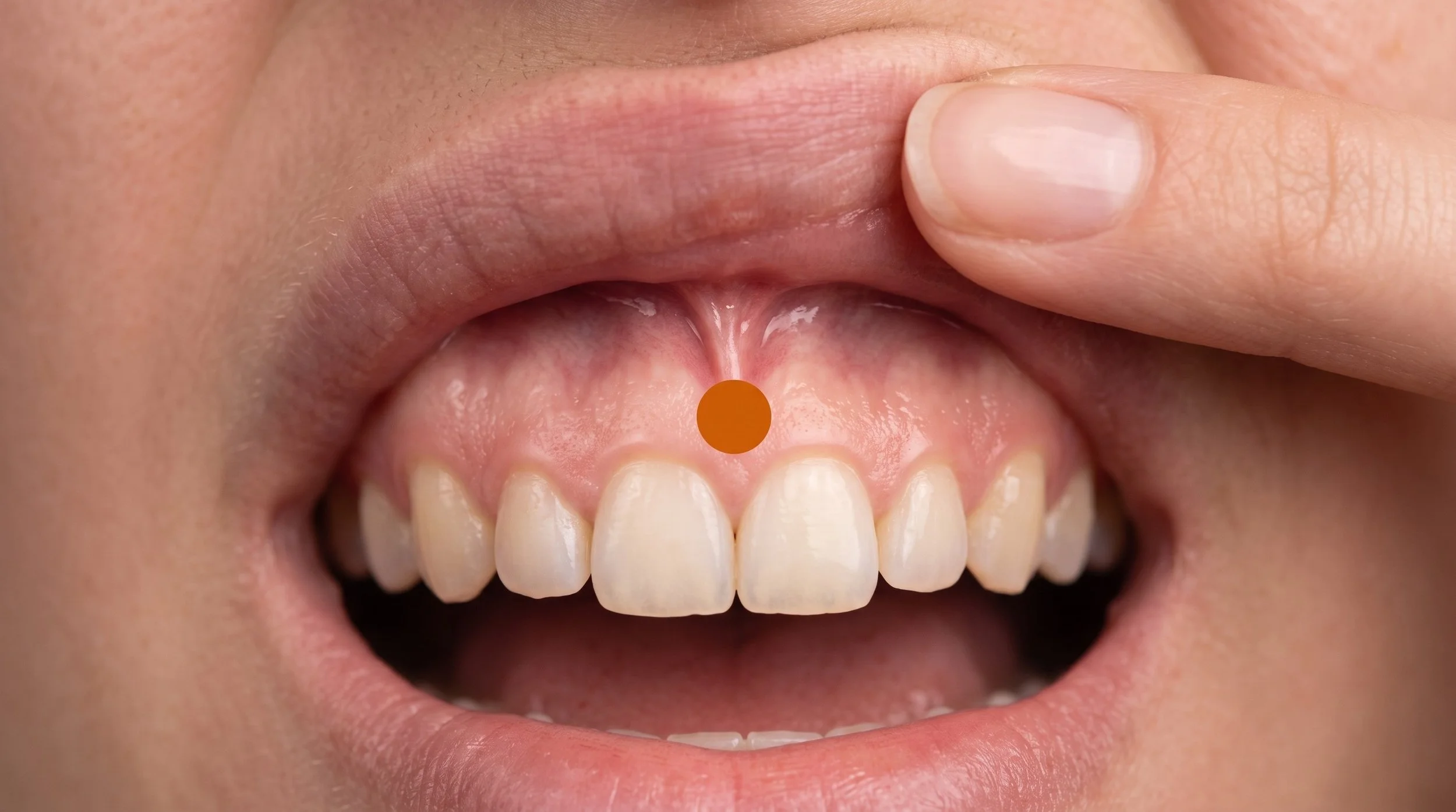
DU28 Acupuncture Point (Yinjiao)
The Gum Intersection Inside the Upper Lip: Anatomy, Mechanism, and Why This Tiny Governing Vessel Point Belongs to the Mouth, Nose, and Eyes
DU28 (Yinjiao, "Gum Intersection"), also written GV28, is the last point of the Governing vessel and one of the very few classical points located inside the mouth. You find it by lifting the upper lip and looking for the thin midline band of tissue, the superior labial frenulum, where the lip meets the gum above the front teeth (Deadman et al., 2009).
Classically it is described as a meeting point of the Governing vessel with the Conception vessel and the Stomach channel, which is a traditional way of saying that this small patch of mucosa sits at the anatomical crossroads of the face. In modern terms, the tissue here is densely supplied by the maxillary division of the trigeminal nerve, the same nerve territory that carries sensation from the gums, the front teeth, the nasal floor, and the inner corner of the eye.
That is why the classical indication list for the GV28 acupuncture point reads the way it does: sore and bleeding gums, a blocked nose, a red and watering inner eye, and, surprisingly, a stiff neck.
- Location and layers: DU28 lies in the superior labial frenulum, the midline fibrous band joining the upper lip to the gum above the central incisors, so the needle passes through thin oral mucosa and a fibrous band rather than skin and muscle (Deadman et al., 2009).
- Traditional categories translated: the classical designation of governing vessel 28 as a meeting point of the Governing and Conception vessels with the Stomach channel is best read as a map of shared innervation and shared clinical territory, since the gums, nasal floor, and lips all draw sensory supply from the maxillary trigeminal division.
- Mechanism: stimulation here recruits trigeminal afferents that terminate in the trigeminal spinal nucleus, a relay where facial and upper cervical inputs converge, which plausibly explains both the local gum effects and the classical neck indication; acupuncture stimulation more broadly engages segmental and descending inhibitory pathways (Zhao, 2008).
- Research picture: no trial has isolated the DU 28 gum point, but reviews of acupuncture in dentistry report modest, low certainty benefits for acute dental pain (Müller et al., 2023; Ernst & Pittler, 1998), and reviews of acupuncture for nasal symptoms report improvements with important methodological caveats (He et al., 2022).
- Clinical practice framing: in a modern clinic this point is used sparingly and selectively, usually as a brief local addition or a pricking technique in acute, hot, swollen gum presentations, with the bulk of the treatment built from more comfortable face, hand, and neck points such as LI20, ST6, and LI4 (Vickers et al., 2018).
- De qi at DU28 is unlike anywhere else on the body: patients typically report a sharp, brief, watery sting rather than the heavy ache of a limb point, often followed by a spreading warm sensation across the upper lip and gum line.
Sore Gums, Jaw Tension, or Facial Pain That Will Not Settle?
Oral and facial complaints rarely stay in one place, and patients often arrive describing gum tenderness, jaw tightness, and sinus pressure as one blurred problem. At Morningside Acupuncture we map that picture against trigeminal nerve territory and treat with a combination of gentle facial points, hand and forearm points, and dry needling of the jaw muscles when indicated. DU28 may be included briefly when the presentation is local, acute, and inflammatory, always with your comfort and consent leading the decision. Schedule a visit and we'll build a plan around what your tissue is actually doing.
Schedule NowAnatomy of DU28: Why the Superior Labial Frenulum Is Such an Important Location
Lift your upper lip in front of a mirror and you'll see a thin vertical web of tissue running from the inner lip down to the gum above the two front teeth. That web is the superior labial frenulum, and DU28 sits in it at the junction where lip meets gum (Deadman et al., 2009). The layers here are unusual for an acupuncture point: a surface of moist, non-keratinized oral mucosa, a thin submucosal layer, and a band of fibrous connective tissue that tethers the lip to the alveolar bone of the maxilla.
There is no muscle belly to needle and no fascial plane to glide through. What loads this tissue is everyday mechanical stress, lip movement during speech and chewing, orthodontic hardware, mouthguards and night guards, and inflammation of the adjacent gum margin, which is why the classical indication list opens with red, swollen, and bleeding gums rather than with anything resembling musculoskeletal pain.
The nerve geography is what makes this location clinically interesting. Sensation in the upper lip, the gum above the incisors, the front teeth themselves, and the floor of the nose is carried almost entirely by branches of the maxillary division of the trigeminal nerve, including the superior labial branches of the infraorbital nerve and the anterior superior alveolar nerve, with the nasopalatine nerve serving the adjacent palate. All of these funnel into the trigeminal ganglion and then into the trigeminal spinal nucleus in the brainstem.
That nucleus extends down into the upper cervical spinal cord, where afferents from the C1 to C3 segments converge on the same second order neurons, a region often described as the trigeminocervical complex. Convergence of this kind is the standard explanation for why face and upper neck problems refer into each other, and it gives a plausible modern reading of the classical pairing of DU28 with DU16 for a neck that will not turn. Needling anywhere in this territory also recruits the diffuse descending inhibitory systems that underpin acupuncture analgesia more generally (Zhao, 2008).
The oral mucosa at DU28 is richly vascular, supplied by superior labial branches of the facial artery, and it bleeds readily. Classical sources describe two techniques here: shallow oblique insertion directed upward to a depth of roughly 0.2 to 0.3 cun, or pricking the point to release a few drops of blood, the latter traditionally reserved for hot, congested gum presentations (Deadman et al., 2009). Both are brief.
There are no deep vessels, nerves, or cavities at risk at this depth, so the main practical cautions are patient comfort, gag sensitivity, adequate lip retraction, strict single-use sterile technique in a mucosal environment, and avoiding bleeding techniques in patients on anticoagulants, with clotting disorders, or with active oral infection. Many clinicians simply choose alternative points when a patient is anxious about intraoral needling, since the surrounding face and hand points cover much of the same clinical ground.
Related Governing Vessel Related Conception VesselDU28 (GV28) at a Glance: Classification, Location, and Clinical Use
| Category | Detail |
|---|---|
| Traditional Name | Yinjiao (Gum Intersection), Governing Vessel 28, DU28 |
| Channel Classification | Governing Vessel (Du Mai), twenty-eighth point of the channel, located inside the mouth (DU28, also written GV28) |
| Point Categories | Meeting point of the Governing vessel with the Conception vessel and the Stomach channel (Deadman et al., 2009). No five-shu, yuan-source, luo-connecting, xi-cleft, or hui-meeting designation. |
| Precise Location | Inside the mouth, in the superior labial frenulum, at the junction of the upper lip and the gum above the central incisors. |
| Tissue Stimulated | Oral mucosa of the inner upper lip, the fibrous midline band of the superior labial frenulum, and the loose submucosa overlying the gum margin and maxillary alveolar bone; sensory supply from maxillary trigeminal branches. |
| Needle Depth / Direction | Oblique insertion directed superiorly, 0.2 to 0.3 cun, or pricked to bleed (Deadman et al., 2009). Requires lip retraction and a very brief, controlled technique. |
| De Qi Sensation | A quick, sharp, watery sting local to the frenulum rather than a deep ache, often followed by warmth or a light tingling spreading across the upper lip and gum line, and frequently by eye watering. |
| Primary Clinical Uses | Traditionally used for red, swollen, eroded, or bleeding gums; nasal congestion, nasal sores and polyps in classical listings; redness, itching and tearing at the inner corner of the eye; frontal and glabellar pain; and stiffness of the neck with difficulty turning the head. |
| Common Point Combinations |
|
Deadman, Al-Khafaji and Baker's A Manual of Acupuncture attributes two broad actions to DU28: clearing heat and benefiting the gums, and benefiting the nose and eyes. Their indication list, presented here as traditional attribution rather than as verified physiology, clusters into four groups: inflamed, eroded, or bleeding gums; blocked nose, nasal sores and growths, and pain across the forehead and between the brows; watering, red, itchy eyes with reduced clarity of vision; and a scattered set including a flushed agitated face, jaundice, and a neck too stiff to turn.
The text also records two classical formulas, a Supplementing Life pairing of DU28 with DU16 for the immobile neck and a Systematic Classic pairing of DU28 with DU26 for madness. What is striking about the classical pattern is how tightly it maps onto a single nerve territory before anyone had described that territory: gums, nasal floor, inner eye, and forehead are all trigeminal, and the odd inclusion of neck stiffness is exactly what convergence in the trigeminocervical complex would predict.
Why DU28 Is Used for Nasal Congestion and a Stiff Neck, Not Just Sore Gums
The most common patient question about this point is why anything inside the lip should matter to the nose or the neck. The answer is convergence. Sensory fibers from the upper gum, the front teeth, the inner lip, the nasal floor, and the skin between the brows all belong to the maxillary and ophthalmic divisions of the trigeminal nerve, and they all synapse in the trigeminal spinal nucleus in the brainstem. That nucleus is continuous with the dorsal horn of the upper cervical cord, so afferents from the suboccipital region and the upper neck land on many of the same second order cells.
When several inputs share a relay, stimulation of one can modulate the sensitivity of the others. This is the same segmental logic that explains why upper cervical problems produce facial and frontal symptoms, and it is a reasonable modern reading of a classical formula that pairs a point inside the lip with DU16 at the base of the skull for a neck that will not turn (Deadman et al., 2009).
Beyond the segmental story, needling recruits ascending signals that activate descending inhibitory pathways from the periaqueductal gray and rostral ventromedial medulla, along with the release of endogenous opioid and monoamine transmitters, mechanisms reviewed extensively in the experimental literature (Zhao, 2008).
Trigeminal territory stimulation may also produce autonomic and vascular effects locally, which is the most plausible explanation for the traditional claim that this point benefits the nose: nasal patency depends heavily on the balance of sympathetic and parasympathetic tone in the mucosal vasculature, and reviews of acupuncture for nasal symptoms report modest improvements in symptom scores and quality of life, though with low certainty and considerable heterogeneity (He et al., 2022).
None of this means DU28 is a specific treatment for congestion. It means the point sits in a neurologically plausible place for a local, short-acting effect that is best judged one patient at a time.
What the Research Shows for DU28 (GV28)
One note on naming before the evidence: in the research literature this point is almost always listed as GV28, the WHO standard code, so GV28 is the term to search if you want to read the studies below in full.
There is no clinical trial of DU28 on its own, and there is unlikely to ever be one. Intraoral points of this kind appear inside multi-point protocols or not at all, so the honest framing is that the evidence relevant to this point is evidence about acupuncture for dental pain, oral symptoms, jaw disorders, and nasal complaints, within which DU28 might contribute one small local input. The reviews below are mostly graded low to moderate certainty, several are dominated by small trials at high risk of bias, and effect sizes are generally modest.
Read them as a reason to consider acupuncture as an adjunct in oral and facial complaints, not as evidence that a needle in the frenulum does something specific.
| Study | Type | Focus | Key Finding |
|---|---|---|---|
| Müller et al., 2023 | Systematic review and meta-analysis | Acupuncture for acute dental pain, intraoperative and postoperative | Pooled results suggested lower postoperative pain scores with acupuncture compared with sham, but the authors emphasized methodological limitations across the included trials. |
| Ernst & Pittler, 1998 | Systematic review | Acupuncture for acute dental pain across controlled trials | Most included trials favored acupuncture for dental analgesia, though the review concluded that optimal technique and comparative efficacy remained undefined. |
| He et al., 2022 | Systematic review and meta-analysis | Acupuncture for allergic rhinitis, nasal symptoms and quality of life | Acupuncture was associated with improved nasal symptom and quality of life scores versus sham and no treatment, with caution warranted given trial quality. |
| Park et al., 2023 | Systematic review and meta-analysis | Acupuncture for temporomandibular disorders in adults | Acupuncture showed benefit for pain outcomes in several comparisons, with the authors noting variable study quality and the need for better trials. |
| Furness et al., 2013 | Cochrane systematic review | Non-pharmacological interventions for dry mouth, including acupuncture | Low quality evidence suggested a small increase in saliva production after radiotherapy-related dry mouth, with reported adverse effects mild and short-lived. |
| Vickers et al., 2018 | Individual patient data meta-analysis | Acupuncture for chronic pain conditions including headache and musculoskeletal pain | Acupuncture outperformed both sham and no-acupuncture controls with effects that persisted over time, supporting its use as a reasonable referral option. |
| Zhao, 2008 | Narrative review of experimental studies | Neural mechanisms of acupuncture analgesia | Analgesic effects are attributed to afferent recruitment, spinal segmental modulation, and descending inhibitory control involving endogenous opioids and monoamines. |
Stuffy Nose and Facial Pressure That Follow You Into Every Season?
Chronic nasal congestion drags on sleep, focus, and workouts, and medication alone often leaves a residue of pressure across the cheeks and brow. Our clinicians combine nose and face points such as LI20 and Yintang with distal regulation, and we track your symptoms week to week rather than guessing. The Yinjiao gum point can be added to that framework when the classical picture fits. Book an appointment and let's see how your nose responds over a short trial of care.
Schedule NowDU28 in the Context of Trigger Point Work
DU28 is not a myofascial point. There is no muscle at the frenulum, so nothing about this location fits the trigger point model directly. What matters clinically is that the symptoms patients bring to this region, upper tooth aching, gum sensitivity, pressure across the cheek and brow, are commonly referred rather than local. Trigger points in the masseter can refer into the upper molars and the maxilla, temporalis trigger points classically refer into the upper teeth and the temple, and sternocleidomastoid can project sensation into the face and behind the eye (Simons et al., 1999).
Before adding any intraoral needling, we examine those muscles, because reproducing a patient's familiar pain by palpating a taut band in the masseter changes the whole treatment plan.
In practice at Morningside, a patient presenting with facial and oral discomfort is far more likely to receive dry needling of masseter, temporalis, medial pterygoid, and the upper cervical extensors than a needle at the Yinjiao gum point. DU28 enters the picture in narrower situations: an acute, locally inflamed gum presentation where a brief pricking technique fits the classical pattern, or a treatment where the practitioner wants one short local input alongside LI20, ST6, and LI4.
Dry needling and classical acupuncture are the same tool used with different reasoning, and combining a segmental muscle approach with channel-based point selection usually gives a more complete plan than either alone (Vickers et al., 2018).
DU28 Facial and Oral Discomfort Treatment at NYC's Highest-Rated Acupuncture Clinic
Morningside Acupuncture is the highest-rated acupuncture and dry needling clinic in New York City with over 500 five-star Google reviews, and our approach to head and face complaints is anatomical, cautious, and clearly explained. We use single-use sterile needles, conservative technique, and a treatment plan that names what we expect to change and by when. Whether your concern is gum sensitivity, jaw tension, nasal congestion, or neck stiffness that wraps into the face, you'll get a plan grounded in both classical point knowledge and current pain science. Schedule your first session and we'll start with a full assessment.
Schedule NowFrequently Asked Questions
Is DU28 the same point as GV28?
Yes. DU28 and GV28 are two codes for the same point, Yinjiao. DU comes from Du Mai, the Chinese name of the Governing Vessel, and it is the code used in most Chinese texts and many acupuncture schools. GV is the WHO standard abbreviation and the one you will see in most Western textbooks and research papers. You will also come across it written as Du 28, GV-28, or Governing Vessel 28. Whichever code is used, the location and the uses are the same.
What does DU28 feel like when needled?
It feels different from body points. Because the tissue is thin oral mucosa rather than skin over muscle, most people report a quick, bright sting at the moment of insertion rather than the heavy, dull ache described as de qi elsewhere. The sting settles within a second or two and is often followed by warmth or a light tingling across the upper lip and gum line, and eye watering is common. The needle stays in only briefly. If the point is pricked to bleed instead, you may notice a small amount of blood and a metallic taste that clears quickly with a rinse.
Why would a practitioner needle inside my lip when my problem is nasal congestion or a stiff neck?
Because the tissue at DU28 shares its nerve supply and its brainstem relay with the nose, the front teeth, the inner eye, and, through the trigeminocervical complex, the upper neck. Inputs from all of these regions converge on the same second order neurons in the trigeminal spinal nucleus, which is the standard neurophysiological explanation for why facial and upper cervical symptoms refer into each other (Zhao, 2008). Classical texts reached the same clinical conclusion by observation, pairing DU28 with DU16 for a neck that will not turn (Deadman et al., 2009). That said, most practitioners will treat congestion or neck stiffness with more accessible points first and reserve DU28 for cases where the local oral picture is prominent.
Can I press DU28 myself between sessions?
Yes, gently. Wash your hands, lift your upper lip with one hand, and use a clean fingertip or the pad of your thumb to apply light pressure to the midline band where the lip meets the gum above your front teeth. Use steady, mild pressure for 20 to 30 seconds, release, and repeat two or three times, once or twice a day. Do not scrub, dig, or use a fingernail, because this tissue is thin and bleeds easily. Many people find that a simple warm salt water rinse plus gentle pressure at LI4 on the hand for one to two minutes per side is more comfortable and just as useful. Stop entirely if the gum is acutely infected, ulcerated, or bleeding, and see a dentist instead.
Is DU28 safe to needle?
In trained hands, yes, with sensible limits. The needle goes obliquely upward only about 0.2 to 0.3 cun and there are no major vessels, nerves, or cavities at risk at that depth (Deadman et al., 2009). The realistic considerations are comfort, gag sensitivity, and bleeding: oral mucosa is vascular, so minor bleeding is expected, and pricking techniques should be avoided in anyone on anticoagulants, with a bleeding disorder, or with active oral infection. Strict single-use sterile needling and good lip retraction are essential. Because this is one of the least comfortable points on the body, a good practitioner will always explain it first, ask consent, and offer alternatives, and plenty of excellent treatment plans never use it at all.
Where exactly is DU28 located?
Inside your mouth, not on the face. Lift your upper lip and look at the midline: a thin vertical band of tissue, the superior labial frenulum, runs from the inner lip down toward the gum above the two central incisors. DU28 is in that band at the point where the lip joins the gum (Deadman et al., 2009). It is the twenty-eighth and final point of the Governing vessel, which reaches it from DU27 at the junction of the upper lip and the philtrum. Note that its pinyin name, Yinjiao, is shared with CV7 on the abdomen, but the characters and the point are entirely different.
References
- Deadman, P., Al-Khafaji, M., & Baker, K. (2009). A manual of acupuncture. Journal of Chinese Medicine Publications.
- Simons, D. G., Travell, J. G., & Simons, L. S. (1999). Travell & Simons' myofascial pain and dysfunction: The trigger point manual, Vol. 1: Upper half of body (2nd ed.). Williams & Wilkins.
- Müller, M., Schmucker, C., Naumann, J., Schlueter, N., Huber, R., & Lederer, A. K. (2023). Acupuncture in management of acute dental pain: A systematic review and meta-analysis. Japanese Dental Science Review, 59, 114-128. https://doi.org/10.1016/j.jdsr.2023.02.005
- Ernst, E., & Pittler, M. H. (1998). The effectiveness of acupuncture in treating acute dental pain: A systematic review. British Dental Journal, 184(9), 443-447. https://doi.org/10.1038/sj.bdj.4809654
- He, M., Qin, W., Qin, Z., & Zhao, C. (2022). Acupuncture for allergic rhinitis: A systematic review and meta-analysis. European Journal of Medical Research, 27(1), 58. https://doi.org/10.1186/s40001-022-00682-3
- Park, E. Y., Cho, J. H., Lee, S. H., Kim, K. W., Ha, I. H., & Lee, Y. J. (2023). Is acupuncture an effective treatment for temporomandibular disorder? A systematic review and meta-analysis of randomized controlled trials. Medicine, 102(38), e34950. https://doi.org/10.1097/MD.0000000000034950
- Furness, S., Bryan, G., McMillan, R., Birchenough, S., & Worthington, H. V. (2013). Interventions for the management of dry mouth: Non-pharmacological interventions. Cochrane Database of Systematic Reviews, 2013(9), CD009603. https://doi.org/10.1002/14651858.CD009603.pub3
- Zhao, Z. Q. (2008). Neural mechanism underlying acupuncture analgesia. Progress in Neurobiology, 85(4), 355-375. https://doi.org/10.1016/j.pneurobio.2008.05.004
- Vickers, A. J., Vertosick, E. A., Lewith, G., MacPherson, H., Foster, N. E., Sherman, K. J., Irnich, D., Witt, C. M., & Linde, K. (2018). Acupuncture for chronic pain: Update of an individual patient data meta-analysis. Journal of Pain, 19(5), 455-474. https://doi.org/10.1016/j.jpain.2017.11.005
Disclaimer: This web site is intended for educational and informational purposes only. Reading this website does not constitute providing medical advice or any professional services. This information should not be used for diagnosing or treating any health issue or disease. Those seeking medical advice should consult with a licensed physician. Seek the advice of a medical doctor or other qualified health professional for any medical condition. If you think you have a medical emergency, call 911 or go to the emergency room. No acupuncturist-patient relationship is created by reading this website or using the information. Morningside Acupuncture PLLC and its employees and contributors do not make any express or implied representations with respect to the information on this site or its use. For any legal interpretation of scope of practice in your state, consult a licensed attorney or regulatory authority.
Read more from our blog



