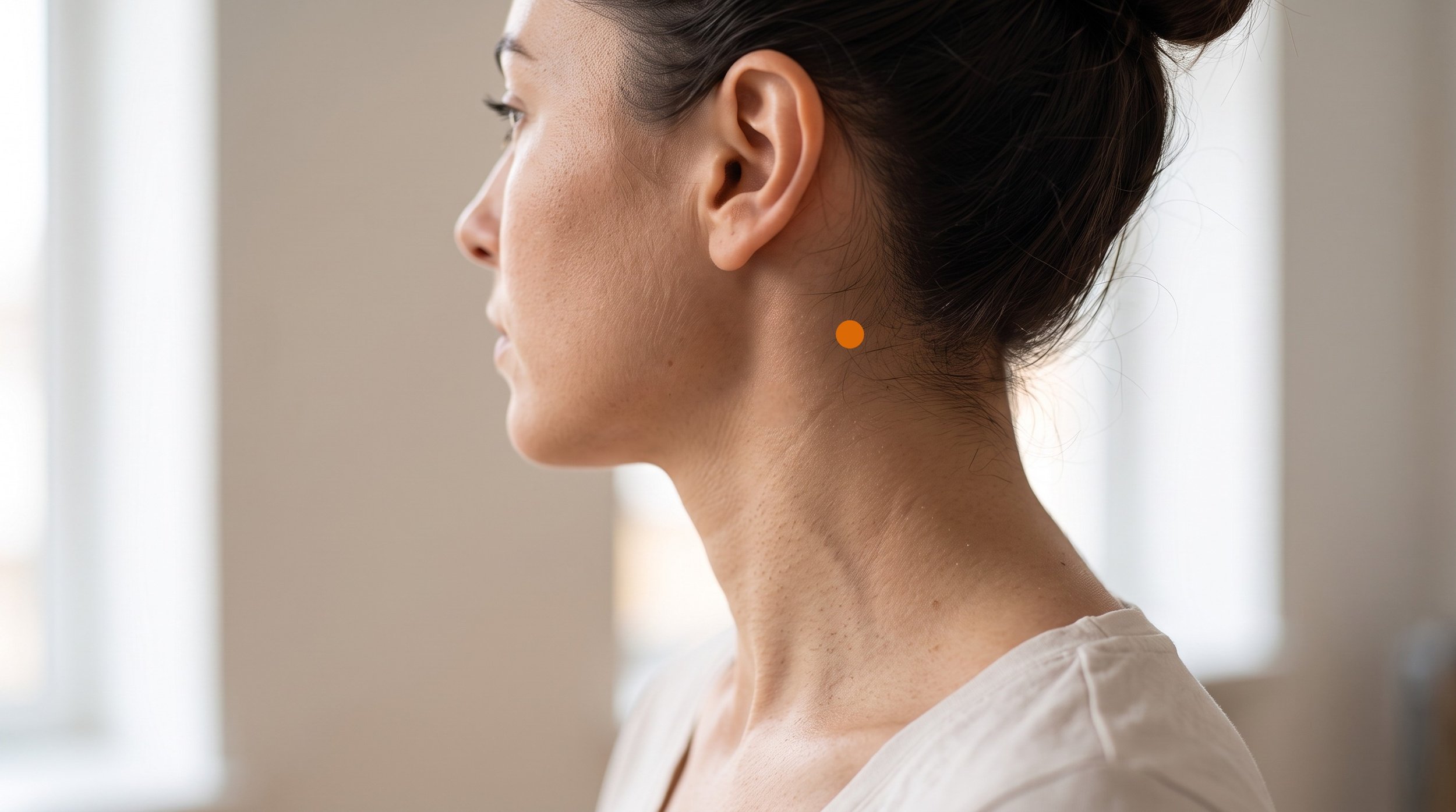
SJ16 Acupuncture Point (Tianyou)
The Window of Heaven on the Side of the Neck: Anatomy, Mechanism, and Why Tianyou Links Head Symptoms to Cervical Tension
SJ16 (Tianyou, often translated as Window of Heaven), also written TE16, sits high on the side of the neck, just behind the back edge of the sternocleidomastoid muscle and roughly a thumb's width below the bony bump behind the ear. It belongs to the Triple Burner channel, and it's the point that gave the classical Window of Heaven group its name, a small cluster of neck points that traditional texts reserved for symptoms in which the head seems overloaded: sudden hearing changes, dizziness, headache, a stiff neck that won't turn, and blocked sinuses.
Anatomically, the te16 acupuncture point sits in a crowded and clinically interesting neighborhood where the upper cervical nerves surface, where several neck muscles converge on the mastoid, and where cervical input feeds into the same brainstem pathways that process pain from the head and face. That overlap, rather than anything mystical, is the most useful modern way to understand why a point on the neck gets used for complaints patients feel in the ear, eye, and skull.
- SJ16 lies on the posterior border of the sternocleidomastoid about 1 cun below GB12, on a line between BL10 and SI17, and the needle passes through skin, superficial fascia and platysma toward the SCM border, with splenius capitis and levator scapulae attachments deeper in the region.
- Classical sources group Tianyou with the Window of Heaven points and traditionally credit it with benefiting the head and sense organs and directing rebellious qi downward, which reads in modern terms as modulating upper cervical and autonomic input that reaches the head.
- The point overlies territory served by the lesser occipital nerve and the upper cervical plexus (C2 to C3), and convergence of cervical and trigeminal afferents in the brainstem offers a plausible route for neck stimulation to change how head, ear and eye symptoms are perceived (Zhao, 2008).
- Needling here also recruits diffuse descending inhibitory systems and segmental spinal mechanisms shared by acupuncture generally, which is why the same point can influence both local neck stiffness and referred head symptoms (Zhao, 2008; Vickers et al., 2018).
- The research picture is indirect: reviews of acupuncture for neck disorders and for tension-type headache test multi-point protocols rather than SJ16 alone, with modest and cautiously worded benefits (Trinh et al., 2016; Linde et al., 2016).
- De qi at sj 16 neck is typically a heavy, spreading fullness that drifts toward the ear, mastoid or back of the head, not a sharp or electric feeling, and depth stays conservative because of the vessels and nerves nearby.
Neck Stiffness That Comes With Headaches or Ear Pressure?
When patients can't turn their head comfortably and also report head pressure, ear fullness or lightheadedness, we look carefully at the upper cervical region where SJ16 sits. Our acupuncturists combine gentle needling of this area with dry needling of the sternocleidomastoid, splenius and suboccipital muscles when the exam supports it. Treatment is paired with practical loading and posture work so the change holds between visits. Schedule an evaluation and we'll map out where your symptoms are actually coming from.
Schedule NowAnatomy of SJ16: Why the Posterior Border of the Sternocleidomastoid Is Such an Important Location
The te16 acupuncture point sits at a junction rather than in the belly of a single muscle. Under the skin and thin platysma, the needle meets the posterior edge of the sternocleidomastoid near its upper attachment on the mastoid process. Just behind and beneath that edge lie the upper fibers of splenius capitis and, a little lower and deeper, levator scapulae, all of which anchor toward the same region of the skull and upper cervical spine.
This area gets loaded by anything that holds the head forward or rotated: long screen hours, phone cradling, carrying a bag on one shoulder, and sleeping with the neck side-bent. Because the muscles here work constantly to stabilize the head against gravity, they tend to accumulate tender, taut bands that reproduce familiar patterns of head and ear discomfort (Simons et al., 1999).
Nerve geography is what makes this location clinically distinct. The lesser occipital nerve, a branch of the cervical plexus arising from the second and third cervical nerves, wraps around the posterior border of the sternocleidomastoid close to the point, and the great auricular nerve travels nearby on its way to the skin over the ear and angle of the jaw. Those same upper cervical segments send afferents into the trigeminocervical complex in the brainstem, where they share second-order neurons with input from the face, ear and dura.
Convergence of that kind is a well-recognized explanation for why irritation in the upper neck can be felt as head, eye or ear symptoms, and why needling the neck can change those sensations. Acupuncture stimulation at points like this appears to engage segmental spinal modulation as well as descending inhibitory pathways using endogenous opioid and monoamine signaling (Zhao, 2008).
Vascular structures set the safety rules. The occipital artery and the external jugular vein run close to this region, and deeper still, anterior and medial to the point, sit the carotid sheath and the transverse process of the first cervical vertebra. Standard references describe perpendicular insertion of roughly 0.5 to 1 cun, with some texts recommending a shallower 0.3 to 0.5 cun, and the practical rule is to stay perpendicular or slightly posterior rather than angling forward and medially.
Careful palpation, conservative depth and avoiding any visible or pulsing vessel keep the technique straightforward. As with any point on the neck, this is work for a trained, licensed practitioner.
Related Acupuncture For Neck Pain Related Best Acupuncture Points For HeadachesSJ16 (TE16) at a Glance: Classification, Location, and Clinical Use
| Category | Detail |
|---|---|
| Traditional Name | Tianyou (Window of Heaven), SJ16, also written TE16 or TB-16 |
| Channel Classification | Sixteenth point of the Triple Burner (Sanjiao) channel of the hand shaoyang (SJ16, also written TE16 or TB16; also called the Triple Energizer, the Triple Heater or Triple Warmer) |
| Point Categories | Window of Heaven point named in Chapter 21 of the Spiritual Pivot, and in fact the point whose name gave the group its label; also described in some traditions as the upper confluent point of the Triple Burner and Pericardium divergent channel pairing. It has no five-shu, hui-meeting or extraordinary vessel designation. |
| Precise Location | On the posterior border of the sternocleidomastoid muscle, about 1 cun inferior to GB12 (behind and below the mastoid process), on the line drawn between BL10 and SI17 |
| Tissue Stimulated | Skin, platysma and superficial cervical fascia, the posterior border of the sternocleidomastoid, with splenius capitis and levator scapulae attachments in the surrounding region; sensory territory of the lesser occipital and great auricular nerves |
| Needle Depth / Direction | Perpendicular insertion 0.5 to 1 cun (some texts advise 0.3 to 0.5 cun); keep the angle perpendicular or slightly posterior and avoid directing the needle forward toward the great vessels |
| De Qi Sensation | Heavy, dull distension at the point that often spreads toward the ear, mastoid or occiput; some patients describe a warm band up the side of the head. Sharp or electric sensations mean the needle should be withdrawn and repositioned. |
| Primary Clinical Uses | Stiff neck with restricted rotation, cervicogenic and tension-type headache, dizziness of cervical origin, ear fullness and tinnitus, and traditionally sudden hearing loss, nasal congestion and loss of smell |
| Common Point Combinations |
|
In the Deadman point manual, Tianyou is presented as one of the five Window of Heaven points listed in Chapter 21 of the Spiritual Pivot, and the entry notes that this point's name is what the group as a whole came to be called. The traditional attributions given there are benefiting the head and sense organs and regulating and descending qi, with the classical rationale being that chaotic or rebellious qi surging upward crowds the head and clouds the senses.
The indication lists that follow are unusually wide for a neck point and fall into a few clear clusters: hearing and vision problems including sudden deafness and dim or painful eyes, nose complaints such as congestion, nosebleed and loss of smell, head symptoms including dizziness and headache, swelling in the face, jaw and neck, and stiffness of the neck with restricted turning. Commentators quoted in that text describe the head's orifices as openings in a high structure that only work when what's below moves freely.
What makes the classical pattern striking is how closely that grouping of symptoms matches what clinicians today see coming out of the upper cervical spine: neck stiffness bundled with headache, ear fullness and unsteadiness, all in one presentation.
Why SJ16 Is Used for Hearing Changes, Dizziness, and Head Fog That Track With Neck Tension
Patients are often surprised that a point on the side of the neck gets used for symptoms they feel in the ear or behind the eye. The reason is segmental. The skin and deep tissues at SJ16 are supplied by the second and third cervical nerves through the cervical plexus, and those same nerves converge in the brainstem with fibers carrying sensation from the face, ear canal and the lining of the skull. When one pool of neurons receives input from several regions, the brain can misattribute where a signal came from, which is why tight upper cervical tissue frequently shows up as head, ear and eye complaints. Needling into the correct segment gives the nervous system a strong, novel input at exactly the level where that confusion happens (Zhao, 2008).
Beyond the local segment, acupuncture appears to recruit descending inhibitory control from the midbrain and brainstem, dampening how readily the spinal cord and trigeminocervical relay pass pain signals upward, with endogenous opioid and monoamine mechanisms described in the experimental literature (Zhao, 2008). Local effects matter too: needling into taut muscle near the mastoid attachments may reduce mechanical pull on those tissues and improve rotation, which changes the sensory picture the brain receives from the neck.
For dizziness and hearing symptoms specifically, the evidence is preliminary and should be read cautiously. Reviews of acupuncture for cervical vertigo report improvements in symptom scales alongside very low quality evidence and a call for better trials (Hou et al., 2017), and reviews of acupuncture for sudden sensorineural hearing loss generally find added benefit when acupuncture is used with standard medical care rather than instead of it (Zhang et al., 2015; Ren et al., 2024).
Sudden hearing loss is a medical urgency, and anyone experiencing it should be evaluated by an ENT physician promptly. Acupuncture, if used, belongs alongside that care.
What the Research Shows for SJ16 (TE16)
One note on naming before the evidence: in the research literature this point appears as TE16, the WHO standard code, and also as SJ16 or TB16 depending on the authors, so it is worth searching all three if you want to read the studies below in full.
No trial has isolated SJ16, and that's worth saying plainly. Clinical research on acupuncture tests whole protocols, usually a set of local neck and head points combined with distal points, delivered over multiple sessions. The reviews below tell us something about whether the treatment approach that includes points like Tianyou tends to help, not about this point's individual contribution. Evidence quality varies considerably by condition, with neck pain and tension-type headache better studied than hearing or dizziness complaints, and much of the hearing and vertigo literature carries a high risk of bias.
| Study | Type | Focus | Key Finding |
|---|---|---|---|
| Trinh et al., 2016 | Cochrane systematic review | Acupuncture for acute, subacute and chronic neck disorders | Moderate quality evidence suggested acupuncture may relieve chronic neck pain more than sham or inactive controls immediately after treatment, with effects that were modest in size. |
| Linde et al., 2016 | Cochrane systematic review | Acupuncture for prevention of tension-type headache | A course of at least six sessions appeared to be a reasonable option for people with frequent tension-type headache, though differences from sham needling were small. |
| Vickers et al., 2018 | Individual patient data meta-analysis | Chronic pain including neck and shoulder pain and headache | Acupuncture was associated with better outcomes than sham and no-acupuncture controls, with benefits that persisted over about a year of follow-up. |
| Hou et al., 2017 | Systematic review and meta-analysis | Acupuncture for cervical vertigo | Pooled results favored acupuncture over conventional medication, but the authors graded the evidence as low to very low quality. |
| Zhang et al., 2015 | Systematic review and meta-analysis | Acupuncture for sudden sensorineural hearing loss | Adding acupuncture to standard medical treatment appeared more effective than that treatment alone, though evidence levels were low and acupuncture alone was not supported. |
| Ren et al., 2024 | Systematic review and meta-analysis | Acupuncture for sudden sensorineural hearing loss, updated search | Combined acupuncture and conventional care was associated with improved response and hearing threshold outcomes, with the usual caveats about trial quality. |
| Zhao, 2008 | Narrative review of experimental studies | Neural mechanisms of acupuncture analgesia | Needle stimulation engages segmental spinal modulation and descending inhibitory systems involving endogenous opioids and monoamines. |
Looking for Targeted Care for Cervicogenic Headaches in NYC?
Headaches that start in the neck and climb over the ear or behind the eye often respond to work at the upper cervical junction, and triple burner 16 is one of the points we consider in that region. We build point selections around your exam findings rather than a fixed template, adding distal points and manual therapy as needed. Most patients notice a shift in neck mobility within the first few visits. Book a session and let's see how your head and neck respond.
Schedule NowSJ16 in the Context of Trigger Point Work
Acupuncture, in our definition, means treatment with an acupuncture needle, and that covers hundreds of styles including dry needling. At Morningside, SJ16 rarely gets used in isolation. When a patient presents with a stiff, painful neck plus head or ear symptoms, the exam usually turns up tender bands in the sternocleidomastoid, splenius capitis, levator scapulae, upper trapezius and the suboccipital group.
The classic descriptions of sternocleidomastoid trigger points include referral into the forehead, ear, cheek and the region behind the eye, along with complaints of unsteadiness and visual disturbance, which lines up remarkably well with the traditional indication list for Tianyou (Simons et al., 1999).
Practically, this means the point location and the myofascial target often overlap. A needle placed at the posterior SCM border near the mastoid can address a taut band in the upper SCM or the leading edge of splenius capitis while also sitting in the classical location for the tianyou window of heaven point. Technique differs by intent: point-based needling favors a single insertion with gentle stimulation and retention, while trigger point technique may involve a small number of controlled passes into the taut band.
Given the vessels and nerves in this region, both are done with conservative depth, careful palpation, and only after screening for anything that would make neck needling inappropriate.
SJ16 Neck and Headache Treatment at NYC's Highest-Rated Acupuncture Clinic
Morningside Acupuncture is the highest-rated acupuncture and dry needling clinic in New York City with over 500 five-star Google reviews, and our Upper West Side practice focuses on musculoskeletal and head and neck complaints. We use SJ16 as part of broader upper cervical treatment for stiff necks, cervicogenic headaches and neck-related dizziness, always with careful depth and angle. Every visit includes hands-on assessment, needling, and a plan you can follow at home. Schedule your appointment today.
Schedule NowFrequently Asked Questions
Is SJ16 the same point as TE16 or TB16?
Yes. SJ16, TE16, and TB16 are all codes for the same point, Tianyou. SJ stands for San Jiao, the Chinese name of the channel. TE (Triple Energizer) is the WHO standard abbreviation and the one you will see in most Western textbooks and research papers. TB (Triple Burner) and TW (Triple Warmer) are older English renderings of the same name that still appear in many books. You will also come across it written as San Jiao 16 or Triple Energizer 16. Whichever code is used, the location and the uses are the same.
What does SJ16 feel like when needled?
Most people describe a deep, heavy fullness right under the fingertip that spreads toward the ear, the mastoid or the back of the head. Some feel a warm band travel up the side of the skull, and a few notice a brief ache that eases within a minute. Because muscles here are often protective, the first insertion can feel more sensitive than at other points, which is why we use fine needles and gentle stimulation. Sharp, burning or electric sensations aren't the goal and mean the needle should be adjusted immediately.
Why treat a point on the neck for ear or eye symptoms?
Because the wiring converges. Sensory nerves from the upper neck and from the face, ear and skull lining share relay neurons in the brainstem, so irritation from cervical tissue can be perceived as head, ear or eye symptoms. Needling at SJ16 puts a clear input into that same segment, and acupuncture stimulation also appears to activate descending inhibitory pathways that reduce how readily those signals pass upward (Zhao, 2008). Classical texts arrived at a similar grouping of symptoms by different reasoning, describing this point as one that clears the head and senses.
Can I press SJ16 myself between sessions?
Yes, with a light touch. Find the bony bump behind your ear, slide about one thumb's width straight down, and let your fingertip settle just behind the back edge of the strap muscle that stands out when you turn your head the other way. Use steady, moderate pressure or small slow circles for 30 to 60 seconds per side, repeat two or three rounds, and breathe slowly throughout. Never press hard on the front of the neck, avoid anything that pulses under your fingers, and stop right away if you feel lightheaded, nauseated or notice visual changes. Once or twice a day is plenty, and it works best paired with gentle rotation and chin tuck movement rather than pressure alone.
Is SJ16 safe to needle?
In trained hands, yes. The safety considerations are the ones common to all neck points: the occipital artery and external jugular vein run nearby, and the carotid sheath sits deeper and more anterior, so the needle stays perpendicular or angled slightly backward and never forward and medially. Standard depth guidance is roughly 0.5 to 1 cun, and some texts recommend shallower. Practitioners also screen for anticoagulant use, vascular history, local infection and skin problems before needling the neck. This isn't a point for self-needling.
Where exactly is SJ16 located?
On the side of the neck, on the posterior border of the sternocleidomastoid, about 1 cun (roughly a thumb's width) below GB12, which sits in the hollow behind the mastoid process. Another way to find it: draw an imaginary line between BL10 at the back of the neck and SI17 below the angle of the jaw, and SJ16 falls along that line at the back edge of the sternocleidomastoid. Turning your head to the opposite side makes the muscle border easier to feel, and the point is usually tender in people with upper cervical tension.
References
- Deadman, P., Al-Khafaji, M., & Baker, K. (2009). A manual of acupuncture. Journal of Chinese Medicine Publications.
- Maciocia, G. (2006). The channels of acupuncture: Clinical use of the secondary channels and eight extraordinary vessels. Churchill Livingstone Elsevier.
- Cunningham, P. M. (2000). Acupuncture points: A practical guide to classical and modern usage. Odyssey Press.
- O'Connor, J., & Bensky, D. (Eds. & Trans.). (1981). Acupuncture: A comprehensive text. Shanghai College of Traditional Medicine. Eastland Press.
- Cecil-Sterman, A. (2012). Advanced acupuncture: A clinic manual. Classical Wellness Press.
- Simons, D. G., Travell, J. G., & Simons, L. S. (1999). Travell & Simons' myofascial pain and dysfunction: The trigger point manual, Vol. 1: Upper half of body (2nd ed.). Williams & Wilkins.
- Trinh, K., Graham, N., Irnich, D., Cameron, I. D., & Forget, M. (2016). Acupuncture for neck disorders. Cochrane Database of Systematic Reviews, 2016(5), CD004870. https://doi.org/10.1002/14651858.CD004870.pub4
- Linde, K., Allais, G., Brinkhaus, B., Fei, Y., Mehring, M., Shin, B.-C., Vickers, A., & White, A. R. (2016). Acupuncture for the prevention of tension-type headache. Cochrane Database of Systematic Reviews, 2016(4), CD007587. https://doi.org/10.1002/14651858.CD007587.pub2
- Vickers, A. J., Vertosick, E. A., Lewith, G., MacPherson, H., Foster, N. E., Sherman, K. J., Irnich, D., Witt, C. M., & Linde, K. (2018). Acupuncture for chronic pain: Update of an individual patient data meta-analysis. Journal of Pain, 19(5), 455-474. https://doi.org/10.1016/j.jpain.2017.11.005
- Zhao, Z. Q. (2008). Neural mechanism underlying acupuncture analgesia. Progress in Neurobiology, 85(4), 355-375. https://doi.org/10.1016/j.pneurobio.2008.05.004
- Hou, Z., Xu, S., Li, Q., Cai, L., Wu, W., Yu, H., & Chen, H. (2017). The efficacy of acupuncture for the treatment of cervical vertigo: A systematic review and meta-analysis. Evidence-Based Complementary and Alternative Medicine, 2017, 7597363. https://doi.org/10.1155/2017/7597363
- Zhang, X.-C., Xu, X.-P., Xu, W.-T., Hou, W.-Z., Cheng, Y.-Y., Li, C.-X., & Ni, G.-X. (2015). Acupuncture therapy for sudden sensorineural hearing loss: A systematic review and meta-analysis of randomized controlled trials. PLOS ONE, 10(4), e0125240. https://doi.org/10.1371/journal.pone.0125240
- Ren, W., Tao, B., & Deng, H. (2024). The efficacy and safety of acupuncture in the treatment of sudden sensorineural hearing loss: A systematic review and meta-analysis. Integrative Medicine Research, 13(4), 101087. https://doi.org/10.1016/j.imr.2024.101087
Disclaimer: This web site is intended for educational and informational purposes only. Reading this website does not constitute providing medical advice or any professional services. This information should not be used for diagnosing or treating any health issue or disease. Those seeking medical advice should consult with a licensed physician. Seek the advice of a medical doctor or other qualified health professional for any medical condition. If you think you have a medical emergency, call 911 or go to the emergency room. No acupuncturist-patient relationship is created by reading this website or using the information. Morningside Acupuncture PLLC and its employees and contributors do not make any express or implied representations with respect to the information on this site or its use. For any legal interpretation of scope of practice in your state, consult a licensed attorney or regulatory authority.
Read more from our blog



