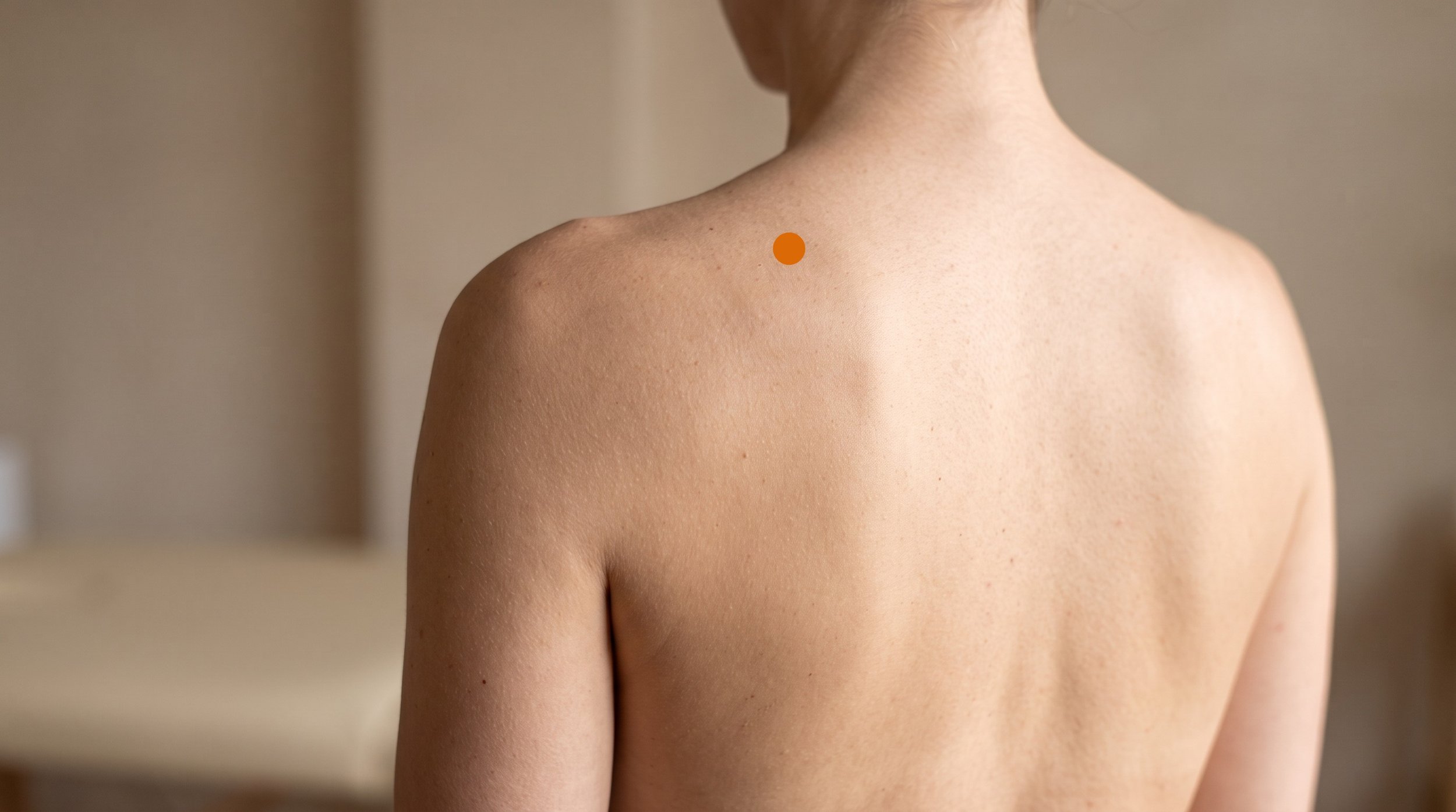
SJ15 Acupuncture Point (Tianliao)
The Heavenly Crevice on Top of the Shoulder: Anatomy, Mechanism, and Why This Suprascapular Point Anchors Neck and Shoulder Tension Treatment
SJ15 (Tianliao, often translated as Heavenly Crevice), also written TE15, sits in the shallow hollow of the suprascapular fossa, just behind and slightly below the crest of the upper trapezius, roughly midway between GB21 at the top of the shoulder and SI13 at the medial end of the fossa. It's the point practitioners reach for when a patient describes that thick, loaded band running from the base of the neck out toward the shoulder blade, the kind that builds through a day of screen work and doesn't release with stretching.
Classically it's listed as a meeting point of the Triple Burner and Gallbladder channels with the Yang Linking vessel, which places it at a crossroads of pathways that traverse the neck, shoulder girdle, and side of the head. In modern terms, the te15 acupuncture point gives direct access to the upper trapezius and the supraspinatus below it, two muscles that generate a large share of everyday neck and shoulder complaints.
- Location and layers: SJ15 lies in the suprascapular fossa about 1 cun posterior to the highest point of the upper trapezius, midway between GB21 and SI13, with skin and fascia over the upper trapezius, then supraspinatus, then the scapular fossa and, more medially and anteriorly, the apex of the lung. Needle direction matters more here than depth.
- Traditional attributions, read neurophysiologically: classical sources credit Tianliao with dispelling wind-damp, freeing the channel, easing pain, and loosening the chest. Those descriptions map reasonably well onto local nociceptive input from a tight, tender muscle band plus autonomic and respiratory-pattern changes that often accompany chronic shoulder guarding.
- Nerve geography: the region is supplied by the accessory nerve and cervical plexus branches to trapezius and by the suprascapular nerve to supraspinatus, so stimulation here feeds into upper cervical and C4 to C6 segments where much neck, shoulder, and arm pain converges (Zhao, 2008).
- Local physiology: needling in the upper trapezius has been shown to change local skin and muscle blood flow, with response patterns differing between healthy subjects and people with chronic trapezius myalgia (Sandberg et al., 2005), and dry needling of the same muscle has been associated with increased muscle oxygenation and blood flow (Cagnie et al., 2012).
- Research picture: reviews of acupuncture for chronic neck disorders suggest short-term pain relief compared with sham (Trinh et al., 2016), individual patient data meta-analysis supports modest but persistent effects across chronic pain conditions (Vickers et al., 2018), and shoulder-specific evidence remains limited and inconclusive (Green et al., 2005).
- De qi and practice framing: patients usually report a heavy, spreading ache across the top of the shoulder that may travel toward the scapula or the base of the neck. Because the lung apex lies beneath, oblique insertion of 0.5 to 1 cun is the convention and perpendicular needling is avoided, particularly in thin patients.
Is Your Neck and Shoulder Tension Never Fully Letting Go?
That band of tightness across the top of the shoulder rarely comes from one muscle acting alone. At Morningside Acupuncture, we palpate the suprascapular fossa carefully and use SJ15 alongside upper trapezius and supraspinatus needling when the tissue there is genuinely reactive. We pair local work with distal points and simple posture and loading strategies you can carry between visits. Schedule a visit and let's find out what's actually driving the tension.
Schedule NowAnatomy of SJ15: Why the Suprascapular Fossa Is Such an Important Location
Run your fingers along the top of the shoulder and you'll feel the rope-like ridge of the upper trapezius. Slide about a thumb's width behind it, roughly midway between the top of the shoulder and the inner corner of the shoulder blade, and the tissue drops into a shallow trough. That trough is the suprascapular fossa, and SJ15 sits within it. The first layer under the skin is the upper trapezius, a muscle loaded every time you carry a bag, hold a phone to your ear, or type with unsupported forearms.
Below it lies supraspinatus, which sits directly in the bony fossa of the scapula and works constantly during reaching and overhead tasks. Both layers are common sources of the dull, poorly localized ache patients point to when they gesture vaguely across the top of the shoulder.
Sensory and motor supply here is layered. Trapezius receives the accessory nerve along with cervical plexus contributions, while supraspinatus is innervated by the suprascapular nerve carrying C5 and C6 fibers. Deep tissue afferents from this region converge in the same dorsal horn segments as afferents from the lower cervical spine and the shoulder joint itself, which helps explain why irritation in one structure can be felt across a wide, ill-defined area.
Needle stimulation of muscle and connective tissue recruits small-diameter afferents that engage spinal and supraspinal pain-modulating circuits, including descending inhibitory pathways from the brainstem (Zhao, 2008). Locally, needling in the upper trapezius has measurable circulatory effects, with different blood flow response patterns in people with chronic trapezius myalgia compared with healthy subjects (Sandberg et al., 2005), and dry needling of the same muscle has been associated with increased local blood flow and oxygenation (Cagnie et al., 2012).
The safety story at SJ15 is straightforward and non-negotiable: the apex of the lung sits beneath the shoulder girdle in this region, and classical texts are explicit that perpendicular insertion here carries a substantial risk of pneumothorax, especially in slender patients. The working convention is oblique insertion of about 0.5 to 1 cun, angled according to the presentation, often toward the spine of the scapula rather than down into the chest.
Transverse cervical and suprascapular vessels run nearby, and the suprascapular nerve travels along the fossa, so a practitioner needles with a clear mental picture of the bony floor and stops well short of any structure they can't account for. In practice this is a point where technique discipline, not needle depth, produces the result.
Related Best Acupuncture Points For Neck Pain Related Best Acupuncture Points For Shoulder PainSJ15 (TE15) at a Glance: Classification, Location, and Clinical Use
| Category | Detail |
|---|---|
| Traditional Name | Tianliao (Heavenly Crevice), Triple Burner 15, also written TE15 or TB-15 |
| Channel Classification | Triple Burner (Sanjiao) channel of Hand Shaoyang, 15th point (SJ15, also written TE15 or TB15; also called the Triple Energizer, the Triple Heater or Triple Warmer) |
| Point Categories | Meeting point of the Triple Burner and Gallbladder channels with the Yang Linking vessel (Yang Wei mai); listed among the Yang Linking vessel trajectory points alongside SJ13, GB21, and GB20 |
| Precise Location | In the suprascapular fossa, in the depression midway between GB21 and SI13, about 1 cun posterior to the highest point of the upper trapezius; alternatively described as midway between the lateral tip of the acromion and DU14 |
| Tissue Stimulated | Upper trapezius and, deeper in the fossa, supraspinatus, with the accessory nerve, cervical plexus branches, and suprascapular nerve in the region |
| Needle Depth / Direction | Oblique insertion 0.5 to 1 cun, angled according to the presentation and commonly directed toward the spine of the scapula; perpendicular insertion is avoided because of pneumothorax risk, particularly in thin patients |
| De Qi Sensation | A heavy, dull, spreading ache across the top of the shoulder, sometimes radiating toward the shoulder blade, the base of the neck, or down the arm; a brief twitch may occur if a taut band is engaged |
| Primary Clinical Uses | Stiffness and pain between the neck and shoulder, tension of the nape, shoulder and arm pain, supraclavicular discomfort, supraspinatus irritation, and in classical listings chest oppression and heat |
| Common Point Combinations |
|
In A Manual of Acupuncture, Deadman and colleagues frame SJ15 as a point that traditionally dispels wind-damp, opens the channel, relieves pain, and loosens the chest, and they group its indications into two families: local stiffness, spasm, and pain spanning the neck, shoulder, arm, and supraclavicular region, and a second cluster of chest symptoms described as agitation, oppression, fullness, and heat, sometimes with fever and absent sweating.
Their commentary points out that Tianliao and GB21 sit close enough together to be functionally interchangeable in neck and shoulder tension, and they advise palpating both and treating whichever is more reactive, a piece of practical guidance that reads as strikingly modern. What stands out about the classical pattern is its reach: a point defined by a shallow bony hollow on top of the shoulder was nonetheless credited with influence extending downward into the chest, a pairing of local musculoskeletal use with thoracic symptoms that recurs across the shoulder-girdle points of the Shaoyang channels.
Why SJ15 Is Used for Chest Tightness and Restricted Breathing, Not Just Shoulder Ache
Patients are often surprised that a point on top of the shoulder appears in classical lists for chest oppression and fullness. The anatomy makes it less strange than it sounds. The upper trapezius and the muscles of the shoulder girdle act as accessory breathing muscles, and in people who habitually breathe into the upper chest, this region works far more than it should. Deep afferent input from the shoulder girdle and lower cervical segments converges in the same spinal levels that receive input from the upper thorax, so the nervous system's map of these areas overlaps considerably.
Reducing nociceptive drive from a chronically loaded shoulder can change how tight the chest and upper back feel, even when nothing in the lungs has changed.
There's also a broader modulation story. Needling recruits A-delta and C fiber afferents that trigger segmental inhibition at the dorsal horn and activate descending pathways from the periaqueductal gray and rostral ventromedial medulla, alongside endogenous opioid and monoamine mechanisms (Zhao, 2008). These effects aren't confined to the needled segment, which is why a treatment plan usually combines local points like SJ15 with distal points.
Locally, the evidence that needling changes muscle blood flow and oxygenation in the trapezius offers a plausible route by which a tender, poorly perfused band becomes less irritable over a course of care (Sandberg et al., 2005; Cagnie et al., 2012).
For most patients, the practical translation is simple. SJ15 is a shoulder and neck point first. If chest tightness or shallow breathing accompanies a chronically guarded shoulder girdle, needling here may contribute to a general sense of the upper body letting go, but any genuine breathing or cardiac symptom needs medical evaluation rather than acupuncture alone.
What the Research Shows for SJ15 (TE15)
One note on naming before the evidence: in the research literature this point appears as TE15, the WHO standard code, and also as SJ15 or TB15 depending on the authors, so it is worth searching all three if you want to read the studies below in full.
Very little research examines SJ15 in isolation. Trials of acupuncture for neck and shoulder pain almost always test multi-point protocols in which a point like Tianliao is one of several local and distal selections, so the honest framing is that the evidence supports the approach rather than any single point.
The most relevant literature falls into three groups: systematic reviews of acupuncture for neck disorders and shoulder pain, meta-analytic work on chronic pain generally, and trigger point dry needling studies for neck and shoulder myofascial pain, which frequently involve the upper trapezius directly beneath this location. Results are mixed, effect sizes are usually modest, and quality varies, so expectations should be set accordingly.
| Study | Type | Focus | Key Finding |
|---|---|---|---|
| Trinh et al., 2016 | Cochrane systematic review | Acupuncture for acute, subacute, and chronic neck disorders | Moderate-quality evidence suggested acupuncture relieved chronic neck pain better than sham at completion of treatment and short-term follow-up, though the review was later withdrawn pending an update. |
| Green et al., 2005 | Cochrane systematic review | Acupuncture for shoulder pain in adults | Evidence was insufficient to draw firm conclusions, with limited data suggesting possible short-term benefit for pain and function over 2 to 4 weeks. |
| Vickers et al., 2018 | Individual patient data meta-analysis | Chronic musculoskeletal pain including neck and shoulder pain | Acupuncture was associated with modest improvements over sham and no-acupuncture controls, with effects persisting over time rather than fading immediately. |
| Liu et al., 2015 | Systematic review and meta-analysis | Dry needling of myofascial trigger points in neck and shoulder pain | Dry needling appeared effective for short-term pain relief compared with sham or no treatment, with weaker evidence over longer follow-up periods. |
| Sandberg et al., 2005 | Controlled experimental study | Blood flow in the trapezius after needle stimulation at the upper shoulder | Needling produced measurable changes in skin and muscle blood flow, with response patterns differing between healthy subjects and patients with chronic trapezius myalgia. |
| Cagnie et al., 2012 | Experimental clinical study | Dry needling of the trapezius and local tissue physiology | Needling was associated with increases in muscle blood flow and oxygenation, offering one plausible local mechanism for symptom change. |
| Zhao, 2008 | Narrative review of mechanisms | Neural basis of acupuncture analgesia | Analgesic effects are attributed to afferent-driven segmental inhibition, descending control pathways, and endogenous opioid and monoamine systems. |
Shoulder Pain That Limits How High You Can Lift?
When reaching overhead pinches, aches, or simply stalls halfway, the rotator cuff and the shoulder girdle stabilizers usually need attention together. Tianliao acupuncture gives us access to supraspinatus and the trapezius layer above it, and we combine it with points along the arm and scapula depending on what your exam shows. Care is graded, and we track range of motion session by session. Book an appointment and we'll build a plan around your movement, not just your pain map.
Schedule NowSJ15 in the Context of Trigger Point Work
SJ15 sits almost directly over territory that trigger point practitioners work constantly. The upper trapezius is one of the most frequently involved muscles in neck pain, and its referral pattern classically travels up the side of the neck toward the ear and temple (Simons et al., 1999). Just beneath, supraspinatus refers pain into the deltoid region and down the lateral arm, often mimicking rotator cuff pathology.
Because acupuncture is defined by the use of an acupuncture needle rather than by any single explanatory model, needling this site can be described in channel terms as sj 15 shoulder work or in myofascial terms as engaging a taut band in trapezius or supraspinatus. Classical commentary already points in this direction by listing supraspinatus tendon irritation among the indications for this location.
At Morningside, we treat what we find on palpation. If the tissue at SJ15 reproduces a patient's familiar symptoms, we needle it, often together with the upper trapezius, levator scapulae, supraspinatus, and infraspinatus depending on the referral pattern and the movement restriction. Angling remains oblique and shallow in the fossa for safety, and we favor precise, well-tolerated stimulation over aggressive technique.
Systematic review evidence suggests dry needling of neck and shoulder trigger points can help with short-term pain (Liu et al., 2015), and we combine it with loading and posture strategies so that gains from the treatment room hold up through a work week.
SJ15 Neck and Shoulder Pain Treatment at NYC's Highest-Rated Acupuncture Clinic
Morningside Acupuncture is the highest-rated acupuncture and dry needling clinic in New York City with over 500 five-star Google reviews. Our licensed acupuncturists treat neck and shoulder tension every day and use points like SJ15 within a thorough, hands-on assessment rather than a fixed formula. Every treatment is adapted to your anatomy, your work demands, and your tolerance for needling. Schedule your visit and start making progress on the tension you've been carrying.
Schedule NowFrequently Asked Questions
Is SJ15 the same point as TE15 or TB15?
Yes. SJ15, TE15, and TB15 are all codes for the same point, Tianliao. SJ stands for San Jiao, the Chinese name of the channel. TE (Triple Energizer) is the WHO standard abbreviation and the one you will see in most Western textbooks and research papers. TB (Triple Burner) and TW (Triple Warmer) are older English renderings of the same name that still appear in many books. You will also come across it written as San Jiao 15 or Triple Energizer 15. Whichever code is used, the location and the uses are the same.
What does SJ15 feel like when needled?
Most people describe a heavy, dull, spreading ache right across the top of the shoulder, sometimes traveling toward the shoulder blade or the base of the neck. That sensation is de qi, and it usually builds over a few seconds and then settles. If the needle engages a taut band in the trapezius or supraspinatus, you may feel a brief involuntary twitch, which is normal and typically brief. Sharp, electric, or radiating symptoms into the hand aren't the goal and should be reported immediately so the needle can be adjusted.
Why treat SJ15 when my pain is really in my neck?
The shoulder girdle and lower cervical spine share overlapping nerve supply and converge on the same spinal segments, so pain felt in the neck often has a driver in the upper trapezius or supraspinatus (Simons et al., 1999). Classical texts recognized this practically, grouping neck stiffness, nape tension, and shoulder pain under the same point. Treating SJ15 targets the muscular layer that anchors the neck to the shoulder blade rather than only the site where the pain is perceived, and it's typically combined with points on the neck itself and with distal points.
Can I press SJ15 myself between sessions?
Yes, acupressure here is safe and easy to self-apply because you're only using finger pressure, not a needle. Reach across your body with the opposite hand, find the ridge of muscle on top of the shoulder, then slide your fingertips about a thumb's width behind it into the softer hollow. Press with steady, moderate pressure using your index and middle fingers for 30 to 60 seconds while breathing slowly, then release. Repeat two or three times per side, once or twice a day. A gentle chin tuck or slow shoulder roll afterward helps. Ease off if the pressure creates sharp pain, numbness, tingling, or dizziness.
Is SJ15 safe to needle?
In trained hands, yes, but it demands respect. The apex of the lung lies beneath this region, and classical sources specifically warn that perpendicular insertion here carries a substantial pneumothorax risk, particularly in thin patients. Licensed acupuncturists use oblique insertion of roughly 0.5 to 1 cun, angled with the scapular bone in mind rather than down toward the chest. Common minor effects include temporary soreness or a small bruise. Any shortness of breath, chest pain, or persistent cough after treatment warrants prompt medical attention, though such events are rare with proper technique.
Where exactly is SJ15 located?
SJ15 sits in the suprascapular fossa on top of the shoulder, in the depression midway between GB21 at the crest of the trapezius and SI13 at the medial end of the fossa, roughly 1 cun behind the highest point of the trapezius. Another way to find it is midway between the lateral tip of the acromion and DU14 below the seventh cervical vertebra. In practice, clinicians locate the general area and then palpate for the most reactive spot, comparing it with GB21 and choosing whichever is more tender.
References
- Deadman, P., Al-Khafaji, M., & Baker, K. (2009). A manual of acupuncture. Journal of Chinese Medicine Publications.
- Cheng, X. (Ed.). (1999). Chinese acupuncture and moxibustion (Rev. ed.). Foreign Languages Press.
- Cunningham, P. M. (2000). Acupuncture points: A practical guide to classical and modern usage. Odyssey Press.
- Maciocia, G. (2005). The foundations of Chinese medicine: A comprehensive text for acupuncturists and herbalists (2nd ed.). Elsevier Churchill Livingstone.
- Simons, D. G., Travell, J. G., & Simons, L. S. (1999). Travell & Simons' myofascial pain and dysfunction: The trigger point manual, Vol. 1: Upper half of body (2nd ed.). Williams & Wilkins.
- Zhao, Z. Q. (2008). Neural mechanism underlying acupuncture analgesia. Progress in Neurobiology, 85(4), 355-375. https://doi.org/10.1016/j.pneurobio.2008.05.004
- Vickers, A. J., Vertosick, E. A., Lewith, G., MacPherson, H., Foster, N. E., Sherman, K. J., Irnich, D., Witt, C. M., & Linde, K. (2018). Acupuncture for chronic pain: Update of an individual patient data meta-analysis. Journal of Pain, 19(5), 455-474. https://doi.org/10.1016/j.jpain.2017.11.005
- Trinh, K., Graham, N., Irnich, D., Cameron, I. D., & Forget, M. (2016). Acupuncture for neck disorders. Cochrane Database of Systematic Reviews, 2016(5), CD004870. https://doi.org/10.1002/14651858.CD004870.pub4
- Green, S., Buchbinder, R., & Hetrick, S. (2005). Acupuncture for shoulder pain. Cochrane Database of Systematic Reviews, 2005(2), CD005319. https://doi.org/10.1002/14651858.CD005319
- Liu, L., Huang, Q. M., Liu, Q. G., Ye, G., Bo, C. Z., Chen, M. J., & Li, P. (2015). Effectiveness of dry needling for myofascial trigger points associated with neck and shoulder pain: A systematic review and meta-analysis. Archives of Physical Medicine and Rehabilitation, 96(5), 944-955. https://doi.org/10.1016/j.apmr.2014.12.015
- Sandberg, M., Larsson, B., Lindberg, L. G., & Gerdle, B. (2005). Different patterns of blood flow response in the trapezius muscle following needle stimulation (acupuncture) between healthy subjects and patients with fibromyalgia and work-related trapezius myalgia. European Journal of Pain, 9(5), 497-510. https://doi.org/10.1016/j.ejpain.2004.11.002
- Cagnie, B., Barbe, T., De Ridder, E., Van Oosterwijck, J., Cools, A., & Danneels, L. (2012). The influence of dry needling of the trapezius muscle on muscle blood flow and oxygenation. Journal of Manipulative and Physiological Therapeutics, 35(9), 685-691. https://doi.org/10.1016/j.jmpt.2012.10.005
Disclaimer: This web site is intended for educational and informational purposes only. Reading this website does not constitute providing medical advice or any professional services. This information should not be used for diagnosing or treating any health issue or disease. Those seeking medical advice should consult with a licensed physician. Seek the advice of a medical doctor or other qualified health professional for any medical condition. If you think you have a medical emergency, call 911 or go to the emergency room. No acupuncturist-patient relationship is created by reading this website or using the information. Morningside Acupuncture PLLC and its employees and contributors do not make any express or implied representations with respect to the information on this site or its use. For any legal interpretation of scope of practice in your state, consult a licensed attorney or regulatory authority.
Read more from our blog



