More Sessions, More Trigger Points, More Twitches: Does the Dose of Dry Needling Change the Result for Neck Pain?
One of the first things patients ask about dry needling is how many sessions it will take. Clinicians ask a related question: how many trigger points should be treated in a visit, and does it matter whether the muscle twitches? A new systematic review from Ghent University set out to see whether the research can answer any of this.
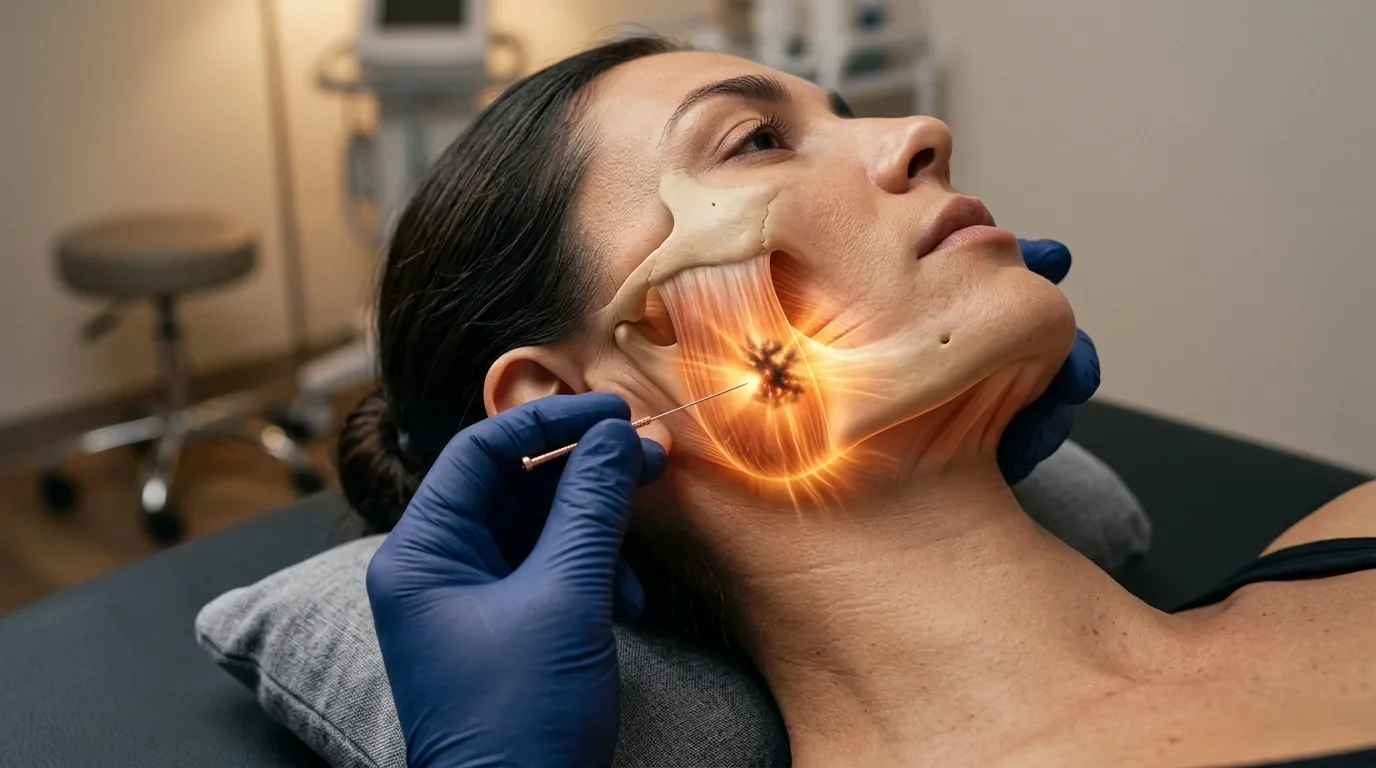
The review, published in the Journal of Manual & Manipulative Therapy in October 2026, gathered randomized trials of dry needling for musculoskeletal pain and then ran a focused analysis on neck pain (De Greef et al., 2026). Dry needling is a needling technique that uses acupuncture needles to target myofascial trigger points, and neck pain is one of the conditions where it has been studied most. Even so, the trials behind it differ widely in how much needling they actually deliver.
The short version: the trials did not show that more sessions, more trigger points, or more twitch responses led to better pain relief for neck pain about a week after treatment. The authors are careful to say this does not mean dose is irrelevant. The data are too thin and too inconsistent to tell. Below we walk through what they found, then add our own read on what it means in the treatment room.
- A 2026 systematic review and meta-analysis examined three dry needling "dose" settings: the number of sessions, the number of trigger points needled per session, and the number of local twitch responses elicited (De Greef et al., 2026).
- It included 70 randomized trials. Twenty-three neck pain trials with 1,185 participants entered the statistical analysis.
- In almost 30% of trials, patients received a single session or had a single trigger point needled, which is less treatment than many people receive in practice.
- For neck pain at about one week, none of the three settings showed a measurable link to how much dry needling helped. Certainty was rated moderate for comparisons with sham needling and low for comparisons with manual therapy or exercise.
- Across the pooled neck pain trials, dry needling reduced pain more than sham needling and performed about the same as manual therapy or exercise.
- When dry needling was added to exercise or manual therapy, the trials that found an extra benefit tended to use more sessions and more trigger points. That pattern is suggestive, not proof.
- Our read: the research has mostly tested a small dose. In the clinic we may needle five or more muscles in a neck pain session because many have overlapping referral patterns, and the best treatment is individualized and based on assessment.
Wondering How Many Dry Needling Sessions Your Neck Pain Needs?
The research does not support a fixed number, and we do not use one. At Morningside, we examine the muscles that may be referring pain to your neck, treat the ones that reproduce your symptoms, and adjust the plan based on how you respond from one visit to the next. You will always know what we are targeting and why.
Schedule NowWhat the Study Set Out to Answer
Earlier reviews, including an umbrella review by several of the same authors, found that dry needling relieves short-term pain better than sham or no treatment and about as well as other active treatments across body regions (Chys et al., 2023). Those reviews kept running into the same problem: the trials were so different from one another that it was hard to say what a good dose of dry needling looks like.
This review focused on three settings a clinician controls:
- Number of sessions. How many treatment visits a patient received.
- Number of trigger points needled. How many trigger points were treated in each session.
- Number of local twitch responses. A local twitch response is a brief, involuntary contraction of a band of muscle fibers when the needle reaches a trigger point. Some practitioners try to elicit as many as possible, sometimes described as needling "to depletion." Others consider the twitch unnecessary.
The authors first described how these settings are reported across the whole literature, then tested whether any of them explained why some neck pain trials found larger benefits than others.
How the Review Was Done
The protocol was registered in advance on PROSPERO and followed PRISMA reporting guidelines. Two reviewers independently screened studies, extracted data, and rated risk of bias. The team searched six databases from their start through November 2024 and identified 5,220 records, which narrowed to 70 randomized trials (De Greef et al., 2026).
Trials fell into three groups: dry needling compared with sham needling, dry needling compared with manual therapy or exercise, and dry needling added to manual therapy or exercise compared with that therapy alone. The main outcome was pain intensity about one week after treatment.
| Feature | Detail |
|---|---|
| Authors and setting | De Greef, Chys, De Sloovere, Murillo, De Meulemeester, and Cagnie; Ghent University, Belgium |
| Design | Systematic review with meta-analysis and meta-regression, registered on PROSPERO (CRD42024394871) |
| Studies included | 70 randomized trials (71 comparisons): 27 versus sham needling, 17 versus manual therapy or exercise, 27 as an add-on to manual therapy or exercise |
| Participants | Adults aged 18 to 65 with musculoskeletal pain and active trigger points, without other medical conditions |
| Excluded treatments | Electrical dry needling, tendon needling, and acupuncture |
| Statistical analysis | Limited to neck pain because results across body regions were too inconsistent to combine; 23 trials, 1,185 participants |
| Main outcome | Pain intensity about one week after treatment |
| Quality tools | Cochrane Risk of Bias 2 for each trial; GRADE for certainty of evidence |
How Much Dry Needling Do the Trials Actually Give?
The descriptive findings may be the most useful part of the paper. In almost 30% of trials, patients received only one session, or only one trigger point was needled. In the sham-controlled neck pain trials, 10 of 14 used a single session and 10 of 14 needled a single trigger point (De Greef et al., 2026).
Twitch responses were often not reported at all. Where they were, needling to depletion was the most common approach in the trials comparing dry needling with manual therapy or exercise.
Reporting in general was thin. Only three of the included trials fully followed STRICTA, the standard checklist for describing needling interventions, and the authors had to write to study teams to fill gaps, which they managed for 22 studies. When a trial does not say how many muscles were treated or how the needle was handled, it is difficult to learn anything about dose from it.
Put plainly, a large share of the evidence for dry needling comes from one visit and one muscle.
Did More Needling Lead to Better Results?
To test dose, the authors used meta-regression, which asks whether trials using more of something tended to report larger effects. For neck pain, none of the three settings showed a detectable link with how much dry needling helped at about one week.
| Dose Setting | Dry Needling vs Sham | Dry Needling vs Manual Therapy or Exercise | Certainty of Evidence |
|---|---|---|---|
| Number of sessions | No link found (14 trials; p = 0.797) | No link found (9 trials; p = 0.205) | Moderate (sham); low (manual therapy or exercise) |
| Trigger points needled per session | No link found (14 trials; p = 0.485) | No link found (9 trials; p = 0.207) | Moderate (sham); low (manual therapy or exercise) |
| Twitch responses elicited | No link found (8 trials; p = 0.903) | No link found (9 trials; p = 0.624) | Moderate (sham); low (manual therapy or exercise) |
p values are from the omnibus test of moderators. Values well above 0.05 mean the setting did not explain a detectable share of the differences between trials.
Two other results from the paper's forest plots help frame this. Across the 14 sham-controlled neck pain trials, the pooled effect favored dry needling, with a standardized mean difference of -0.69 (95% CI -1.02 to -0.35), which is a moderate-sized effect. Across the 9 trials comparing dry needling with manual therapy or exercise, the pooled estimate was 0.14 (95% CI -0.24 to 0.52), meaning no clear difference between them (De Greef et al., 2026).
In every analysis, a large share of the variation between trials remained unexplained even after accounting for dose, with I2 values between about 68% and 83%. Something other than these three settings is driving most of the differences between studies.
The Add-On Trials Showed a Pattern Worth Watching
The 27 trials that added dry needling to exercise or manual therapy could not be pooled, because the separate contribution of needling cannot be isolated in that design. The authors described them instead.
Eighteen of the 27 found that adding dry needling reduced pain more than the other therapy alone. Those trials gave between 3 and 8 sessions (median 4) and, where reported, needled 2 to 8 trigger points per session (median 3). Eight trials found no added benefit. Those gave at most 3 sessions and most often needled a single trigger point (De Greef et al., 2026).
Twitch responses followed the same direction, though only four trials in each group reported them. The authors caution that a descriptive pattern like this cannot establish a dose-response relationship. It is still the clearest hint in the paper that dose may matter when needling is combined with active rehabilitation.
Neck Pain That Keeps Coming Back?
Recurring neck pain often involves several muscles at once, including the upper trapezius, levator scapulae, sternocleidomastoid, scalenes, and the small muscles at the base of the skull. We assess each of them, combine dry needling and acupuncture where they fit, and reassess at every visit so the number of sessions follows your response.
Schedule NowOur Read: What This Study Means in the Treatment Room
We think the authors' conclusion is correct and appropriately cautious. Reading the paper closely, a few points stand out that are worth drawing out for patients.
The evidence mostly tests the smallest possible dose
When 10 of 14 sham-controlled neck pain trials give one session to one trigger point, a meta-regression comparing "one session" with "more than one" has very little to work with. It is a bit like testing whether exercise improves fitness when most of the studies prescribe a single workout. The finding that dose did not explain differences between trials tells us about the range of doses that has been studied, which is narrow and low.
Clinically, we may needle five or more muscles in a single neck pain session. Many neck and shoulder muscles have overlapping referral patterns, so pain at the side of the neck, the base of the skull, or the top of the shoulder can come from several muscles at once, such as the upper trapezius, levator scapulae, splenius capitis, and suboccipitals. Treating only one of them may leave the others still contributing to your symptoms. A single-muscle trial protocol tells us whether needling one trigger point can change pain. It does not tell us much about treating the full pattern a patient actually presents with.
That is why we think the best treatments are individualized and based on assessment. Which muscles we needle, and how many, depends on what we find on examination: where your pain is, which muscles reproduce it when pressed, and how your neck moves. The number of muscles is a result of that assessment, not a target set in advance.
No detected effect is not the same as no effect
The authors make this point themselves, and it deserves emphasis. The confidence intervals around every dose estimate were wide and crossed zero, so they are compatible with a meaningful benefit from more treatment as well as with none. The analysis also compares trials with each other, not patients within a trial. Studies that gave more sessions may have enrolled people with more severe or longer-standing pain, used different comparison treatments, or measured outcomes later after the first visit. Those differences can hide a real dose effect.
Chasing twitches: what we take from the twitch response data
This review adds to a mixed picture on twitch responses. A 2022 meta-analysis of six trials in spinal pain found that eliciting twitches reduced pain more immediately after treatment, but the difference was gone at short-term follow-up (Fernández-de-las-Peñas et al., 2022). An earlier review concluded that twitches may not be necessary for good outcomes and noted that post-needling soreness rises with the number of needle insertions used to provoke them (Perreault et al., 2017).
Our take: a twitch can be a useful sign that the needle has reached the target tissue. Pursuing as many twitches as possible has not been shown to add benefit, and it may add soreness. We wrote about the needle technique side of this question in our summary of a 2025 study comparing dynamic and static dry needling for neck pain, and about soreness in what to expect after dry needling.
One session can matter, and more is not automatically better
Two studies outside this review help frame the session question. In 35 adults with chronic ankle instability, a single dry needling session to the fibularis longus improved balance and patient-reported function right away. Three more weekly sessions sustained that improvement, with further gains in one measure of joint position sense but not in the others, and the improvement held four weeks after treatment stopped (Mullins et al., 2023). The review authors also point to animal research in which five sessions did not outperform one for pain-related biomarkers.
On the other side, a sham-controlled trial in 77 adults with neck pain added dry needling to seven sessions of manual therapy and exercise over four weeks and found no difference from sham needling at any follow-up (Gattie et al., 2021). More visits did not guarantee an added effect there.
Taken together, the number of visits on its own does not look like the main lever. Whether the right muscles are identified, whether the needling is paired with active rehabilitation, and how a given person responds may matter more. That is a hypothesis the field has not yet tested directly.
Who was left out
The review only included adults aged 18 to 65 without other medical conditions, and only trials that needled active trigger points. It excluded electrical dry needling. If you are over 65, have other health conditions, or are treated with electrical stimulation, these findings may not apply directly. The difference between active and latent trigger points also matters here, and we explain it in active vs latent trigger points.
How much weight to give this paper
The methods are solid for a review of this kind: a registered protocol, two independent reviewers, formal risk-of-bias ratings, and GRADE certainty ratings. The weaknesses are in the underlying trials. Only one sham-controlled trial was rated low risk of bias, and most trials in the other two groups were rated high risk. The twitch response analyses included fewer than the 10 studies usually recommended for a reliable meta-regression, and the authors describe all of the regressions as exploratory.
Four of the six authors disclose that they give, or have given, paid lectures and workshops on dry needling. The study had no outside funding, and its conclusion is cautious rather than promotional. We read it as a careful map of what the trials have and have not tested, not as evidence that dose is unimportant.
What This Means If You Are Considering Dry Needling for Neck Pain
There is no research-based number of dry needling sessions for neck pain. The authors recommend that clinicians set treatment intensity based on each patient's presentation, tolerance, symptom irritability, and goals. That is a reasonable standard to hold any provider to. In practical terms:
- Ask how progress will be judged. A good plan names the muscles being treated and what should change, such as range of motion, headache frequency, or pain with desk work, so you can tell whether it is working.
- Expect the plan to change. Some trials show change after a single session. If your symptoms are not shifting, the plan should be reassessed, not simply extended.
- More twitches are not the goal. Twitch responses may be part of treatment, but chasing them has not been shown to improve results and may increase soreness afterward.
- Pair needling with movement. The trials that found the clearest added benefit combined dry needling with exercise or manual therapy and used several sessions.
If you want to understand which muscles may be behind your symptoms before your first visit, our Trigger Point Pain Finder lets you tap where it hurts and see the muscles that commonly refer pain there. For an overview of how we approach treatment, see our page on dry needling in NYC.
Related What to Expect After Dry Needling Related How Does Dry Needling Work?Dry Needling for Neck Pain at NYC's Highest-Rated Acupuncture and Dry Needling Clinic
Morningside Acupuncture is NYC's highest-rated acupuncture and dry needling clinic, with over 500 five-star Google reviews. If neck pain, stiffness, or tension headaches are holding you back, we will find the muscles involved, explain what we are treating, and let your response guide how many visits you need.
Schedule NowFrequently Asked Questions
How many dry needling sessions do I need for neck pain?
There is no research-based number. A 2026 meta-analysis found no measurable link between the number of sessions and pain relief in neck pain trials, but most of those trials gave only one session, so the question is not settled. In practice, the number of sessions should follow your response, with the plan reassessed if symptoms are not changing.
Can one dry needling session help?
It may. Several trials in the 2026 review used a single session and still found less pain than sham needling about a week later. A study in chronic ankle instability also found that improvements appeared after the first session and were maintained with further treatment. Whether one session is enough for you depends on how long you have had symptoms and how many muscles are involved.
Is it better to needle more trigger points in one session?
The evidence does not say. In the neck pain trials, the number of trigger points needled per session did not explain differences in results. Add-on trials that found a benefit tended to treat more trigger points, but that is a descriptive pattern. Clinically, we may needle five or more muscles in a neck pain session, because several neck muscles can refer pain to the same area. The number should come from your assessment: treating the muscles that actually reproduce your symptoms is likely more important than the count.
Does the muscle need to twitch for dry needling to work?
Current evidence does not show that more twitches lead to better results. One review of spinal pain found a short-lived extra reduction in pain right after treatment when twitches were elicited, with no difference at later follow-up. Repeated needling to provoke twitches is also linked with more soreness afterward.
Is dry needling better than massage, manual therapy, or exercise for neck pain?
In the 2026 review, dry needling reduced neck pain more than sham needling and performed about the same as manual therapy or exercise. Many trials found an added benefit when dry needling was combined with exercise or manual therapy, which is how it is often used in practice.
References
- Chys, M., De Meulemeester, K., De Greef, I., Murillo, C., Kindt, W., Kouzouz, Y., Lescroart, B., & Cagnie, B. (2023). Clinical effectiveness of dry needling in patients with musculoskeletal pain: An umbrella review. Journal of Clinical Medicine, 12(3), 1205. https://doi.org/10.3390/jcm12031205
- De Greef, I., Chys, M., De Sloovere, M., Murillo, C., De Meulemeester, K., & Cagnie, B. (2026). Do treatment parameters of dry needling influence its effect on pain? A systematic review and meta-analysis. Journal of Manual & Manipulative Therapy. Advance online publication. https://doi.org/10.1080/10669817.2026.2747616
- Fernández-de-las-Peñas, C., Plaza-Manzano, G., Sanchez-Infante, J., Gómez-Chiguano, G. F., Cleland, J. A., Arias-Buría, J. L., & Navarro-Santana, M. J. (2022). The importance of the local twitch response during needling interventions in spinal pain associated with myofascial trigger points: A systematic review and meta-analysis. Acupuncture in Medicine, 40(4), 299-311. https://doi.org/10.1177/09645284211056346
- Gattie, E., Cleland, J. A., Pandya, J., & Snodgrass, S. (2021). Dry needling adds no benefit to the treatment of neck pain: A sham-controlled randomized clinical trial with 1-year follow-up. Journal of Orthopaedic & Sports Physical Therapy, 51(1), 37-45. https://doi.org/10.2519/jospt.2021.9864
- Mullins, J. F., Hoch, M. C., Gribble, P., Heebner, N., Kosik, K., Westgate, P., & Nitz, A. J. (2023). Examination of dry needling dose and effect duration for individuals with chronic ankle instability. Journal of Manipulative and Physiological Therapeutics, 46(2), 132-142. https://doi.org/10.1016/j.jmpt.2023.05.007
- Perreault, T., Dunning, J., & Butts, R. (2017). The local twitch response during trigger point dry needling: Is it necessary for successful outcomes? Journal of Bodywork and Movement Therapies, 21(4), 940-947. https://doi.org/10.1016/j.jbmt.2017.03.008
Disclaimer: This web site is intended for educational and informational purposes only. Reading this website does not constitute providing medical advice or any professional services. This information should not be used for diagnosing or treating any health issue or disease. Those seeking medical advice should consult with a licensed physician. Seek the advice of a medical doctor or other qualified health professional for any medical condition. If you think you have a medical emergency, call 911 or go to the emergency room. No acupuncturist-patient relationship is created by reading this website or using the information. Morningside Acupuncture PLLC and its employees and contributors do not make any express or implied representations with respect to the information on this site or its use. For any legal interpretation of scope of practice in your state, consult a licensed attorney or regulatory authority.
Read more from our blog