KI23 Acupuncture Point (Shenfeng)
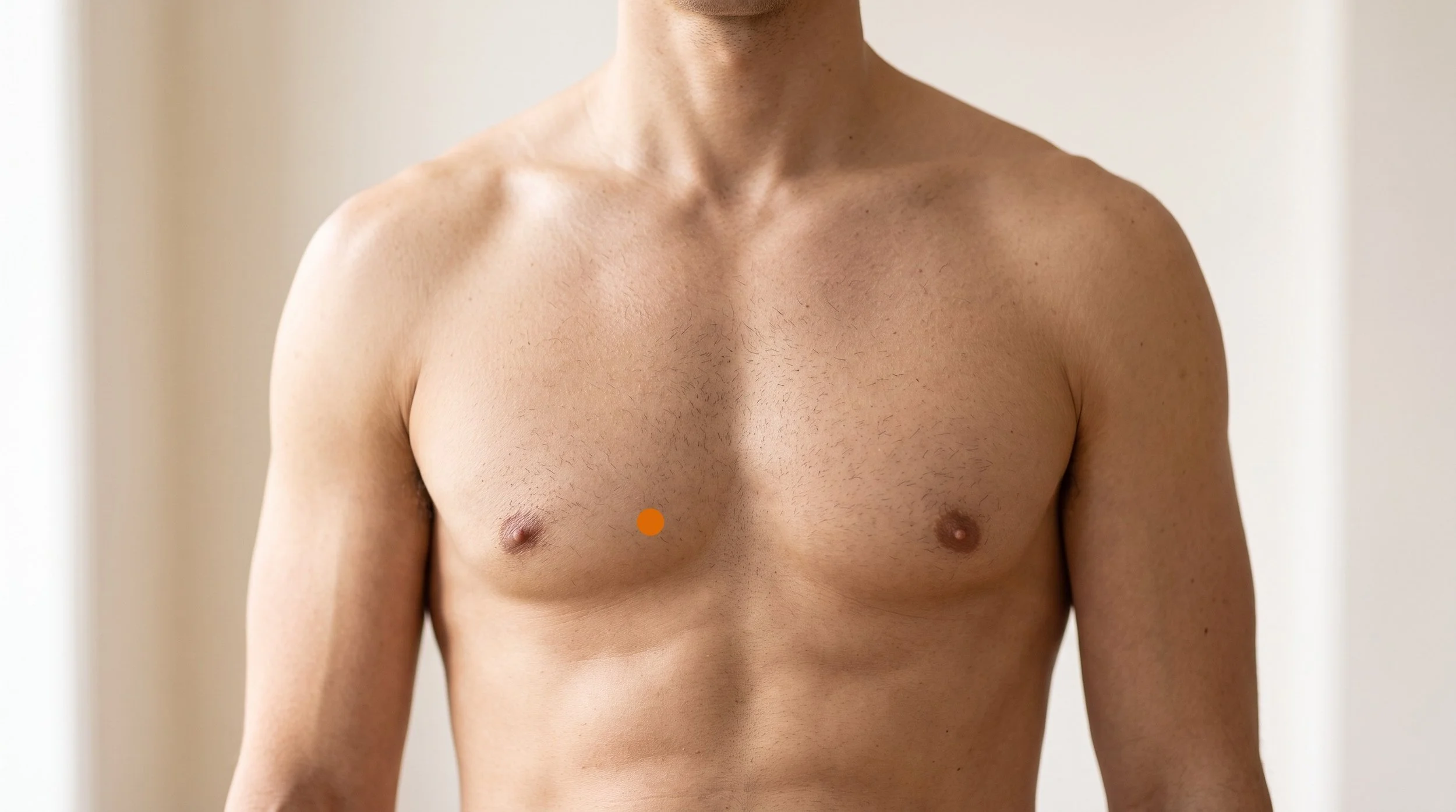
KI3 Acupuncture Point
The Spirit Seal Over the Fourth Rib Space: Anatomy, Segmental Mechanism, and Why This Kidney Chest Point Belongs in Breathing and Chest Tension Work
KI23 (Shenfeng, often translated as Spirit Seal or Mind Seal) is the fourth point in the Kidney channel's chest row, sitting in the fourth intercostal space, 2 cun lateral to the midline of the sternum, roughly midway between the breastbone and the nipple line (Deadman et al., 2001). In men the nipple usually sits in this same rib space, which makes the level easy to find and equally easy to needle carelessly, so the point is worked shallow and along the rib space rather than into it.
Clinically, the ki23 acupuncture point matters because it lies directly over the pectoralis major and the fourth intercostal muscles at a spinal level (roughly T4) that also receives afferent traffic from the heart, the airways, and the breast tissue. That convergence is why classical texts group it with the chest points that were traditionally said to unbind the chest, and why modern clinicians reach for kidney 23 when a patient describes a band of tightness across the upper chest that gets worse with shallow, guarded breathing.
- Location and layers: KI23 sits in the fourth intercostal space, 2 cun lateral to the anterior midline, over skin, superficial fascia, the sternal fibers of pectoralis major, and the external and internal intercostal muscles, with pleura and lung immediately deep to that (Deadman et al., 2001; Kim, 2015).
- Traditional attributions: classical and modern Chinese sources describe KI23 as unbinding the chest, descending rebellious Lung and Stomach qi, and benefiting the breasts, with listed indications covering chest and rib-side fullness, breathlessness, cough and wheeze, breast abscess, and vomiting with poor appetite (Deadman et al., 2001; Kim, 2015). We present those as traditional categories, not as physiology.
- Mechanism: needling here recruits anterior cutaneous branches of the fourth intercostal nerve and the pectoral nerves, feeding segmental input into upper thoracic dorsal horn levels that also receive visceral afferents from the heart, airways, and chest wall, and engaging the spinal and brainstem pathways that underlie needle-evoked analgesia (Zhao, 2008).
- Autonomic angle: meta-analytic data suggest manual acupuncture may shift heart rate variability toward greater parasympathetic tone, which is a plausible partial explanation for the settled, easier breathing patients often report after chest-point work (Hamvas et al., 2023).
- Research picture: reviews of acupuncture for cough and for obstructive lung disease test multi-point protocols rather than KI23 alone, and results are cautiously favorable for symptom scores while remaining limited by trial quality (McCarney et al., 2004; Suzuki et al., 2012; Lee et al., 2025).
- De qi and practice framing: because insertion is transverse-oblique and shallow, the sensation is usually a mild spreading heaviness or dull ache tracking along the rib space rather than a deep grip, and large prospective safety data show serious events from acupuncture are rare when trained clinicians respect thoracic depth limits (Witt et al., 2009).
Is Chest Tightness Making Every Breath Feel Shallow?
Patients often arrive describing a strap of tension across the upper chest, breath that stops at the collarbones, and ribs that never quite let go. At Morningside Acupuncture we use KI23 with the neighboring Kidney chest points and gentle intercostal and pectoralis work to reduce guarding in the chest wall and give the ribs room to move again. Treatment is paired with breathing retraining so the change holds between visits. Schedule a session and let's see how your chest moves when it isn't bracing.
Schedule NowAnatomy of KI23: Why the Fourth Intercostal Space Is Such an Important Location
From the surface down, KI23 passes through thin anterior chest skin and superficial fascia into the sternal fibers of pectoralis major, then into the external and internal intercostal muscles bridging the fourth and fifth ribs. This is loaded tissue in most desk-based New Yorkers: pectoralis major shortens with rounded shoulder posture and forward reaching, while the intercostals work continuously with every breath and stiffen further when someone habitually breathes into the upper chest.
Rib cage guarding after a coughing illness, after a rib injury, or during prolonged stress leaves this exact strip of tissue tender to light pressure, which is often how the point is found in practice. The 2 cun line places KI23 midway between the sternal border and the nipple line, so it sits over muscle rather than over cartilage (Deadman et al., 2001).
The nerve geography explains most of what the point does. Sensory supply here comes from the anterior cutaneous branch of the fourth intercostal nerve, with motor input to pectoralis major arriving through the pectoral nerves, so needling delivers a focused burst of A-delta and C fiber activity into the T3 to T5 segments of the spinal cord. Those same segments receive visceral afferents from the heart, the great vessels, the airways, and the breast, which is the standard neuroanatomical account of why chest wall stimulation can modulate sensations that patients interpret as coming from inside the chest.
Segmental input of this kind also recruits descending inhibitory control from the periaqueductal gray and rostral ventromedial medulla, along with endogenous opioid and monoaminergic signaling (Zhao, 2008). Add the local axon reflex effects on skin blood flow and the reduction in muscle tone that follows a needle response in a tender pectoral or intercostal band, and you have a plausible mechanism for the loosening patients describe, without invoking any energetic explanation.
Deep to the intercostal muscles lie the parietal pleura and lung, and perforating branches of the internal thoracic artery emerge in the upper intercostal spaces near this line, so KI23 is treated as a caution point in every major text. The standard convention is transverse-oblique insertion directed laterally along the intercostal space to a depth of roughly 0.5 to 1 cun, and deep perpendicular or oblique needling is specifically warned against because of the risk of puncturing the lung (Deadman et al., 2001).
Some texts advise even shallower oblique insertion and caution against deep needling given the proximity of the heart on the left side (Kim, 2015). In practice this means angling the needle so it travels parallel to the chest wall, palpating the rib margins first, and never combining deep needling with a moving or coughing patient. Large prospective safety data indicate that serious adverse events are uncommon overall, with bleeding, bruising, and needling pain being the common complaints, which is reassuring precisely because thoracic technique conventions are respected (Witt et al., 2009).
Related Intercostal Muscles Trigger Points Related Pectoralis Major Trigger PointsKI23 at a Glance: Classification, Location, and Clinical Use
| Category | Detail |
|---|---|
| Traditional Name | Shenfeng (Spirit Seal, also translated as Mind Seal) |
| Channel Classification | Kidney channel of Foot Shaoyin, twenty-third point, part of the Kidney Channel chest row |
| Point Categories | No five-shu, luo, xi-cleft, or hui-meeting designation and no extraordinary vessel intersection is listed in the classical sources. KI23 is classified as one of the Kidney chest points of the fourth intercostal space, part of the row running from KI22 to KI27 that traditional texts credit with unbinding the chest, descending rebellious Lung and Stomach qi, and benefiting the breasts (Deadman et al., 2001; Kim, 2015). Some modern Western texts additionally treat it as an alternate front-mu style point for the Heart (Cunningham, 2010). |
| Precise Location | On the anterior chest, in the fourth intercostal space, 2 cun lateral to the anterior midline, midway between the midline and the mamillary (nipple) line. Locate the second intercostal space first at the level of KI25, then count down two spaces. In males the nipple typically lies in the fourth intercostal space. |
| Tissue Stimulated | Skin and superficial fascia, sternal fibers of pectoralis major, and the external and internal intercostal muscles of the fourth space, innervated by the anterior cutaneous branch of the fourth intercostal nerve and the pectoral nerves. |
| Needle Depth / Direction | Transverse-oblique insertion directed laterally along the intercostal space, 0.5 to 1 cun. Caution: deep perpendicular or oblique needling may puncture the lung, and some texts advise shallower oblique insertion given the underlying heart and pleura. |
| De Qi Sensation | Usually a mild, spreading heaviness or dull ache that tracks laterally along the rib space, sometimes with a sense of warmth or release across the front of the chest. Sharp, radiating, or breath-catching sensations are not expected and mean the needle should be adjusted or withdrawn. |
| Primary Clinical Uses | Traditionally used for chest and rib-side fullness with difficult breathing, cough and wheezing, breast disorders including breast abscess in classical listings, and vomiting with no pleasure in eating (Deadman et al., 2001). In modern practice it is used as a local point for anterior chest wall tension, intercostal and pectoral soreness, and guarded upper chest breathing patterns. |
| Common Point Combinations |
|
Deadman, Al-Khafaji and Baker's A Manual of Acupuncture presents KI23 in the traditional idiom as a point that unbinds the chest, sends rebellious Lung and Stomach qi downward, and benefits the breasts, and its indication list clusters tightly around those three themes: fullness of the chest and rib-side with laboured breathing, cough, wheezing and painful obstruction of the chest, breast abscess, and vomiting with no pleasure in eating (Deadman et al., 2001). Contemporary Chinese teaching texts summarize the same territory in briefer form, adding mastitis to the list (Kim, 2015).
Presented as traditional attribution rather than as physiology, the pattern is striking for its internal consistency: everything on the list involves something in the trunk moving upward or outward when it should be settling downward, whether that is breath, stomach contents, or heat in the breast tissue. That a single point on the fourth rib space was asked to address respiratory, digestive, and glandular complaints alike makes far more sense once you notice that all three regions send afferent traffic into roughly the same upper thoracic spinal segments.
Why KI23 Is Used for Chest Tightness That Feels Like Anxiety
One of the more common reasons we end up at KI23 has nothing to do with the lungs themselves. A patient describes pressure across the front of the chest, a breath that will not fill, and a low hum of anxiety that gets worse as the day goes on. Examination frequently finds short, tender pectoral fibers, stiff upper intercostals, and a rib cage that barely expands laterally.
The fourth intercostal space is a productive place to intervene because sensory input from this patch of chest wall enters the same upper thoracic segments that receive afferents from the heart and airways, so the nervous system does not cleanly separate chest wall signals from visceral ones. Reducing nociceptive drive from an irritable chest wall can therefore change how the whole chest is perceived, which is a mundane and testable explanation for a sensation patients often describe in dramatic terms.
Beyond the segment, needling recruits descending inhibitory pathways from the midbrain and brainstem along with endogenous opioid and monoaminergic signaling, mechanisms mapped in detail in the analgesia literature (Zhao, 2008).
There is also a plausible autonomic contribution: a systematic review with meta-analysis of randomized trials comparing real needling to placebo methods reported changes in heart rate variability indices consistent with increased parasympathetic tone (Hamvas et al., 2023). That finding is drawn from small studies at varied point prescriptions, so it should be read as supportive background rather than proof of what KI23 specifically does, but it fits what patients report: slower breathing, less bracing, and a chest that feels less like it is being held shut.
The individual patient data meta-analysis of acupuncture for chronic pain remains the strongest single body of evidence for needling effects that exceed sham and persist over time, and it supports the general clinical value of this kind of treatment for persistent musculoskeletal pain, including chest wall and postural pain of the type we treat around KI23 (Vickers et al., 2018). We do not claim it validates this point in isolation.
It does mean that when we needle a tender pectoral or intercostal band near the fourth rib space, we are working within a treatment class that has been studied seriously and holds up reasonably well.
What the Research Shows for KI23
There is no clinical trial of KI23 on its own, and it would be misleading to suggest otherwise. What exists is research on multi-point acupuncture protocols for respiratory symptoms, chest wall pain, autonomic regulation, and breast complaints, in which chest points like this one may appear as part of a larger prescription.
The honest reading is that reviews of acupuncture for cough and obstructive lung disease show cautiously positive symptom-level findings limited by trial quality, that Cochrane's assessment of acupuncture for asthma found the evidence insufficient, and that KI23's contribution within any of these protocols has never been isolated. The table below summarizes the most relevant studies and what each can and cannot tell us.
| Study | Type | Focus | Key Finding |
|---|---|---|---|
| McCarney et al., 2004 | Cochrane systematic review | Acupuncture for chronic asthma, randomized trials versus sham or usual care | The review concluded there was insufficient evidence to make recommendations about acupuncture for asthma, with variable trial quality and inconsistent results. |
| Lee et al., 2025 | Systematic review and meta-analysis (30 RCTs, 2,835 participants) | Acupuncture-related therapy for chronic cough of various causes | Added to conventional care, acupuncture-related therapy was associated with improved cough severity and cough-related quality of life, with generally moderate certainty of evidence limited by risk of bias. |
| Suzuki et al., 2012 | Randomized placebo-controlled trial (68 patients) | Acupuncture for dyspnea on exertion in COPD, added to standard medication | Real needling was associated with greater improvement in exertional breathlessness than placebo needling, though blinding and generalizability were debated in subsequent correspondence. |
| Hamvas et al., 2023 | Systematic review and meta-analysis (9 RCTs) | Manual acupuncture versus placebo effects on heart rate variability | Pre-to-post changes in high frequency and LF/HF indices in the verum group suggest acupuncture may shift autonomic balance toward parasympathetic tone. |
| Hajian et al., 2021 | Systematic review of interventional studies | Acupuncture, acupressure and massage for breast engorgement and milk volume in lactating mothers | Findings across the included studies were mixed and point prescriptions varied widely, so no firm conclusion about acupuncture for engorgement symptoms could be drawn. |
| Witt et al., 2009 | Prospective observational safety study (229,230 patients) | Adverse effects of acupuncture in routine care | About 8.6 percent of patients reported at least one adverse effect, most commonly bleeding or bruising, with serious events such as pneumothorax being rare. |
| Vickers et al., 2018 | Individual patient data meta-analysis (about 20,827 patients, 39 trials) | Acupuncture for chronic musculoskeletal, headache and osteoarthritis pain | Acupuncture was superior to both sham and no-acupuncture controls, with effects persisting over time, supporting the treatment class rather than any single point. |
Lingering Cough or Breathless Ribs After a Chest Infection?
A cough that outlasts the illness usually leaves a fatigued, overworked chest wall behind it, with tender intercostals and a stiff sternum. We combine shenfeng acupuncture with distal points such as LU7 and ST36, plus careful dry needling of the pectoral and intercostal muscles, to reduce chest wall soreness and support easier, fuller breaths. Studies suggest acupuncture protocols may help cough severity and cough-related quality of life alongside standard care. Book an evaluation and we'll build a plan around your breathing.
Schedule NowKI23 in the Context of Trigger Point Work
The ki 23 chest location sits directly over tissue that myofascial pain research has mapped in detail. Trigger points in the sternal division of pectoralis major refer pain across the front of the chest, into the anterior shoulder, and down the medial arm, a pattern that can convincingly mimic cardiac pain and often sends patients for cardiac workup before anyone palpates the muscle (Simons et al., 1999). Intercostal trigger points produce more localized rib-space soreness that flares with deep inspiration, coughing, twisting, or sleeping on the affected side.
When a patient presents with anterior chest pain that reproduces on palpation and changes with arm position or breath, that combination points toward a chest wall source, although cardiac and pulmonary causes must always be excluded first by their physician.
At Morningside we treat this region as one functional unit rather than as isolated dots. A session might combine shallow, laterally directed needling at KI23 and its Kidney channel neighbors with dry needling of pectoralis major and pectoralis minor, careful superficial intercostal technique, and release of scalene and subclavius contributions to upper chest breathing. The needling is only part of it: we pair it with breathing retraining and thoracic mobility work so the ribs actually use the range that treatment restores.
All thoracic needling is performed with tangential angles and conservative depths, since acupuncture is defined by the use of an acupuncture needle regardless of style, and the same anatomical rules apply whether the label is dry needling or classical point work.
KI23 Chest Tension and Breathing Treatment at NYC's Highest-Rated Acupuncture Clinic
Morningside Acupuncture is the highest-rated acupuncture and dry needling clinic in New York City with over 500 five-star Google reviews, and our approach blends classical point selection with modern orthopedic and myofascial needling. For chest tightness, stubborn cough, rib pain, and stress-driven shallow breathing, KI23 is one part of a full assessment that includes posture, breathing mechanics, and trigger point examination. Every chest point is needled with conservative, shallow technique by licensed acupuncturists trained in thoracic safety. Schedule your first visit and get a clear, individualized plan.
Schedule NowFrequently Asked Questions
What does KI23 feel like when needled?
Most people feel a brief pinch at insertion followed by a mild, spreading heaviness or dull ache that travels sideways along the rib space. Because the needle is inserted shallowly and almost flat against the chest wall, the sensation stays fairly superficial rather than producing the deep grip common at points like ST36. Some patients report a warm, loosening feeling across the front of the chest and find their next breath goes deeper. Sharp pain, a radiating electric sensation, or any catch in the breath is not a normal response, and you should tell your acupuncturist immediately so the needle can be adjusted or removed.
Why needle the chest wall for a cough instead of only using distal points on the arms and legs?
Both approaches have a rationale, and in practice they are usually combined. Distal points like LU7 work through broader central mechanisms, including descending inhibitory control and widespread neurochemical effects (Zhao, 2008). Local chest points like KI23 add something different: they deliver input into the specific spinal segments that serve the chest wall, airways, and heart, and they directly address the tired, tender pectoral and intercostal muscles left behind by weeks of coughing. Classical texts framed the same combination as local plus distal treatment. If your chest wall is genuinely sore to touch, treating it locally usually makes a noticeable difference in comfort.
Can I press KI23 myself between sessions?
Yes, acupressure here is safe and easy to do because there is no needle involved. Find the fourth intercostal space, which in most men is the space at nipple level, then move to a spot roughly two thumb-widths out from the center of the breastbone, about halfway between the sternum and the nipple line. Use the pad of your index or middle finger, angle the pressure into the soft space between the ribs rather than pressing on bone, and hold steady, moderate pressure for 30 to 60 seconds while breathing slowly into your lower ribs. Repeat on the other side, and do two or three rounds per session, once or twice a day. Aim for a sensation of firm tenderness that eases as you hold, never sharp pain. Skip it over broken or irritated skin, over breast tissue itself, or during pregnancy without checking with your clinician first.
Is KI23 safe to needle?
It is safe in trained hands and requires respect. The lung and pleura lie directly beneath this point, so every major text warns that deep perpendicular or oblique needling may puncture the lung, and insertion is instead done transverse-oblique along the intercostal space at 0.5 to 1 cun (Deadman et al., 2001). Some texts advise even shallower technique given the underlying heart, particularly on the left (Kim, 2015). Large prospective safety data from routine practice show most adverse effects are minor, chiefly bruising, bleeding, and needling soreness, with pneumothorax being rare (Witt et al., 2009). Tell your acupuncturist about lung disease, emphysema, a history of pneumothorax, blood thinners, breast implants, or a pacemaker before any chest point is used.
Where exactly is KI23 located?
KI23 lies on the front of the chest in the fourth intercostal space, 2 cun lateral to the anterior midline, positioned midway between the midline and the nipple line (Deadman et al., 2001). The most reliable way to find it is to locate the second intercostal space at the level of KI25 and count down two spaces, or in men to use the nipple as a marker, since the nipple usually sits in the fourth space. The 2 cun measurement is taken as half the distance from the midline to the mamillary line, so it scales to the individual rather than being a fixed number of centimeters. Your acupuncturist will palpate the rib margins to confirm the space before any needle goes in.
References
- Deadman, P., Al-Khafaji, M., & Baker, K. (2009). A manual of acupuncture. Journal of Chinese Medicine Publications.
- Kim, H. (2008). Handbook of Oriental medicine (3rd ed.). Harmony & Balance Press.
- Cunningham, P. M. (2000). Acupuncture points: A practical guide to classical and modern usage. Odyssey Press.
- O'Connor, J., & Bensky, D. (Eds. & Trans.). (1981). Acupuncture: A comprehensive text. Shanghai College of Traditional Medicine. Eastland Press.
- Simons, D. G., Travell, J. G., & Simons, L. S. (1999). Travell & Simons' myofascial pain and dysfunction: The trigger point manual, Vol. 1: Upper half of body (2nd ed.). Williams & Wilkins.
- McCarney, R. W., Brinkhaus, B., Lasserson, T. J., & Linde, K. (2004). Acupuncture for chronic asthma. Cochrane Database of Systematic Reviews, 2004(1), CD000008. https://doi.org/10.1002/14651858.CD000008.pub2 [VERIFY BEFORE PUBLISHING]
- Lee, B., Kwon, C. Y., Jeong, Y. K., Ha, N. Y., Kim, K. I., Lee, B. J., & Lee, J. H. (2025). Acupuncture-related therapy for chronic cough: A systematic review and meta-analysis. Integrative Medicine Research, 14(1), 101121. https://doi.org/10.1016/j.imr.2025.101121
- Suzuki, M., Muro, S., Ando, Y., Omori, T., Shiota, T., Endo, K., Sato, S., Aihara, K., Matsumoto, M., Suzuki, S., Itotani, R., Ishitoko, M., Hara, Y., Takemura, M., Ueda, T., Kagioka, H., Hirabayashi, M., Fukui, M., & Mishima, M. (2012). A randomized, placebo-controlled trial of acupuncture in patients with chronic obstructive pulmonary disease (COPD): The COPD-acupuncture trial (CAT). Archives of Internal Medicine, 172(11), 878-886. https://doi.org/10.1001/archinternmed.2012.1233
- Hamvas, S., Hegyi, P., Kiss, S., Lohner, S., McQueen, D., & Havasi, M. (2023). Acupuncture increases parasympathetic tone, modulating HRV: Systematic review and meta-analysis. Complementary Therapies in Medicine, 72, 102905. https://doi.org/10.1016/j.ctim.2022.102905
- Hajian, H., Soltani, M., Mohammadkhani, M. S., et al. (2021). The effect of acupressure, acupuncture and massage techniques on the symptoms of breast engorgement and increased breast milk volume in lactating mothers: A systematic review. International Journal of Pediatrics (Mashhad), 9(3), 12939-12950. https://doi.org/10.22038/ijp.2020.54458.4305 [VERIFY BEFORE PUBLISHING]
- Witt, C. M., Pach, D., Brinkhaus, B., Wruck, K., Tag, B., Mank, S., & Willich, S. N. (2009). Safety of acupuncture: Results of a prospective observational study with 229,230 patients and introduction of a medical information and consent form. Forschende Komplementärmedizin, 16(2), 91-97. https://doi.org/10.1159/000209315
- Zhao, Z. Q. (2008). Neural mechanism underlying acupuncture analgesia. Progress in Neurobiology, 85(4), 355-375. https://doi.org/10.1016/j.pneurobio.2008.05.004
- Vickers, A. J., Vertosick, E. A., Lewith, G., MacPherson, H., Foster, N. E., Sherman, K. J., Irnich, D., Witt, C. M., & Linde, K. (2018). Acupuncture for chronic pain: Update of an individual patient data meta-analysis. Journal of Pain, 19(5), 455-474. https://doi.org/10.1016/j.jpain.2017.11.005
Disclaimer: This web site is intended for educational and informational purposes only. Reading this website does not constitute providing medical advice or any professional services. This information should not be used for diagnosing or treating any health issue or disease. Those seeking medical advice should consult with a licensed physician. Seek the advice of a medical doctor or other qualified health professional for any medical condition. If you think you have a medical emergency, call 911 or go to the emergency room. No acupuncturist-patient relationship is created by reading this website or using the information. Morningside Acupuncture PLLC and its employees and contributors do not make any express or implied representations with respect to the information on this site or its use. For any legal interpretation of scope of practice in your state, consult a licensed attorney or regulatory authority.
Read more from our blog



