KI22 Acupuncture Point (Bulang)
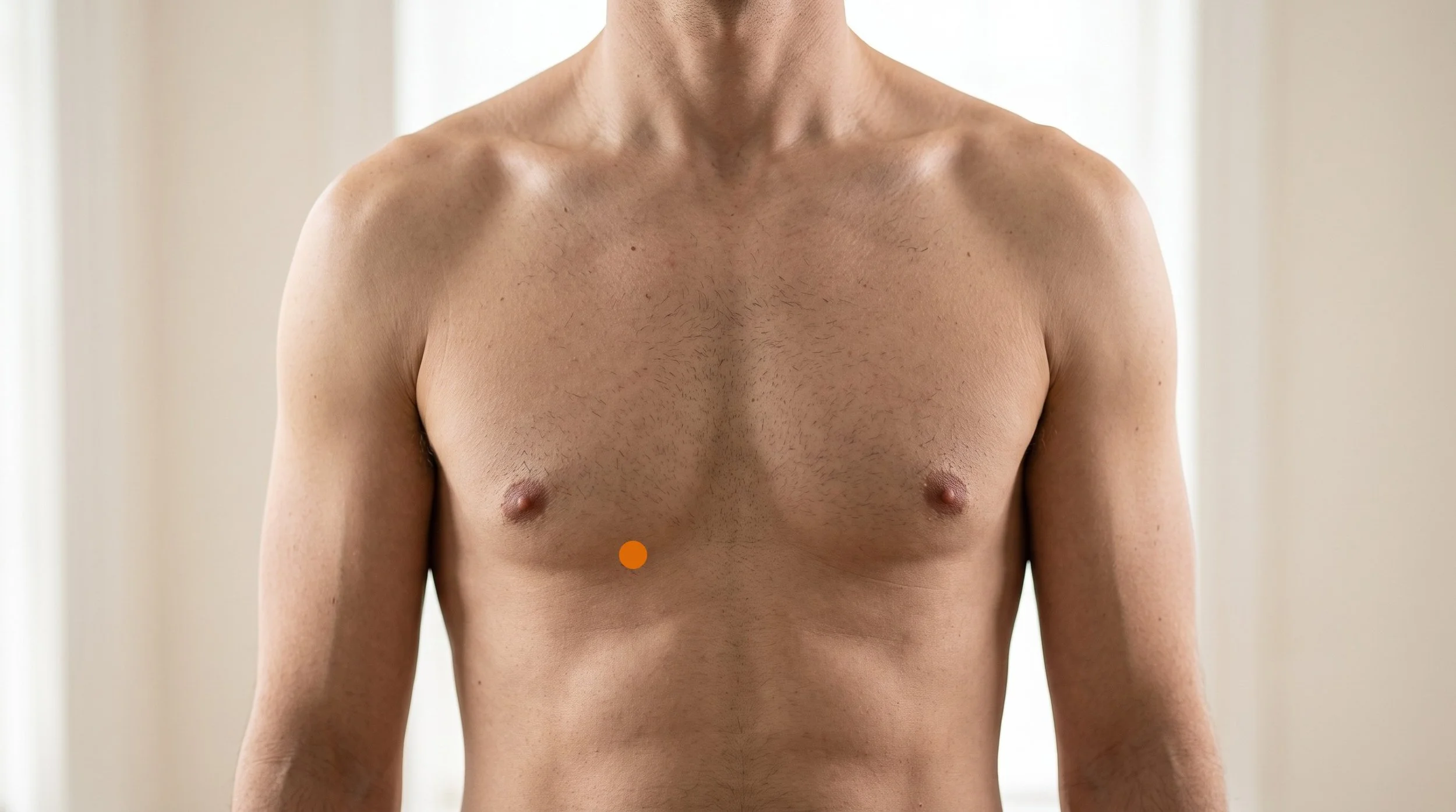
KI22 Acupuncture Point (Bulang)
The First Chest Point of the Kidney Channel: Anatomy, Mechanism, and Why a Fifth Rib Space Point Is Used for Cough, Chest Tightness and Unsettled Digestion
KI22, known in Chinese as Bulang and usually translated as Walking Corridor, is the first of the six Kidney channel points that sit on the front of the chest. You'll find it in the fifth intercostal space, two cun lateral to the midline, which in practical terms means the soft gap between the fifth and sixth ribs, roughly halfway between the breastbone and a vertical line through the nipple.
Classical texts group it with KI23 through KI27 as one of the twelve shu points of the chest and describe it as unbinding the chest and directing rebellious Lung and Stomach qi downward (Deadman et al., 2000). Read anatomically, that traditional description maps onto something concrete: a shallow point over pectoralis major and the intercostal muscles, sitting in a spinal segment that also receives afferent traffic from the airways, the heart and the upper digestive tract.
That overlap is why the ki22 acupuncture point shows up in treatment plans for cough, chest tightness, rib space pain and a stomach that feels like it will not settle.
- Location and layers: KI22 lies in the fifth intercostal space, two cun lateral to the midline, midway between the midline and the nipple line, over the costal fibers of pectoralis major and the external and internal intercostal muscles, with pleura, lung and (on the right) the dome of the liver deeper still (Deadman et al., 2000).
- Traditional categories, translated: the Essential Questions lists KI22 to KI27 as the twelve shu points of the chest, sharing the attributed actions of unbinding the chest and lowering rebellious Lung and Stomach qi (Deadman et al., 2000). In modern language, that's a row of segmentally matched chest wall points used for breathing and upper digestive complaints.
- Mechanism: needling here stimulates the anterior cutaneous branch of the fifth intercostal nerve and the muscles it supplies, recruiting small diameter afferents that engage spinal and descending pain modulating pathways rather than moving anything through a channel (Zhao, 2008).
- Research picture: reviews of acupuncture in respiratory disease are mixed. A Cochrane review found the asthma evidence too inconsistent to support recommendations (McCarney et al., 2004), while a placebo-controlled trial in COPD reported reduced exertional breathlessness with adjunctive acupuncture (Suzuki et al., 2012), and a later systematic review described technique and protocol variability as a limiting factor (Fernández-Jané et al., 2020).
- Clinical framing: KI22 is a supporting point, not a stand-alone treatment. It's used alongside standard medical care for respiratory conditions, and it may help most with the muscular and postural side of chest tightness, where rib cage stiffness and guarded breathing amplify symptoms (Simons et al., 1999).
- De qi and technique: because the needle travels transverse-obliquely along the rib space to 0.5 to 1 cun, the sensation is usually a mild spreading heaviness or dull fullness along the intercostal line rather than a strong grab (Deadman et al., 2000). Sharp or radiating pain means the angle needs adjusting.
Feeling Tight Through the Chest and Ribs When You Breathe?
Chest tightness is rarely one thing: it can involve rib cage stiffness, pectoral and intercostal tension, shallow upper chest breathing and a nervous system stuck in a guarded pattern. At Morningside Acupuncture we use KI22 and its neighboring Kidney chest points as part of a plan that addresses the chest wall directly while calming the autonomic drive behind it. Every plan is built around your medical care, not in place of it. Schedule a visit and let's look at how you're actually breathing.
Schedule NowAnatomy of KI22: Why the Fifth Intercostal Space Is Such an Important Location
From the surface down, KI22 passes through skin and a thin layer of subcutaneous fat into the lower costal fibers of pectoralis major, then into the external and internal intercostal muscles bridging the fifth and sixth ribs. This is a working region, not a quiet one. Every breath moves the intercostals, and the pectoral fibers just above load heavily with desk posture, driving, carrying, pushing and long hours with the shoulders rolled forward. Chronic cough adds a second layer of demand, since the intercostals and abdominal wall contract repeatedly and forcefully. Patients who describe a band of soreness under the breast or a rib space that feels bruised often have tenderness right around this point.
The nerve geography explains a good deal of the traditional indication list. KI22 sits in the territory of the fifth intercostal nerve, whose anterior cutaneous branch surfaces near the sternal border, while pectoralis major above it is supplied by the pectoral nerves. The fifth thoracic segment is also part of the sympathetic outflow that serves the airways and, a little lower, the upper digestive tract, so somatic input from this rib space converges in the dorsal horn with visceral afferent traffic from structures that have nothing to do with the chest wall itself.
That convergence is the plain-language version of what classical texts framed as one point governing both Lung and Stomach. Needling recruits A-delta and C fiber afferents that trigger segmental inhibition at the spinal cord and engage descending modulation from the brainstem (Zhao, 2008), and pooled patient level data show acupuncture producing modest but persistent effects across chronic pain conditions (Vickers et al., 2018).
Depth is the whole safety story here. Beneath the intercostal muscles lie the endothoracic fascia, parietal pleura and lung, and on the right side the dome of the liver rises higher than most people expect. The intercostal vessels and nerve run along the lower border of the rib above, and the internal thoracic artery runs closer to the midline than the point itself.
For all these reasons the standard technique is transverse-oblique insertion directed laterally along the rib space, 0.5 to 1 cun, with deep perpendicular or oblique needling specifically cautioned against because of the risk to lung and liver (Deadman et al., 2000). Large prospective safety data show serious events with acupuncture are rare when practitioners are trained and technique is appropriate to the region (Witt et al., 2009), and chest points are exactly where that training matters.
Related Intercostal Muscles Trigger Points Related Pectoralis Major Trigger PointsKI22 at a Glance: Classification, Location, and Clinical Use
| Category | Detail |
|---|---|
| Traditional Name | Bulang (Walking Corridor, also translated as Stepping Corridor) |
| Channel Classification | Kidney channel, foot shaoyin, point 22 of 27; first of the Kidney channel's chest points |
| Point Categories | Listed in the Essential Questions among the twelve shu points of the chest along with KI23, KI24, KI25, KI26 and KI27 (Deadman et al., 2000); described in some modern texts as the exit point of the Kidney channel (Cunningham, 2001). No five-shu, xi-cleft, hui-meeting or extraordinary vessel designation. |
| Precise Location | On the chest, in the fifth intercostal space, 2 cun lateral to the anterior midline, midway between the midline and the nipple line. Locate the second intercostal space first, then count down three spaces. In men the nipple usually sits in the fourth intercostal space, one space above the point. |
| Tissue Stimulated | Costal fibers of pectoralis major and the external and internal intercostal muscles of the fifth space, with the anterior cutaneous branch of the fifth intercostal nerve |
| Needle Depth / Direction | Transverse-oblique insertion directed laterally along the intercostal space, 0.5 to 1 cun (Deadman et al., 2000); some texts use a shallower oblique 0.3 to 0.5 cun (Kim, 2010). Deep perpendicular or oblique needling is contraindicated because of the lung and liver beneath. Moxibustion is applicable with appropriate care. |
| De Qi Sensation | A soft, spreading heaviness or dull fullness running along the rib space, sometimes a light ache under the breast tissue. Sharp, electric or radiating sensation, or any cough or breathlessness on insertion, means the needle should be withdrawn and re-angled. |
| Primary Clinical Uses | Traditionally used for cough, wheezing and breathlessness alongside standard medical care, fullness and pain of the chest and ribs, nasal congestion, and vomiting with poor appetite; used in modern practice for intercostal and chest wall pain, rib cage stiffness and guarded upper chest breathing |
| Common Point Combinations |
|
Deadman, Al-Khafaji and Baker record that the Essential Questions counted KI22 together with KI23 through KI27 as the twelve shu points of the chest, six on each side, and that this whole row was traditionally credited with a single shared job: sending rebellious Lung and Stomach qi back downward. The classical indications attributed to KI22 cluster in two groups, one respiratory and thoracic (cough, wheezing, breathlessness, diminished qi, chest and rib fullness and pain, breast abscess, blocked nose) and one digestive (vomiting, taking no pleasure in food).
What makes the traditional reasoning striking is the pattern the commentary singles out, described as fullness above with deficiency below, in which the Kidney is said to be too weak to anchor the Lung's qi so breath piles up in the chest. Whatever one makes of the physiology as stated, it reflects an early clinical instinct that persistent breathlessness is a whole-body problem rather than a purely local one, and that treating the chest alone will often not be enough.
Why KI22 Is Used for Breathlessness and a Stomach That Will Not Settle
The pairing of chest and stomach symptoms at one small point on the rib cage looks odd until you follow the nerves. Sensory input from the chest wall at the fifth intercostal space enters the spinal cord at the same general levels that receive afferent traffic from the airways, the heart and, a little lower, the upper digestive tract. In the dorsal horn these inputs converge on shared neurons, which is why visceral irritation can be felt as chest wall soreness and why stimulating the chest wall can influence the reflexes that govern those organs (Zhao, 2008).
The classical instruction to direct rebellious Lung and Stomach qi downward is, in modern terms, a description of using a somatic input to nudge a segmental autonomic reflex.
There's a second layer above the spinal cord. Needling engages descending inhibitory pathways from the brainstem that dampen incoming signals across a wider area than the segment treated (Zhao, 2008), and a meta-analysis of randomized trials found that real acupuncture, compared with placebo needling, shifted heart rate variability measures toward greater parasympathetic activity, though the authors urged caution given study quality and heterogeneity (Hamvas et al., 2023).
For a patient whose chest feels locked and whose breathing sits high and fast, that combination matters: less nociceptive drive from an irritable chest wall, plus a small autonomic shift toward the state in which slower, lower breathing becomes possible.
None of this makes KI22 a treatment for lung disease, and we don't present it that way. What it may offer, alongside standard medical care, is relief of the musculoskeletal and autonomic components that ride along with respiratory and digestive complaints: the sore rib space, the stiff chest wall, the habit of breathing from the top of the lungs. If you want to work on the breathing pattern itself between sessions, our guide to [deep breathing and the vagus nerve](https://www.morningsideacupuncturenyc.com/blog/deep-breathing-and-the-vagus-nerve) is a good place to start.
What the Research Shows for KI22
Almost no clinical trial tests KI22 on its own. Respiratory acupuncture research evaluates multi-point protocols delivered over weeks, usually with back shu points, distal limb points and chest points combined, so the honest framing is that KI22 is one component of protocols whose overall results are mixed and often limited by small samples, inconsistent sham designs and variable technique. Read the table below as a picture of the field this point sits inside, not as evidence for the point itself.
| Study | Type | Focus | Key Finding |
|---|---|---|---|
| McCarney et al., 2004 | Cochrane systematic review | Acupuncture for chronic asthma | Trial quality varied and results were inconsistent, leaving insufficient evidence to make recommendations about acupuncture for asthma. |
| Suzuki et al., 2012 | Randomized placebo-controlled trial | Adjunctive acupuncture for exertional breathlessness in COPD | Patients receiving real acupuncture alongside standard medication reported less dyspnea on exertion and walked farther than the placebo needling group, in a single-country trial needing replication. |
| Fernández-Jané et al., 2020 | Systematic review | Acupuncture techniques used in COPD trials | Protocols, point selections and stimulation methods differed widely across studies, which limits how confidently any single technique can be recommended. |
| Hamvas et al., 2023 | Systematic review and meta-analysis | Acupuncture and heart rate variability | Real acupuncture shifted heart rate variability toward greater parasympathetic activity compared with placebo, though the authors advise cautious interpretation given study quality. |
| Vickers et al., 2018 | Individual patient data meta-analysis | Acupuncture for chronic pain | Acupuncture outperformed both sham and no-acupuncture controls for chronic pain, with effects persisting over twelve months, which supports its use for chest wall and musculoskeletal pain rather than for lung disease. |
| Witt et al., 2009 | Prospective observational safety study | Adverse events across 229,230 patients | Serious adverse events were rare, with minor effects such as needling site pain and tiredness most common, supporting acupuncture's safety when performed with appropriate technique. |
Cough, Breathlessness or Rib Pain That Keeps Coming Back?
Persistent cough and long-standing breathlessness leave the chest wall sore and mechanically restricted, and that restriction can keep symptoms cycling. Our licensed acupuncturists combine bulang acupuncture with careful work on pectoralis major and the intercostals, plus breathing retraining you can practice at home. We're clear about what acupuncture may and may not do, and we always coordinate with your physician. Book an appointment to get started.
Schedule NowKI22 in the Context of Trigger Point Work
KI22 sits directly over two muscle groups that produce chest pain patients often find alarming. Taut bands in the costal and sternal fibers of pectoralis major can refer pain across the front of the chest and down the inner arm, closely enough to cardiac patterns that medical evaluation always comes first, and intercostal trigger points tend to produce a tight, local ache along the rib space that worsens with a deep breath, a cough or a twist (Simons et al., 1999).
Because the point lies in the fifth space over both tissues, a needle placed there is often engaging myofascial targets and a classical point at the same moment.
In practice, we palpate before we needle. If pressing along the fifth space or into the pectoral fibers reproduces the pain you came in with, we treat that tissue with flat, shallow, laterally directed technique consistent with the standard caution for this region, and we typically add the intercostal spaces above and pectoralis minor if the shoulder sits protracted. Manual therapy, breathing work and posture changes for desk-heavy days round out the plan, since a rib cage that never gets to expand tends to re-tighten between visits.
Acupuncture here means the use of an acupuncture needle, whether the reasoning is drawn from channel theory or from trigger point anatomy, and in the chest the two frameworks land on much the same spot.
KI22 Chest and Breathing Treatment at NYC's Highest-Rated Acupuncture Clinic
Morningside Acupuncture is the highest-rated acupuncture and dry needling clinic in New York City with over 500 five-star Google reviews, and our approach to chest and breathing complaints reflects that standard of care. We treat the ki 22 chest region with conservative, anatomically informed technique, and we combine it with trigger point needling and manual work when the muscles are driving the symptoms. You'll always know why each point was chosen. Schedule your session today.
Schedule NowFrequently Asked Questions
What does KI22 feel like when needled?
Most people feel a brief pinch at the skin and then a soft, spreading heaviness or dull fullness that travels sideways along the rib space. Because the needle is angled almost flat and inserted only 0.5 to 1 cun, the sensation is usually mild compared with points on the limbs. If the muscle is taut, you may feel a short cramp or twitch as the needle contacts a band. Sharp, burning or electric sensation is not the goal and should be reported immediately so the needle can be adjusted.
Why needle a point on the chest for a stomach complaint?
Because the chest wall and the upper digestive tract share spinal segments. Sensory fibers from the fifth intercostal space and visceral afferents from thoracic and upper abdominal organs converge on overlapping populations of dorsal horn neurons, so stimulating the chest wall can influence reflexes serving those organs (Zhao, 2008). Classical texts described this as KI22 lowering rebellious Stomach qi. The anatomy suggests a segmental reflex mechanism rather than anything flowing along a channel, and for most digestive presentations we combine KI22 with abdominal and lower limb points rather than relying on it alone.
Can I press KI22 myself between sessions?
Yes, acupressure here is safe because you're using fingertip pressure rather than a needle. Find the gap between the fifth and sixth ribs, about two finger widths out from the center of the breastbone, roughly one rib space below nipple level in most men and correspondingly on the chest wall in women, staying on bone-and-gap territory rather than pressing into breast tissue. Use one or two fingertips, press in gently at an angle toward the rib space, and hold steady, comfortable pressure for 30 to 60 seconds while you exhale slowly. Repeat two or three times per side, once or twice a day, and pair it with a slow six-second exhale for the best effect. Ease off if pressure produces sharp pain, and stop entirely if you have unexplained chest pain, which needs medical evaluation, not self-treatment.
Is KI22 safe to needle?
It's safe in trained hands and requires respect. The lung sits beneath this point, and on the right side the liver rises high under the diaphragm, so the standard technique is transverse-oblique insertion directed laterally along the intercostal space, 0.5 to 1 cun, with deep perpendicular or oblique needling specifically cautioned against (Deadman et al., 2000). Large prospective series show serious adverse events with acupuncture are rare overall (Witt et al., 2009), and pneumothorax risk in particular comes down to angle and depth discipline at points like this one. Tell your practitioner if you have emphysema, a history of pneumothorax, a pacemaker or an implanted chest device, are pregnant, or take blood thinners.
Where exactly is KI22 located?
On the front of the chest, in the fifth intercostal space, two cun lateral to the anterior midline, which places it midway between the midline and the nipple line. The cleanest way to find it is to locate the second intercostal space first, then count down three spaces. In men the nipple typically sits in the fourth intercostal space, so KI22 is one space below nipple level. KI23 sits directly above it in the fourth space, and the row continues upward through KI24, KI25, KI26 and KI27 just below the collarbone.
References
- Deadman, P., Al-Khafaji, M., & Baker, K. (2009). A manual of acupuncture. Journal of Chinese Medicine Publications.
- Cunningham, P. M. (2000). Acupuncture points: A practical guide to classical and modern usage. Odyssey Press.
- Kim, H. (2008). Handbook of Oriental medicine (3rd ed.). Harmony & Balance Press.
- O'Connor, J., & Bensky, D. (Eds. & Trans.). (1981). Acupuncture: A comprehensive text. Shanghai College of Traditional Medicine. Eastland Press.
- Simons, D. G., Travell, J. G., & Simons, L. S. (1999). Travell & Simons' myofascial pain and dysfunction: The trigger point manual, Vol. 1: Upper half of body (2nd ed.). Williams & Wilkins.
- McCarney, R. W., Brinkhaus, B., Lasserson, T. J., & Linde, K. (2004). Acupuncture for chronic asthma. Cochrane Database of Systematic Reviews, 2004(1), CD000008. https://doi.org/10.1002/14651858.CD000008.pub2 [VERIFY BEFORE PUBLISHING]
- Suzuki, M., Muro, S., Ando, Y., Omori, T., Shiota, T., Endo, K., Sato, S., Aihara, K., Matsumoto, M., Suzuki, S., Itotani, R., Ishitoko, M., Hara, Y., Takemura, M., Ueda, T., Kagioka, H., Hirabayashi, M., Fukui, M., & Mishima, M. (2012). A randomized, placebo-controlled trial of acupuncture in patients with chronic obstructive pulmonary disease (COPD): The COPD-acupuncture trial (CAT). Archives of Internal Medicine, 172(11), 878-886. https://doi.org/10.1001/archinternmed.2012.1233
- Fernández-Jané, C., Vilaró, J., Fei, Y., Wang, C., Liu, J., Huang, N., Xia, R., Tian, X., Hu, R., Wen, Q., Yu, M., & Mist, S. (2020). Acupuncture techniques for COPD: A systematic review. BMC Complementary Medicine and Therapies, 20(1), 138. https://doi.org/10.1186/s12906-020-02899-3
- Hamvas, S., Hegyi, P., Kiss, S., Lohner, S., McQueen, D., & Havasi, M. (2023). Acupuncture increases parasympathetic tone, modulating HRV: Systematic review and meta-analysis. Complementary Therapies in Medicine, 72, 102905. https://doi.org/10.1016/j.ctim.2022.102905
- Witt, C. M., Pach, D., Brinkhaus, B., Wruck, K., Tag, B., Mank, S., & Willich, S. N. (2009). Safety of acupuncture: Results of a prospective observational study with 229,230 patients and introduction of a medical information and consent form. Forschende Komplementärmedizin, 16(2), 91-97. https://doi.org/10.1159/000209315
- Zhao, Z. Q. (2008). Neural mechanism underlying acupuncture analgesia. Progress in Neurobiology, 85(4), 355-375. https://doi.org/10.1016/j.pneurobio.2008.05.004
- Vickers, A. J., Vertosick, E. A., Lewith, G., MacPherson, H., Foster, N. E., Sherman, K. J., Irnich, D., Witt, C. M., & Linde, K. (2018). Acupuncture for chronic pain: Update of an individual patient data meta-analysis. Journal of Pain, 19(5), 455-474. https://doi.org/10.1016/j.jpain.2017.11.005
Disclaimer: This web site is intended for educational and informational purposes only. Reading this website does not constitute providing medical advice or any professional services. This information should not be used for diagnosing or treating any health issue or disease. Those seeking medical advice should consult with a licensed physician. Seek the advice of a medical doctor or other qualified health professional for any medical condition. If you think you have a medical emergency, call 911 or go to the emergency room. No acupuncturist-patient relationship is created by reading this website or using the information. Morningside Acupuncture PLLC and its employees and contributors do not make any express or implied representations with respect to the information on this site or its use. For any legal interpretation of scope of practice in your state, consult a licensed attorney or regulatory authority.
Read more from our blog



