BL40 Acupuncture Point
The Command Point for the Back at the Popliteal Fossa — Anatomy, Neurophysiology, and Why This Knee Crease Point Is One of the Most Important Locations for Low Back Pain and Sciatica
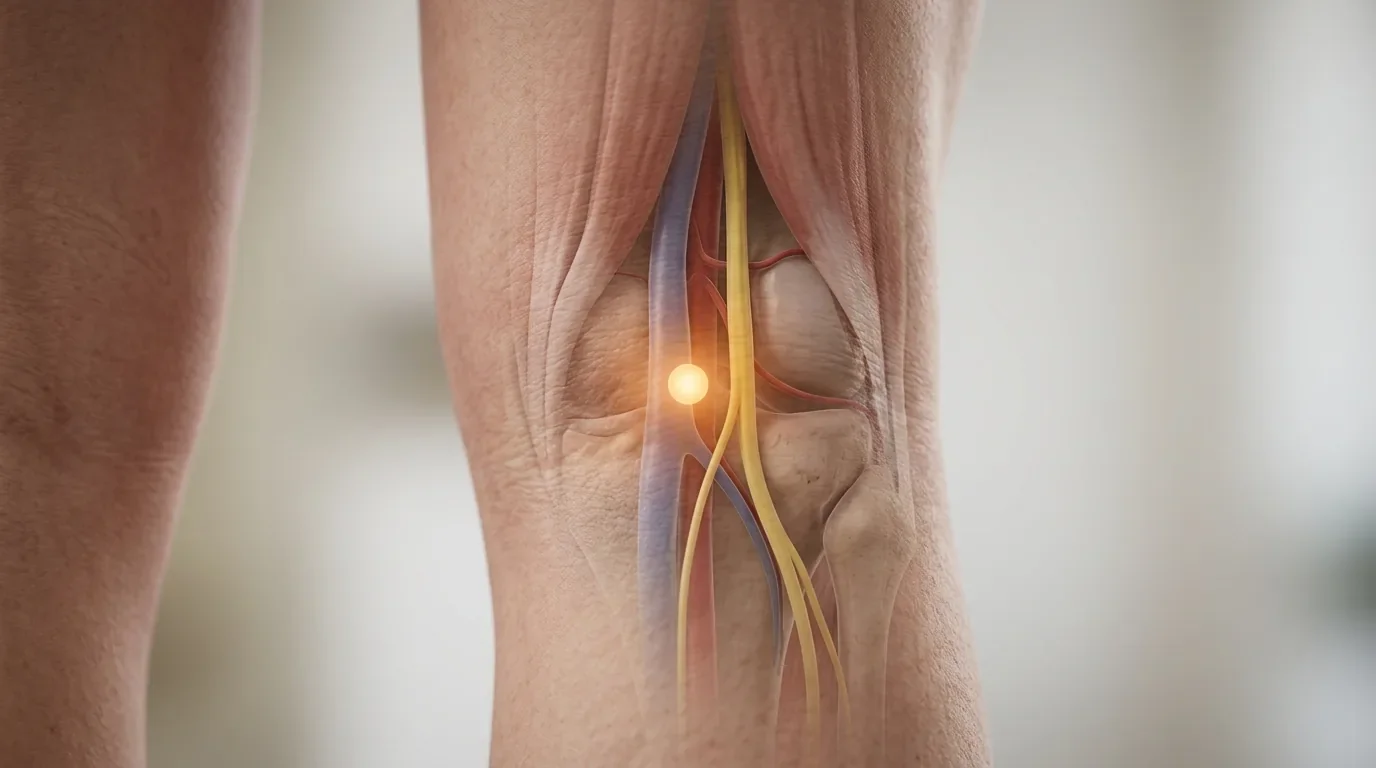
BL40, known as Weizhong or "Bend Middle," sits at the midpoint of the popliteal crease at the back of the knee, where the tibial nerve and popliteal vessels pass through the fossa. Classified as the He-Sea point of the bladder channel and historically designated the command point for the back, BL40 is one of the most consistently effective distal points in acupuncture for low back pain, sciatica, and hip conditions, with a neurophysiological mechanism rooted in both segmental spinal modulation and supraspinal descending inhibition.
- BL40 is located at the midpoint of the popliteal crease, between the tendons of biceps femoris laterally and semitendinosus medially, directly over the tibial nerve and the popliteal artery and vein, in the S1-S2 dermatomal territory.
- As the He-Sea point of the bladder channel, BL40 is the primary distal point for the entire posterior chain from occiput to heel, and the classical designation as "command point for the back" reflects its consistent clinical effectiveness for lumbar, sacral, and sciatic pain distributed throughout this territory.
- The tibial nerve at BL40 carries afferent signals in the S1-S2 spinal territory, which directly overlaps with the lumbar spine, sacroiliac joint, gluteal musculature, and sciatic nerve distribution, making BL40 a powerful segmental modulation point for conditions in the posterior lower body (Zhao, 2008).
- Controlled trials and meta-analyses of acupuncture for low back pain consistently demonstrate meaningful pain reduction compared to sham and usual care, with BL40 among the most frequently included points in effective treatment protocols (Vickers et al., 2018; Cherkin et al., 2009).
- Beyond segmental effects, needling BL40 activates supraspinal descending inhibitory pathways via the periaqueductal gray, reducing pain sensitivity throughout the spinal cord in a pattern consistent with conditioned pain modulation (Yarnitsky, 2010).
- De qi at BL40 is typically felt as a strong, spreading ache or electric sensation in the popliteal fossa, often with radiation proximally up the posterior thigh or distally down the posterior calf into the heel, tracing the course of the tibial nerve.
Is low back pain or sciatica limiting your movement?
BL40 is among the most important points in our treatment protocols for low back pain and sciatic pain at Morningside Acupuncture. Its position at the tibial nerve in the popliteal fossa gives it direct segmental access to the same spinal levels generating your symptoms, making it a consistently reliable component of posterior chain pain treatment plans.
Schedule NowAnatomy of BL40: The Popliteal Fossa as a Neural Crossroads
The popliteal fossa is the diamond-shaped depression behind the knee, bounded superolaterally by the biceps femoris tendon, superomedially by the tendons of semimembranosus and semitendinosus, and inferiorly by the two heads of the gastrocnemius. Within this fossa, the tibial nerve, common peroneal nerve, popliteal artery, and popliteal vein course through the adipose tissue, with the tibial nerve being the largest and most medially positioned of the neural structures.
BL40 is located at the exact center of the popliteal crease, where the tibial nerve lies just beneath the surface before it continues distally into the posterior calf. Needling at this point contacts the tibial nerve and its surrounding connective tissue sheath, activating a dense concentration of mechanoreceptors and nociceptors that generate afferent signals ascending to the S1 and S2 spinal cord segments. The popliteal artery is immediately adjacent, which is why practitioners palpate the popliteal pulse before needling to ensure proper needle placement away from the vessel.
The surrounding muscle tendons at the BL40 site are also clinically significant. Trigger points in the biceps femoris, semitendinosus, and the proximal gastrocnemius all refer pain patterns into the popliteal fossa and down the posterior calf, and these are frequently active in patients with chronic low back pain and sciatica. Dry needling of trigger points in these muscles at or near BL40 addresses both the peripheral muscle pathology and the central sensitization component through the same tibial nerve afferent pathway (Simons et al., 1999).
Related Best Acupuncture Points for Back Pain: BL40, BL23, GB30, and the Full ProtocolBL40 at a Glance: Classification, Location, and Clinical Use
| Category | Detail |
|---|---|
| Traditional Name | Weizhong — "Bend Middle" |
| Channel Classification | He-Sea point of the Bladder channel; Earth point of a Water channel; one of the Four Command Points ("command point for the back") |
| Precise Location | At the midpoint of the transverse crease of the popliteal fossa, between the tendons of biceps femoris (lateral) and semitendinosus (medial); the popliteal artery pulse is palpable here and used as a landmark to confirm correct position |
| Tissue Stimulated | Tibial nerve (directly); popliteal adipose tissue; posterior joint capsule with deep needling; perivascular neural plexus adjacent to popliteal artery; proximal gastrocnemius and distal biceps femoris / semitendinosus in their convergent tendinous region |
| Needle Depth / Direction | 0.5–1.0 cun perpendicular; palpate popliteal pulse first and direct needle medially away from artery; strong de qi is typical and expected at this depth given tibial nerve proximity |
| De Qi Sensation | Strong spreading ache, pressure, or electric sensation in the popliteal fossa; frequent distal radiation down the posterior calf toward the heel; occasional proximal radiation up the posterior thigh; sensation traces the tibial nerve distribution |
| Primary Clinical Uses | Low back pain; sciatica; sacroiliac joint pain; hip pain; posterior thigh and hamstring conditions; posterior knee pain; calf cramping and tightness; plantar fasciitis; heel pain |
| Commonly Combined With | BL23 and BL25 for lumbar pain (local segmental); GB30 for hip and sciatic pain; BL57 for calf and gastrocnemius; BL60 for lateral ankle and heel; GV4 for lumbar stiffness; SI3 for upper posterior chain extension |
Why BL40 Works for Back Pain: The Segmental Neurophysiology
The tibial nerve at BL40 carries afferent signals in the S1 and S2 spinal cord territory. This same territory receives sensory input from the sacrum, the sacroiliac joint, the gluteus maximus and gluteus medius, the piriformis, the posterior hip capsule, the hamstrings, the gastrocnemius, the plantar fascia, and the Achilles tendon. When BL40 is needled and generates robust afferent activity at S1-S2, it creates competitive inhibition at the dorsal horn neurons processing pain from all of these structures simultaneously.
This mechanism is sometimes described as segmental pain modulation: the needle-generated sensory traffic "occupies" the dorsal horn pain processing gates at S1-S2, reducing the volume of pain signals that can pass through to the brain from the lumbar spine, sacroiliac joint, and sciatic nerve. For patients with acute low back pain or a sciatica flare, this mechanism may explain the relatively rapid pain reduction that can occur within a single treatment session when BL40 is needled effectively.
The S1-S2 spinal levels also correspond to the L5-S1 disc level, the most commonly involved segment in disc herniation causing sciatica. BL40's afferent input at this spinal level provides direct modulation at the exact neurological address where sciatic nerve root irritation is processed, which is more than coincidental and contributes to its position as the primary distal point for sciatica in virtually every acupuncture system (Zhao, 2008).
Related Best Acupuncture Points for Sciatica: Following the Sciatic Nerve From Lumbar to FootHas sciatica or low back pain been unresponsive to other treatments?
BL40 works through direct tibial nerve stimulation at the same spinal segments generating your sciatic pain, not through general relaxation or placebo. At Morningside, our practitioners combine BL40 with local lumbar points and other distal points along the bladder channel to address both the central sensitization and the peripheral tissue pathology driving your symptoms.
Schedule NowSupraspinal Effects: Beyond the Local Spinal Segment
BL40's effects on back pain extend beyond the S1-S2 spinal territory through supraspinal mechanisms that the segmental model alone cannot explain. Needling at the popliteal fossa generates afferent signals that ascend not only to the dorsal horn at S1-S2 but through the spinothalamic and spinoreticular tracts to the brainstem, hypothalamus, and periaqueductal gray. Activation of the periaqueductal gray triggers the descending inhibitory pathway, releasing serotonin and norepinephrine from the raphe nuclei and locus coeruleus into the dorsal horn throughout the entire spinal cord.
This supraspinal activation explains why BL40 can reduce back pain even when the specific disc level or facet joint involved is at L2-L3 or higher, segments that are not part of the S1-S2 territory but are still relieved by BL40 needling. It also explains findings from controlled trials showing that acupuncture at traditional points, including BL40, produces significantly greater pain reduction than sham acupuncture at non-acupuncture points, even when the sham also involves skin penetration at nearby locations. The supraspinal activation is stronger and more sustained from a properly needled major nerve trunk than from penetration at arbitrary sites (Vickers et al., 2018).
Additionally, the conditioned pain modulation effect documented by Yarnitsky and colleagues involves the same periaqueductal-gray-mediated descending system: a conditioning stimulus at one body site reduces pain sensitivity at a distant, tested site. BL40 needling functions as a conditioning stimulus for the lumbar spine and sacral regions, reducing their overall pain sensitivity rather than merely blocking individual pain signals (Yarnitsky, 2010).
BL40 in the Context of the Bladder Channel Pathway
The bladder channel runs from the inner corner of the eye, over the top of the skull, down the entire posterior spine in two parallel lines on either side of the midline, through the gluteal region and hip, down the posterior thigh, through the popliteal fossa at BL40, down the posterior calf, around the lateral ankle at BL60, and to the fifth toe. This pathway traces the posterior fascial line of the body and parallels the sciatic nerve for most of its course in the leg.
The clinical observation that the bladder channel runs from the posterior neck to the heel, encompassing virtually the entire posterior chain that generates low back pain and sciatica, is the classical rationale for using bladder channel points for back conditions. In neurophysiological terms, the bladder channel points from BL23 in the lumbar region down through BL40 in the popliteal fossa and BL60 at the lateral ankle all share spinal cord territory at L4 through S2, the exact levels that generate low back pain, posterior hip pain, and sciatic nerve pain. Needling multiple bladder channel points in sequence creates overlapping dorsal horn inhibition and supraspinal activation throughout this territory.
BL40 sits precisely at the midpoint of the lower extremity portion of this chain, making it the point that activates both the proximal lumbar-to-popliteal segment and the distal popliteal-to-ankle segment of the posterior chain simultaneously. This central location within the chain, combined with its position directly over the tibial nerve rather than in a muscular belly, makes it the most potent single point in the bladder channel for generating reliable, strong afferent input.
Related Best Acupuncture Points for Sciatica: The Bladder Channel Pathway and the Sciatic NerveBL40 for Hip Pain, Posterior Knee Pain, and Plantar Fasciitis
While BL40's most prominent use is for low back pain and sciatica, its S1-S2 segmental coverage gives it relevance for several other conditions distributed throughout the posterior lower extremity.
Hip Pain
The gluteus maximus, the largest muscle in the body and the primary load-bearing structure of the posterior hip, is innervated by the inferior gluteal nerve at L5-S1-S2. The same spinal territory covered by BL40. Hip pain originating from gluteus maximus trigger points, posterior hip capsule irritation, or sacroiliac joint dysfunction all generate pain signals at the S1-S2 dorsal horn, where BL40's afferent input arrives. For posterior hip pain specifically, BL40 is typically combined with GB30, which needles the piriformis and sciatic nerve exit point, and BL54, which addresses the sciatic nerve at the sacral level.
Posterior Knee Pain
When pain is located in the popliteal fossa itself, BL40 serves as both a local and neurophysiological point. Local needling directly addresses trigger points in the gastrocnemius heads and the distal hamstring tendons, which are common sources of posterior knee pain. The gastrocnemius trigger point at the medial head refers pain to the posterior knee and proximal calf, a pattern easily confused with deep vein thrombosis or bursitis, and direct needling at BL40 effectively inactivates these trigger points (Simons et al., 1999).
Plantar Fasciitis and Heel Pain
The plantar fascia and heel are innervated by the medial calcaneal branch of the tibial nerve, which originates directly from the tibial nerve trunk that BL40 needles in the popliteal fossa. Needling BL40 for plantar fasciitis addresses the central component of heel pain through tibial nerve stimulation at the proximal portion of the nerve, complementing local points at the sole of the foot and the medial ankle that address the peripheral tissue. Several clinical protocols for plantar fasciitis include BL40 alongside BL57 and BL60 as the primary distal points along the tibial nerve pathway.
Ready to try one of acupuncture's most powerful points for back, hip, or leg pain?
At Morningside Acupuncture, the highest-rated acupuncture and dry needling clinic in New York City with over 500 five-star Google reviews, our practitioners use BL40 as a cornerstone of treatment plans for low back pain, sciatica, hip pain, and posterior chain conditions. Book a new patient visit to learn which combination of points is right for your presentation.
Schedule NowFrequently Asked Questions About BL40 Acupuncture Point
Where exactly is BL40 and what does it feel like to needle it?
BL40 is at the center of the crease behind your knee, in the popliteal fossa, between the hamstring tendons that you can feel on either side. The tibial nerve runs through the center of this space, so needling here typically produces a strong sensation, often described as a deep, spreading ache, electric feeling, or pressure that radiates either up the back of the thigh or down the calf toward the heel. This propagated sensation along the nerve pathway is the de qi response and is considered a sign that the needle has achieved adequate nerve stimulation. The sensation should be intense but not sharp or unbearable.
Why would a practitioner needle behind my knee for low back pain?
The tibial nerve at BL40 carries sensory signals to the same spinal cord segments, S1 and S2, that receive pain signals from the lumbar spine, sacroiliac joint, and sciatic nerve. Stimulating the tibial nerve at the knee creates competitive inhibition at those spinal cord segments, reducing the pain signal traffic from your back to your brain. It is the same principle as rubbing a sore elbow to reduce the pain, but applied at a more distant and neurologically powerful location using a needle. For sciatica specifically, the S1-S2 overlap is even more direct since sciatica typically involves L5-S1 nerve root compression at exactly these spinal levels.
Is BL40 safe to needle given the blood vessels there?
BL40 is safe in the hands of a trained acupuncturist or dry needling practitioner who palpates the popliteal pulse before inserting the needle. The popliteal artery is identified by touch and the needle is directed slightly medially to avoid it. Bruising in the popliteal fossa is possible given the vascular density of the region and is the most common minor adverse event, but serious vascular injury from properly performed BL40 needling is exceedingly rare in the published literature. Patients on anticoagulant medications should inform their practitioner before treatment so appropriate precautions can be taken.
How is BL40 different from BL57 or BL60 for back and sciatic pain?
All three are bladder channel points in the lower extremity and all contribute to back and sciatic pain treatment, but at different locations and with slightly different neural targets. BL40 at the popliteal fossa stimulates the tibial nerve trunk directly, producing the strongest and most consistent afferent signal. BL57 is in the posterior calf at the gastrocnemius muscle belly, where it addresses trigger points in the calf and provides tibial nerve stimulation at a more distal level. BL60 is at the lateral ankle between the lateral malleolus and Achilles tendon, providing sural nerve stimulation at the most distal point on the posterior chain. Most protocols for sciatica use all three in combination to create overlapping neural stimulation throughout the entire tibial nerve course.
Can BL40 be used for conditions other than back and sciatic pain?
Yes. BL40's S1-S2 segmental coverage makes it relevant for any condition whose pain signals pass through those spinal levels, including posterior hip pain, sacroiliac joint dysfunction, posterior knee pain, calf cramping, plantar fasciitis, and heel pain. It is also used in traditional protocols for summer heat conditions and skin conditions, which reflects the classical understanding of the bladder channel's relationship to body fluid regulation, though the neurophysiological mechanisms for those applications are less clearly established than for musculoskeletal pain.
How many sessions are typically needed before BL40 makes a difference for back pain?
Many patients with acute low back pain report noticeable relief within the first one to three sessions. Chronic low back pain that has been present for months or years typically requires more sessions, often six to ten, before consistent improvement is sustained between appointments. The evidence base for acupuncture in low back pain includes studies showing meaningful and durable improvements at 12 weeks and one year follow-up compared to usual care, suggesting that the benefits from a course of treatment can outlast the treatment period itself (Vickers et al., 2018).
References
- Zhao, Z. Q. (2008). Neural mechanism underlying acupuncture analgesia. Progress in Neurobiology, 85(4), 355–375. https://doi.org/10.1016/j.pneurobio.2008.05.004
- Vickers, A. J., Vertosick, E. A., Lewith, G., MacPherson, H., Foster, N. E., Sherman, K. J., Irnich, D., Witt, C. M., & Linde, K. (2018). Acupuncture for chronic pain: Update of an individual patient data meta-analysis. The Journal of Pain, 19(5), 455–474. https://doi.org/10.1016/j.jpain.2017.11.005
- Cherkin, D. C., Sherman, K. J., Avins, A. L., Erro, J. H., Ichikawa, L., Barlow, W. E., Delaney, K., Hawkes, R., Hamilton, L., Pressman, A., Khalsa, P. S., & Deyo, R. A. (2009). A randomized trial comparing acupuncture, simulated acupuncture, and usual care for chronic low back pain. Archives of Internal Medicine, 169(9), 858–866. https://doi.org/10.1001/archinternmed.2009.214
- Yarnitsky, D. (2010). Conditioned pain modulation (the diffuse noxious inhibitory control-like effect): Its relevance for acute and chronic pain states. Current Opinion in Anaesthesiology, 23(5), 611–615. https://doi.org/10.1097/ACO.0b013e32833c348b
- Simons, D. G., Travell, J. G., & Simons, L. S. (1999). Travell and Simons' Myofascial Pain and Dysfunction: The Trigger Point Manual (2nd ed.). Lippincott Williams & Wilkins.
Disclaimer: This web site is intended for educational and informational purposes only. Reading this website does not constitute providing medical advice or any professional services. This information should not be used for diagnosing or treating any health issue or disease. Those seeking medical advice should consult with a licensed physician. Seek the advice of a medical doctor or other qualified health professional for any medical condition. If you think you have a medical emergency, call 911 or go to the emergency room. No acupuncturist-patient relationship is created by reading this website or using the information. Morningside Acupuncture PLLC and its employees and contributors do not make any express or implied representations with respect to the information on this site or its use. For any legal interpretation of scope of practice in your state, consult a licensed attorney or regulatory authority.
Read more from our blog