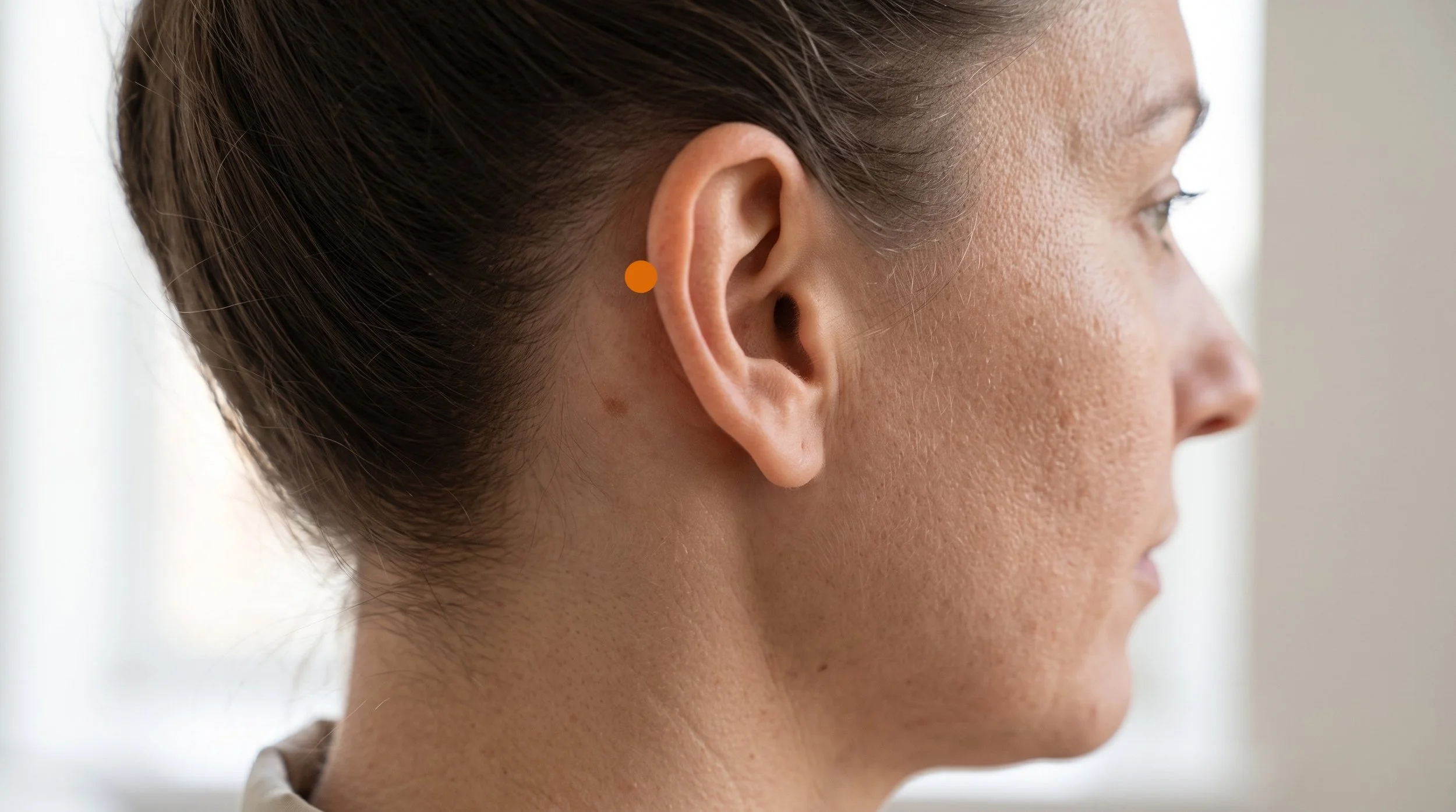
SJ19 Acupuncture Point (Luxi)
Skull's Rest Behind the Upper Ear: Anatomy, Mechanism, and Why This Triple Burner Point Belongs in Headache, Tinnitus, and Ear Pain Treatment
SJ19 (Luxi, "Skull's Rest"), also written TE19, sits on the arc of Triple Burner points that curve up behind the ear, two thirds of the way along the line from SJ17 at the bottom of the earlobe to SJ20 above the ear apex, following the rim of the helix.
In plain terms, it is a shallow dip on the skull just behind and above the ear, close enough to the bone that the needle stays under the skin rather than going down. Classical sources group it with the retroauricular points that were traditionally used to benefit the ears and clear heat, and one famous ode singles it out for tetany, which is why the te19 acupuncture point still shows up in treatment plans for one-sided headache, a heavy head, tinnitus, and ear pain even though it is used far less often than its neighbors.
- Location and layers: SJ19 lies posterior to the ear in a small depression two thirds of the way along the curve from SJ17 to SJ20, where skin and thin subcutaneous tissue sit almost directly on the temporal bone, so needling is subcutaneous and angled along the channel rather than perpendicular (Deadman et al., 2007).
- Traditional categories, translated: the classical actions attributed to Luxi are benefiting the ears and clearing heat, plus calming fright and relieving tetany (Deadman et al., 2007). Read neurophysiologically, that describes local stimulation of an ear-region sensory field plus modulation of an arousal-heavy, startle-prone state.
- Nerve story: Chinese Acupuncture and Moxibustion places SJ19 in the territory of the lesser occipital nerve and the anastomotic branch of the great auricular nerve, both upper cervical (C2 and C3) in origin. Those cervical afferents converge with trigeminal input on shared second-order neurons in the trigeminocervical complex, which is the accepted anatomical basis for pain that spreads between the back of the head, the temple, and the ear (Bartsch & Goadsby, 2002).
- Mechanism beyond the segment: needling recruits A-delta and C fiber input that engages descending inhibitory pathways using serotonin, noradrenaline, and endogenous opioids, which is the most consistent explanation for analgesia that outlasts the session (Zhao, 2008).
- Research picture: no trial isolates SJ19, but Cochrane reviews of acupuncture for episodic migraine and tension-type headache report modest benefit over sham and usual care in multi-point protocols (Linde et al., 2016a; Linde et al., 2016b), while tinnitus reviews are mixed and low certainty (Huang et al., 2021).
- De qi and safety: expect a spreading, dull, slightly heavy sensation under the skin behind the ear, sometimes traveling toward the ear apex, and note that several classical texts consider this point contraindicated to bleeding because the posterior auricular vessels run right beneath it (Deadman et al., 2007).
Is Your Headache Wrapping Around One Side of Your Head and Behind the Ear?
One-sided head pain that settles behind or above the ear rarely comes from one structure. At Morningside Acupuncture we map where the pain sits, check the upper cervical and jaw muscles that feed it, and use retroauricular points such as SJ19 alongside GB20, SJ5, and Taiyang as part of a full treatment. If your headaches keep returning in the same place, schedule a visit and let's look at the whole pattern.
Schedule NowAnatomy of SJ19: Why the Curve Behind the Upper Ear Is Such an Important Location
SJ19 sits in a small depression on the skull behind the upper ear, two thirds of the way along the curved line from SJ17 (Yifeng) at the base of the ear to SJ20 (Jiaosun) above the ear apex, tracking the rim of the helix. The tissue stack here is shallow: mobile skin, a thin layer of loose subcutaneous fat and fascia, slips of the posterior auricular and superior auricular muscles, then periosteum over the mastoid and temporal bone.
Because there is so little soft tissue, this region loads in ways patients rarely connect to their symptoms: side sleeping with pressure on the ear, over-ear headphones and glasses arms, tight hats and helmets, long phone calls held against the ear, and chronic jaw clenching that keeps the temporalis and auricular muscles in low-grade contraction.
The nerve geography is what makes this a useful point rather than just a landmark. Chinese Acupuncture and Moxibustion describes SJ19 as lying in the field of the lesser occipital nerve and the anastomotic branch of the great auricular nerve, both derived from the upper cervical roots (C2 and C3).
Cervical afferents of this kind converge with trigeminal afferents onto the same second-order neurons in the trigeminocervical complex, and experimental stimulation of one input can change the excitability of the other, which is why pain and hypersensitivity spread so readily between the neck, temple, and ear in headache patients (Bartsch & Goadsby, 2002).
Needling within that receptive field creates competing afferent traffic at the same segmental level and recruits descending inhibitory control from the brainstem, a serotonergic, noradrenergic, and opioid-mediated process that helps explain relief lasting beyond the treatment (Zhao, 2008).
Deep to the point run the posterior auricular artery and vein. This matters practically: classical texts describe pricking to bleed at many head points, yet several of them specifically prohibit bleeding here, and modern point texts repeat the caution because bleeding in this location can be difficult to control. Standard technique is subcutaneous or oblique insertion of 0.3 to 0.5 cun directed along the course of the channel, either toward SJ20 or back toward SJ17, keeping the shaft in the loose tissue plane and off the periosteum (Deadman et al., 2007). Hair is parted and the skin is prepped carefully, since visibility behind the ear is limited.
Related Muscles That Cause Neck Pain Related Pain Finder Head NeckSJ19 (TE19) at a Glance: Classification, Location, and Clinical Use
| Category | Detail |
|---|---|
| Traditional Name | Luxi (Skull's Rest), Triple Burner 19, also written TE19 or TB-19 |
| Channel Classification | Nineteenth point of the Triple Burner (Sanjiao, hand shaoyang) channel, on the retroauricular arc between SJ18 and SJ20 (SJ19, also written TE19 or TB19; also called the Triple Energizer, the Triple Heater or Triple Warmer) |
| Point Categories | No five-shu, luo-connecting, xi-cleft, or hui-meeting designation and no extraordinary vessel intersection is recorded for this point in the classical literature. It is a local channel point of the behind-the-ear group (SJ17, SJ18, SJ19, SJ20), singled out in the Ode to the One Hundred Symptoms as indispensable for tetany. |
| Precise Location | Posterior to the ear, in a small depression two thirds of the distance along a curved line drawn from SJ17 (Yifeng) to SJ20 (Jiaosun), following the line of the rim of the ear |
| Tissue Stimulated | Skin and loose subcutaneous fascia over the mastoid and temporal bone, slips of the posterior and superior auricular muscles, within the sensory field of the lesser occipital and great auricular nerves; clinically related myofascial territory includes temporalis, occipitalis, and sternocleidomastoid (see the Pain Finder Head Neck) |
| Needle Depth / Direction | Subcutaneous or oblique insertion 0.3 to 0.5 cun along the course of the channel, toward SJ20 or SJ17; do not needle deep or perpendicular into periosteum, and several classical texts consider this point contraindicated to bleeding |
| De Qi Sensation | A spreading, dull, mildly heavy or distending feeling under the skin behind the ear, sometimes traveling toward the ear apex or into the ear itself; sharp or stinging sensation means the needle should be adjusted |
| Primary Clinical Uses | One-sided headache and a sensation of heaviness in the head, tinnitus, hearing changes and ear pain, restlessness with body heat, headache and poor sleep in classical listings, and childhood convulsive and fright disorders in classical listings |
| Common Point Combinations |
|
Deadman's Manual of Acupuncture is candid that Luxi is rarely used in modern practice, yet it preserves an unusually strong classical claim: the Ode to the One Hundred Symptoms held that tetany could not be treated successfully without this point. Tetany in the classical sense meant rigidity of the neck and back, clenched jaw, twitching limbs, and arching of the spine, a picture that overlaps with what we would now describe as convulsive and severe spasmodic states.
Alongside that, the traditional actions attributed to SJ19 are benefiting the ears and clearing heat, and the indication lists cluster into four groups: ear complaints (ringing, hearing loss, pain, discharge), head complaints (one-sided headache, heaviness of the head, dizziness, facial and forehead heat signs), agitation states (childhood convulsions, fright, body heat with headache and inability to sleep), and a scattering of chest, rib-side, and digestive entries.
What is striking is the contrast between how seldom the point is chosen today and how emphatically the classical record insists on it, a reminder that traditional attributions and modern usage patterns do not always line up.
Why SJ19 Is Used for One-Sided Headache and Startle-Prone Tension, Not Only for the Ear
The most useful way to understand SJ19 is by its address. It sits in skin supplied by the lesser occipital and great auricular nerves, both of which carry upper cervical (C2 and C3) input. Those cervical afferents share second-order neurons in the brainstem and upper cord with trigeminal afferents from the dura, temple, and jaw.
Experimental work has shown that stimulating one of these inputs changes the excitability of the other, which is why patients with migraine and tension-type headache so often report pain that runs from the neck to the temple, into the ear, or around the eye without respecting any single nerve's map (Bartsch & Goadsby, 2002). Needling a point inside that shared receptive field is a way of speaking to the same relay station that is generating the referral.
On top of that segmental story, needle stimulation activates descending inhibitory systems from the periaqueductal gray and rostral ventromedial medulla, releasing serotonin, noradrenaline, and endogenous opioids at the dorsal horn, which is the best-supported account of why acupuncture analgesia can outlast the treatment itself (Zhao, 2008). Individual patient data from nearly 21,000 people in chronic pain trials found effects that were modest but consistent and durable over a year, with headache among the conditions studied (Vickers et al., 2018).
The classical framing of SJ19 for fright, restlessness, and heat with sleeplessness maps loosely onto the autonomic side of this picture. Needling in the retroauricular and upper cervical region can shift the balance toward parasympathetic activity, and many patients describe a settled, drowsy feeling within a few minutes. We do not claim the point calms the nervous system by moving qi; we describe it as sensory input from a highly connected cranial region that changes both pain processing and arousal, and we judge the response session by session.
What the Research Shows for SJ19 (TE19)
One note on naming before the evidence: in the research literature this point appears as TE19, the WHO standard code, and also as SJ19 or TB19 depending on the authors, so it is worth searching all three if you want to read the studies below in full.
There is no clinical trial that isolates SJ19, and it would be misleading to suggest otherwise. What exists are reviews of multi-point acupuncture protocols for headache and tinnitus, in which retroauricular and shaoyang points like this one may appear as part of a prescription selected for the individual. The reasonable way to read the table below is that acupuncture as a whole treatment shows modest, reproducible benefit for migraine and tension-type headache, weaker and less certain results for tinnitus, and that SJ19's contribution within those protocols has never been separately measured. Studies suggest benefit for the approach, not proof for the point.
| Study | Type | Focus | Key Finding |
|---|---|---|---|
| Linde et al., 2016a | Cochrane systematic review | Acupuncture for the prevention of episodic migraine (22 trials, 4,985 participants) | Moderate certainty evidence suggested acupuncture reduced migraine frequency somewhat more than sham, usual care, or prophylactic drugs, though the advantage over drugs was not maintained at follow-up. |
| Linde et al., 2016b | Cochrane systematic review | Acupuncture for the prevention of tension-type headache (12 trials, around 2,349 participants) | Acupuncture added to usual care may reduce headache frequency, with small additional benefit over sham and evidence rated moderate at best. |
| Vickers et al., 2018 | Individual patient data meta-analysis | Chronic pain including headache and migraine, nearly 21,000 patients | Effects were superior to both sham and no-acupuncture controls and persisted over 12 months, with the authors describing the differences as modest. |
| Huang et al., 2021 | Systematic review and meta-analysis | Acupuncture for tinnitus, 8 randomized trials, 504 participants | No significant effect appeared on the primary visual analogue outcome, though tinnitus handicap and severity scores favored acupuncture, and the authors judged the evidence insufficient for firm conclusions. |
| Liu et al., 2016 | Systematic review and meta-analysis | Acupuncture in the treatment of tinnitus | Pooled results were inconsistent and limited by trial quality, so the review stopped short of endorsing acupuncture as an established tinnitus treatment. |
| Bartsch & Goadsby, 2002 | Experimental electrophysiology (animal) | Convergence of greater occipital nerve and dural afferents in the trigeminocervical complex | A substantial population of second-order neurons received convergent cervical and dural input, supporting a functional continuum that explains pain referral between neck, ear, and temple. |
Tinnitus, Ear Fullness, or Pain Around the Ear With No Clear Cause?
When an ENT workup is clear but the ear still rings, aches, or feels full, the surrounding muscles and cervical nerves are worth examining. Luxi acupuncture is used locally with SJ17 and SJ18, combined with careful work on the jaw and upper neck, and we set realistic expectations because the tinnitus evidence is genuinely mixed. Book an evaluation and we'll tell you honestly whether this is a reasonable trial for you.
Schedule NowSJ19 in the Context of Trigger Point Work
Acupuncture, by our definition, is the use of an acupuncture needle, and that includes dry needling. So when a patient presents with one-sided head pain that sits behind or above the ear, we are not choosing between traditions.
SJ19 may be threaded subcutaneously along the retroauricular curve while, in the same session, we address the muscles that refer into exactly that territory: temporalis, which projects pain across the temple and into the teeth; occipitalis and the upper fibers of the posterior cervical group, which send pain forward over the scalp; sternocleidomastoid, whose clavicular division is well described as referring into and around the ear and as being associated with ear symptoms; and masseter, whose deep fibers can refer to the ear region and jaw (Simons et al., 1999).
The overlap is anatomical, not coincidental. SJ19 sits in a C2 and C3 cutaneous field, and the muscles listed above are innervated or referred through neighboring segments, so both needling targets feed the same convergent pool of dorsal horn neurons. Practically, we tend to treat the myofascial targets with standard dry needling technique and keep SJ19 shallow and tangential because of the bone and the posterior auricular vessels beneath it. Patients often notice a change in ear fullness or temple pressure before they notice a change in headache frequency, and we track both.
SJ19 Headache and Ear Pain Treatment at NYC's Highest-Rated Acupuncture Clinic
Morningside Acupuncture is the highest-rated acupuncture and dry needling clinic in New York City with over 500 five-star Google reviews, and our approach blends classical point selection with modern pain science. For head, ear, and jaw complaints we combine points like SJ19 with targeted dry needling of temporalis, occipitalis, and sternocleidomastoid. Schedule your appointment on the Upper West Side and start with a clear plan rather than a guess.
Schedule NowFrequently Asked Questions
Is SJ19 the same point as TE19 or TB19?
Yes. SJ19, TE19, and TB19 are all codes for the same point, Luxi. SJ stands for San Jiao, the Chinese name of the channel. TE (Triple Energizer) is the WHO standard abbreviation and the one you will see in most Western textbooks and research papers. TB (Triple Burner) and TW (Triple Warmer) are older English renderings of the same name that still appear in many books. You will also come across it written as San Jiao 19 or Triple Energizer 19. Whichever code is used, the location and the uses are the same.
What does SJ19 feel like when needled?
Because the needle is threaded just under the skin rather than driven down, the sensation is usually mild: a spreading, slightly heavy or full feeling behind the ear, sometimes with a faint traveling sensation toward the top of the ear or into the ear canal. Some patients feel almost nothing at insertion and then notice a dull warmth build over a minute or two. Sharp, burning, or electric sensations are not the goal and mean the angle or depth should be adjusted.
Why needle behind the ear for a headache that hurts at the temple or forehead?
The skin behind the upper ear is supplied by the lesser occipital and great auricular nerves, which carry upper cervical input. Those fibers converge with trigeminal fibers from the dura, temple, and jaw onto shared second-order neurons in the trigeminocervical complex, and stimulating one input measurably alters the responsiveness of the other (Bartsch & Goadsby, 2002). That convergence is also why headache pain refuses to stay inside neat nerve boundaries, so treating a point behind the ear is treating the same relay that is producing the temple pain.
Can I press SJ19 myself between sessions?
Yes, and it is one of the easier self-care points to find. Trace the curve behind your ear from the notch behind the earlobe up toward the point directly above the ear apex, then stop about two thirds of the way up and feel for a small soft dip against the bone. Use a fingertip or thumb pad with steady, moderate pressure, hold for 30 to 60 seconds, release, and repeat two or three times per side, once or twice a day. Small circular pressure works too. Keep it comfortable rather than intense, since the tissue here is thin and sits directly on bone, and stop if you feel dizzy, if the area is bruised or inflamed, or if there is any ear infection, drainage, recent ear surgery, or broken skin.
Is SJ19 safe to needle?
In trained hands it is safe when the standard conventions are respected: subcutaneous or oblique insertion of 0.3 to 0.5 cun along the channel, no deep perpendicular needling into the periosteum, and no bleeding technique. Several classical texts specifically list this point as contraindicated to bleeding, and modern point texts add the anatomical reason, which is that the posterior auricular artery and vein lie beneath and bleeding here can be hard to control (Deadman et al., 2007). Clean technique matters because the area behind the ear is hairy and less visible, and firm pressure on withdrawal is routine. Tell your acupuncturist about blood thinners, recent ear surgery, or an active ear infection before this region is needled.
Where exactly is SJ19 located?
Posterior to the ear, in a small depression two thirds of the way along a curved line drawn from SJ17 (Yifeng, in the hollow behind the earlobe) to SJ20 (Jiaosun, directly above the ear apex at the hairline), following the rim of the ear. In practice, fold the ear forward, trace the crease where the ear meets the skull, and palpate along that arc for a slight give in the tissue in the upper third. SJ18 (Qimai) sits below it on the same curve, which is why sj 19 ear treatments are often given with its neighbors rather than alone.
References
- Deadman, P., Al-Khafaji, M., & Baker, K. (2009). A manual of acupuncture. Journal of Chinese Medicine Publications.
- Cheng, X. (Ed.). (1999). Chinese acupuncture and moxibustion (Rev. ed.). Foreign Languages Press.
- Cunningham, P. M. (2000). Acupuncture points: A practical guide to classical and modern usage. Odyssey Press.
- O'Connor, J., & Bensky, D. (Eds. & Trans.). (1981). Acupuncture: A comprehensive text. Shanghai College of Traditional Medicine. Eastland Press.
- Simons, D. G., Travell, J. G., & Simons, L. S. (1999). Travell & Simons' myofascial pain and dysfunction: The trigger point manual, Vol. 1: Upper half of body (2nd ed.). Williams & Wilkins.
- Linde, K., Allais, G., Brinkhaus, B., Fei, Y., Mehring, M., Vertosick, E. A., Vickers, A., & White, A. R. (2016a). Acupuncture for the prevention of episodic migraine. Cochrane Database of Systematic Reviews, 2016(6), CD001218. https://doi.org/10.1002/14651858.CD001218.pub3
- Linde, K., Allais, G., Brinkhaus, B., Fei, Y., Mehring, M., Shin, B. C., Vickers, A., & White, A. R. (2016b). Acupuncture for the prevention of tension-type headache. Cochrane Database of Systematic Reviews, 2016(4), CD007587. https://doi.org/10.1002/14651858.CD007587.pub2
- Vickers, A. J., Vertosick, E. A., Lewith, G., MacPherson, H., Foster, N. E., Sherman, K. J., Irnich, D., Witt, C. M., & Linde, K. (2018). Acupuncture for chronic pain: Update of an individual patient data meta-analysis. Journal of Pain, 19(5), 455-474. https://doi.org/10.1016/j.jpain.2017.11.005
- Huang, K., Liang, S., Chen, L., & Grellet, A. (2021). Acupuncture for tinnitus: A systematic review and meta-analysis of randomized controlled trials. Acupuncture in Medicine, 39(4), 264-271. https://doi.org/10.1177/0964528420938380
- Liu, F., Han, X., Li, Y., & Yu, S. (2016). Acupuncture in the treatment of tinnitus: A systematic review and meta-analysis. European Archives of Oto-Rhino-Laryngology, 273(2), 285-294. https://doi.org/10.1007/s00405-014-3341-7
- Bartsch, T., & Goadsby, P. J. (2002). Stimulation of the greater occipital nerve induces increased central excitability of dural afferent input. Brain, 125(7), 1496-1509. https://doi.org/10.1093/brain/awf166
- Zhao, Z. Q. (2008). Neural mechanism underlying acupuncture analgesia. Progress in Neurobiology, 85(4), 355-375. https://doi.org/10.1016/j.pneurobio.2008.05.004
Disclaimer: This web site is intended for educational and informational purposes only. Reading this website does not constitute providing medical advice or any professional services. This information should not be used for diagnosing or treating any health issue or disease. Those seeking medical advice should consult with a licensed physician. Seek the advice of a medical doctor or other qualified health professional for any medical condition. If you think you have a medical emergency, call 911 or go to the emergency room. No acupuncturist-patient relationship is created by reading this website or using the information. Morningside Acupuncture PLLC and its employees and contributors do not make any express or implied representations with respect to the information on this site or its use. For any legal interpretation of scope of practice in your state, consult a licensed attorney or regulatory authority.
Read more from our blog



