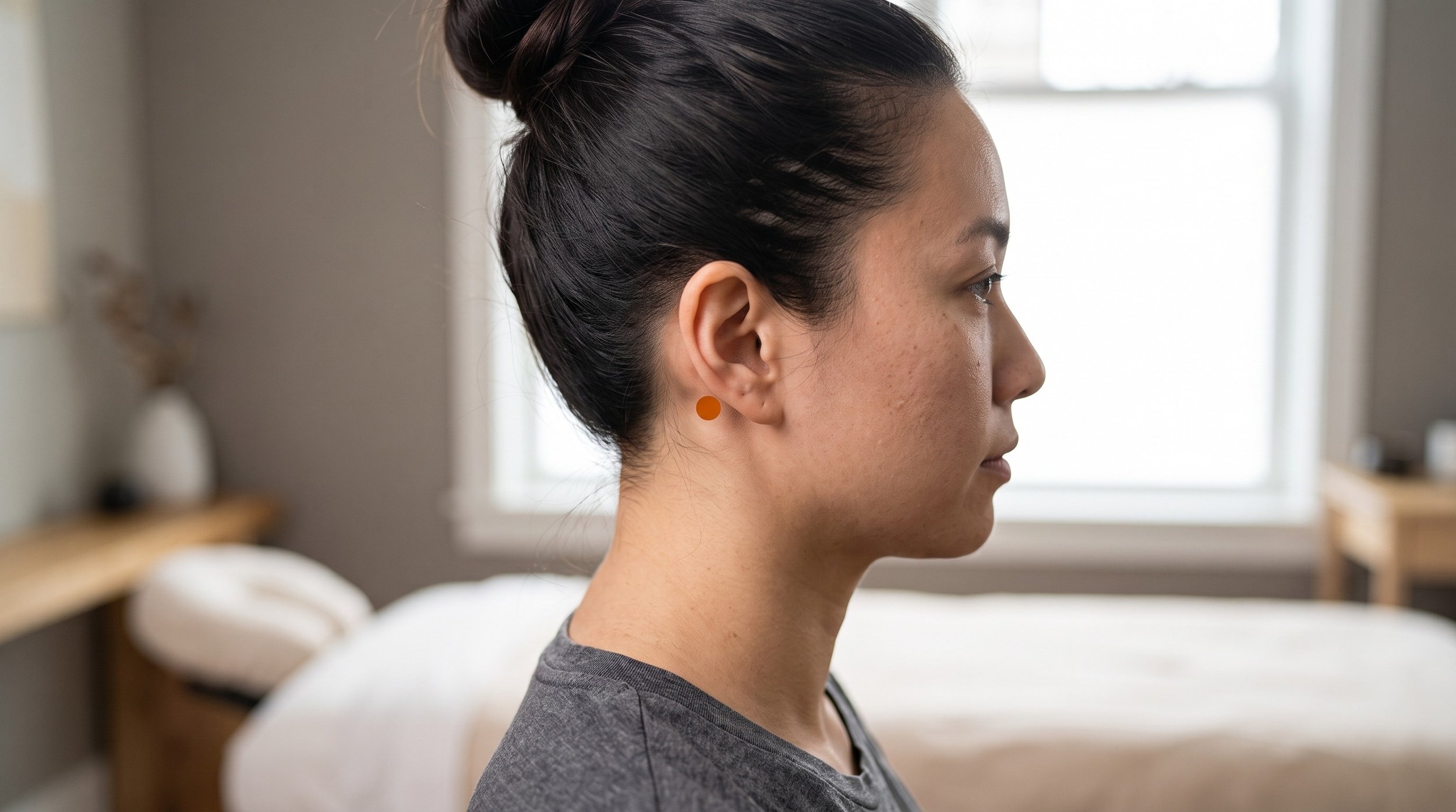
SJ18 Acupuncture Point (Qimai)
The Spasm Vessel Behind the Ear: Anatomy, Nerve Convergence, and Why This Small Mastoid Point Supports Ear Symptoms and Head Pain
SJ18 (Qimai), also written TE18, often translated as Spasm Vessel and sometimes rendered as Feeding the Vessels, is the eighteenth point of the Triple Burner (Sanjiao) channel. You will find it in a small hollow on the mastoid bone behind the ear, roughly one third of the way along the curve that runs from SJ17 at the earlobe up to SJ20 above the ear, following the rim of the auricle.
It is a compact, superficial point in a crowded neighborhood: the posterior auricular vessels run through the area, the great auricular and lesser occipital nerves supply the skin, and the mastoid serves as an attachment site for muscles that commonly drive head and neck pain.
Classically, triple burner 18 was grouped with the ear points and with the fright and convulsion points, and modern clinicians tend to reach for the sj 18 ear region when someone has tinnitus, blocked or aching ears, or headache that wraps from the neck around behind the ear.
- Location and layers: SJ18 sits on the mastoid process behind the auricle, about a third of the way along the curve from SJ17 to SJ20, where skin, thin subcutaneous tissue and posterior auricular muscle fibers lie directly over periosteum and bone (Cheng, 1987; Deadman et al., 2007).
- Traditional categories, translated: classical sources credit qimai with benefiting the ears and calming fright and wind, which maps in modern terms onto local sensory modulation around the ear plus a broad autonomic and arousal-calming response to needling (Deadman et al., 2007).
- Nerve story: the skin here is supplied mainly by the posterior auricular branch of the great auricular nerve with contributions from the lesser occipital nerve, both C2 and C3 in origin (Peuker & Filler, 2002), and these upper cervical afferents converge with trigeminal dural afferents in the trigeminocervical complex, a documented substrate for referred head pain (Bartsch & Goadsby, 2002).
- Mechanism: needle stimulation of small-diameter afferents in this segment may recruit segmental inhibition and descending pain control from the brainstem, along with local vascular and autonomic changes (Zhao, 2008).
- Research picture: reviews of acupuncture for migraine and tension-type headache report modest benefits with multi-point protocols (Linde et al., 2016a; Linde et al., 2016b), while tinnitus reviews are mixed and limited by trial quality (Liu et al., 2016; Huang et al., 2021), so SJ18 is best framed as one component of a plan rather than a standalone answer.
- De qi and practice framing: because insertion is subcutaneous and shallow, the sensation is usually a superficial pressure, warmth or spreading fullness around the ear rather than a deep muscular ache, and some classical texts describe pricking the small vessels here to bleed instead of retaining a needle (Deadman et al., 2007; Cheng, 1987).
Dealing With Ringing Ears, Ear Fullness or Pain Behind the Ear?
Ear symptoms rarely sit in isolation, and we treat them that way. At Morningside Acupuncture we combine gentle needling around SJ18 and the ear line with work on the jaw, upper neck and suboccipital muscles that so often feed into ear discomfort. Your acupuncturist will assess hearing history, jaw mechanics, sleep position and stress load before choosing a strategy. Schedule a visit and let us build a plan around what is actually driving your symptoms.
Schedule NowAnatomy of SJ18: Why the Curve Behind the Auricle Is Such an Important Location
SJ18 lies on a strip of thin, mobile skin stretched over the mastoid process. Beneath the skin is a shallow layer of subcutaneous fat, then fibers of the posterior auricular muscle and its fascia, then periosteum and bone. There is very little soft tissue to work with, which is exactly why the classical needling instruction is a shallow, threaded insertion along the curve of the channel rather than a perpendicular one (Deadman et al., 2007).
The mastoid itself is a busy attachment site: sternocleidomastoid and splenius capitis anchor here, and posture habits like long hours at a laptop, side sleeping, heavy over-ear headphones and clenching all load this corner of the skull.
The nerve geography is the interesting part. Cadaveric mapping shows that the great auricular nerve supplies the largest share of the auricle and the skin behind it, with the lesser occipital nerve contributing over the medial surface (Peuker & Filler, 2002). Both are branches of the cervical plexus carrying C2 and C3 fibers, and upper cervical afferents are known to converge with trigeminal input onto shared second-order neurons in the trigeminocervical complex (Bartsch & Goadsby, 2002).
That convergence is the plain-language reason a point behind the ear can influence how the head and face feel: the nervous system is already blending signals from these regions. Needling in this segment may engage that shared circuitry through segmental inhibition and descending modulation from the brainstem, along with local changes in blood flow and autonomic tone (Zhao, 2008).
The safety-relevant structures are vascular rather than visceral. The posterior auricular artery and vein run in the immediate field, and standard texts note them explicitly for this point (Cheng, 1987). Bruising is the most common minor effect, which is also why classical sources describe deliberately pricking a small vessel here to bleed as an alternative technique. Conventional needling is subcutaneous, 0.3 to 0.5 cun along the channel line, with some texts allowing a slightly deeper oblique angle; the mastoid bone limits depth, so a perpendicular deep insertion is neither useful nor appropriate.
Clean technique matters near the ear, and anyone taking anticoagulants, with recent ear surgery or with an active ear infection should mention it before needling.
Related Best Acupuncture Points For Headaches Related Pain Finder Head NeckSJ18 (TE18) at a Glance: Classification, Location, and Clinical Use
| Category | Detail |
|---|---|
| Traditional Name | Qimai (Spasm Vessel), also translated as Feeding the Vessels or Feeding the Channels |
| Channel Classification | Triple Burner (Sanjiao) channel, hand shaoyang, the eighteenth point of the channel, on the mastoid behind the ear (SJ18, also written TE18 or TB18; also called the Triple Energizer, the Triple Heater or Triple Warmer) |
| Point Categories | No five-shu, luo, xi-cleft, hui-meeting or extraordinary vessel designations are listed for this point in the standard references. It is classified as a local ear and head point of the Sanjiao channel, and is one of the points traditionally treated by pricking to bleed. |
| Precise Location | Behind the ear, in a small depression on the mastoid bone, one third of the way along the curved line running from SJ17 (Yifeng) to SJ20 (Jiaosun) and following the rim of the auricle. |
| Tissue Stimulated | Thin skin over the mastoid process, subcutaneous tissue and posterior auricular muscle fibers, fascia and periosteum. The posterior auricular vessels and cutaneous branches of the great auricular and lesser occipital nerves lie in the immediate field, and nearby myofascial targets treated in the same visit often include sternocleidomastoid, splenius capitis, occipitalis, upper trapezius and the suboccipital group. See our Pain Finder Head Neck tool for referral patterns in this region. |
| Needle Depth / Direction | Subcutaneous threading along the curve of the channel, 0.3 to 0.5 cun; some texts allow a slanted insertion slightly deeper. Alternatively the point may be pricked to bleed with a fine three-edged needle. Moxibustion is described as applicable in classical sources. Perpendicular deep needling is not used because bone lies immediately beneath. |
| De Qi Sensation | Usually a superficial spreading pressure, tightness or warmth around the back of the ear, sometimes with a brief sting on insertion or a sensation that travels toward the ear canal or jaw angle. It is a lighter, more surface-level feeling than the deep heavy ache typical of limb points. |
| Primary Clinical Uses | Tinnitus and reduced hearing, pain and tenderness behind the ear, headache and neck-related head pain, and the classical fright and convulsive presentations recorded in the older literature. |
| Common Point Combinations |
|
In A Manual of Acupuncture, Deadman and colleagues list two traditional actions for qimai: benefiting the ears, and calming fright while pacifying wind. The indication list that follows is unusually varied for such a small point. Alongside the expected ear complaints (ringing, reduced hearing, soreness behind the ear) the classical sources attribute to SJ18 a role in headache and head wind, in digestive upset with vomiting and diarrhea, in dimness of vision and eye discharge, and in the childhood convulsive and startle disorders that gave the point its name.
The pairing with GV1 from the Systematic Classic for a child with convulsions, vomiting, diarrhea and fear brings all of those threads together in a single formula. What is striking, read as traditional attribution rather than physiology, is the internal logic: a point named for spasm, sitting over visible surface vessels behind the ear, was used both to quiet a frightened, over-reactive nervous system and to settle the ear and gut symptoms that so often accompany that state.
Why SJ18 Is Used for Ringing Ears, Startle and Headaches That Wrap Behind the Ear
Start with the map. The skin behind the ear is supplied largely by the great auricular nerve with help from the lesser occipital nerve, both carrying fibers from the second and third cervical nerve roots (Peuker & Filler, 2002). Those same upper cervical segments feed neurons in the trigeminocervical complex that also receive input from the lining of the skull, which is one reason irritation in the upper neck can be felt as pain across the head and face (Bartsch & Goadsby, 2002).
Needling SJ18 puts a controlled, non-threatening input into that shared segment. For a patient whose headache seems to climb from the neck, curl behind the ear and settle behind the eye, that anatomical overlap explains why a point on the mastoid can matter as much as a point on the temple.
The second layer is central. Acupuncture stimulation of small-diameter afferents has been shown to activate descending inhibitory pathways involving the midbrain and brainstem, with release of endogenous opioids and monoamines that reduce the responsiveness of pain-transmitting neurons in the spinal cord and its trigeminal extension (Zhao, 2008). Practically, this means SJ18 is not only a local point.
Patients frequently report a general settling during the retention period, and pooled analyses of chronic pain trials suggest that acupuncture effects are modest but durable rather than fleeting (Vickers et al., 2018).
For ear symptoms specifically, keep expectations honest. Tinnitus has many possible drivers, from noise exposure and hearing loss to jaw dysfunction and cervical tension, and acupuncture research in this area is limited by small, variable trials (Liu et al., 2016; Huang et al., 2021). Where we see the most useful change is in the muscular and stress-related contributors: jaw clenching, neck guarding, poor sleep and the amplification that comes with hypervigilance. SJ18 earns its place in that plan as a local point in the right nerve territory, used with the neck and jaw rather than instead of them.
What the Research Shows for SJ18 (TE18)
One note on naming before the evidence: in the research literature this point appears as TE18, the WHO standard code, and also as SJ18 or TB18 depending on the authors, so it is worth searching all three if you want to read the studies below in full.
There is no clinical trial of SJ18 on its own, and it would be misleading to suggest otherwise. What the literature offers is evidence for multi-point acupuncture protocols in the conditions where this point is traditionally used, mainly headache and tinnitus, plus anatomical and physiological work that explains why a point in this nerve territory could contribute. Read the table below as context for how SJ18 is used within a larger prescription, not as evidence about the single point.
| Study | Type | Focus | Key Finding |
|---|---|---|---|
| Linde et al., 2016a | Cochrane systematic review | Acupuncture for the prevention of episodic migraine | Adding acupuncture to usual care reduced migraine frequency, with effects at least comparable to prophylactic drug treatment, though the advantage over sham needling was small. |
| Linde et al., 2016b | Cochrane systematic review | Acupuncture for the prevention of tension-type headache | Acupuncture was associated with fewer headache days compared with usual care, with a smaller difference against sham comparators. |
| Vickers et al., 2018 | Individual patient data meta-analysis | Chronic pain conditions including headache | Acupuncture outperformed both sham and no-acupuncture controls by modest margins, with benefits that persisted over roughly a year. |
| Huang et al., 2021 | Systematic review and meta-analysis | Acupuncture for tinnitus | Tinnitus handicap and severity scores improved relative to controls while the primary loudness rating did not differ significantly, and the authors judged the evidence too weak for firm conclusions. |
| Liu et al., 2016 | Systematic review and meta-analysis | Acupuncture in the treatment of tinnitus | Across the included trials the reviewers found no convincing evidence of benefit, largely because of methodological limitations. |
| Peuker & Filler, 2002 | Cadaveric anatomical study | Nerve supply of the human auricle and surrounding skin | The great auricular nerve predominates on both surfaces of the auricle, with the lesser occipital nerve contributing over the medial aspect, which defines the sensory territory of SJ18. |
| Bartsch & Goadsby, 2002 | Experimental electrophysiology | Convergence of cervical and dural afferents | Stimulating upper cervical nerve input altered the excitability of neurons receiving dural input, supporting a shared relay for neck and head pain. |
| Zhao, 2008 | Narrative review of mechanisms | Neural basis of acupuncture analgesia | Needle stimulation engages segmental inhibition and descending control pathways with opioid and monoaminergic signaling, offering a plausible mechanism for point effects. |
Are Your Headaches Wrapping From the Neck Around Behind the Ear?
That pattern usually involves upper cervical nerves, and SJ18 sits right in their territory. We pair it with neck and scalp points, dry needling of the muscles that refer pain into the head, and simple ergonomic changes you can use between visits. Most patients notice how the neck and the head pain travel together once treatment starts unwinding them. Book an appointment and we will map your pattern in the first session.
Schedule NowSJ18 in the Context of Trigger Point Work
SJ18 sits on the mastoid, which is prime real estate for myofascial referral into the ear and head. Trigger points in the clavicular division of sternocleidomastoid are described as referring pain deep into the ear and behind it, and points in the deep masseter, upper trapezius, splenius capitis, occipitalis and the suboccipital group all send pain into the same region (Simons et al., 1999). When a patient describes ear pain or a sense of fullness with a normal ear exam, those muscles are worth examining carefully before assuming the problem sits inside the ear.
In practice at Morningside, we often treat SJ18 as the local anchor of a broader session. A visit might include a shallow threaded needle at SJ18 and SJ17 behind the ear, dry needling of sternocleidomastoid and splenius capitis in the neck, work on masseter and temporalis when jaw clenching is part of the picture, and points at the occiput such as GB20 and GB12. The point itself is too superficial and too close to bone to serve as a trigger point target in the usual sense, so we use it for its nerve territory and its local effect while the deeper muscular work happens a few centimeters away. Manual therapy, breathing work and a review of desk setup and sleep position usually round out the plan.
SJ18 Tinnitus and Headache Treatment at NYC's Highest-Rated Acupuncture Clinic
Morningside Acupuncture is the highest-rated acupuncture and dry needling clinic in New York City with over 500 five-star Google reviews. Our licensed acupuncturists blend classical point selection like qimai acupuncture around the ear with modern orthopedic needling of the neck and jaw. Every session includes an evaluation, a clear explanation of what we are treating and why, and a plan you can follow at home. Schedule your appointment today and get started.
Schedule NowFrequently Asked Questions
Is SJ18 the same point as TE18 or TB18?
Yes. SJ18, TE18, and TB18 are all codes for the same point, Qimai. SJ stands for San Jiao, the Chinese name of the channel. TE (Triple Energizer) is the WHO standard abbreviation and the one you will see in most Western textbooks and research papers. TB (Triple Burner) and TW (Triple Warmer) are older English renderings of the same name that still appear in many books. You will also come across it written as San Jiao 18 or Triple Energizer 18. Whichever code is used, the location and the uses are the same.
What does SJ18 feel like when needled?
Most people feel a brief sting as the needle passes through the thin skin behind the ear, then a mild spreading pressure, tightness or warmth over the mastoid. Because the insertion is subcutaneous and shallow, the sensation stays fairly superficial rather than becoming the deep, heavy ache typical of points in large muscles. Some patients notice a light sensation traveling toward the ear canal or the angle of the jaw. If pricking to bleed is used instead, there is a quick pinprick and a small drop or two of blood, and the whole thing is over in seconds.
Why treat a point behind the ear for a headache that hurts at the front of the head?
Because the nervous system does not sort head pain by tidy anatomical borders. The skin at SJ18 is supplied by branches of the great auricular and lesser occipital nerves, which carry C2 and C3 fibers (Peuker & Filler, 2002), and those upper cervical inputs converge with trigeminal afferents from the lining of the skull onto shared neurons in the trigeminocervical complex (Bartsch & Goadsby, 2002). Input at the back of the head can therefore influence how pain at the front is processed. That said, we rarely use SJ18 alone for a frontal headache; it is typically combined with neck, scalp and distal points.
Can I press SJ18 myself between sessions?
Yes, and it is easy to find. Trace the rim of your ear from the earlobe upward, keeping your fingertip on the bone just behind the ear, and stop about a third of the way up, where you should feel a slight hollow on the mastoid. Use one fingertip with light to moderate pressure, enough to feel a dull tenderness but nothing sharp, and hold for 30 to 60 seconds with slow breathing. Small circles can be substituted for static pressure. Two or three rounds per side, once or twice a day, is plenty. Skip it if you have an active ear infection, recent ear or mastoid surgery, broken skin, or if pressing reproduces dizziness. Acupressure is a supportive habit between visits, not a replacement for evaluation of new or one-sided ear symptoms.
Is SJ18 safe to needle?
In trained hands, yes. The needling technique is shallow and threaded along the surface, which keeps the needle well away from anything of consequence; the mastoid bone lies immediately beneath. The main structures to respect are the posterior auricular artery and vein, which run through the area, so a small bruise is the most common side effect (Cheng, 1987). Tell your acupuncturist if you take blood thinners, bruise easily, have had ear or mastoid surgery, or currently have an ear infection or drainage. Sterile single-use needles and clean skin preparation are standard, and new, sudden or one-sided hearing loss should be evaluated by a physician promptly rather than treated first with acupuncture.
Where exactly is SJ18 located?
Behind the ear, on the mastoid bone, in a small depression along the curved line that runs from SJ17 (in the hollow behind the earlobe) up to SJ20 (at the hairline above the ear tip). Divide that curve, which follows the rim of the auricle, into thirds; SJ18 sits at the first third counting up from SJ17, with SJ19 at the second third. Standard texts describe it as lying over the center of the mastoid process (Cheng, 1987; Deadman et al., 2007). Palpating for the small tender hollow along that line is usually the fastest way to confirm the location.
References
- Deadman, P., Al-Khafaji, M., & Baker, K. (2009). A manual of acupuncture. Journal of Chinese Medicine Publications.
- Cheng, X. (Ed.). (1999). Chinese acupuncture and moxibustion (Rev. ed.). Foreign Languages Press.
- Simons, D. G., Travell, J. G., & Simons, L. S. (1999). Travell & Simons' myofascial pain and dysfunction: The trigger point manual, Vol. 1: Upper half of body (2nd ed.). Williams & Wilkins.
- Linde, K., Allais, G., Brinkhaus, B., Fei, Y., Mehring, M., Vertosick, E. A., Vickers, A., & White, A. R. (2016a). Acupuncture for the prevention of episodic migraine. Cochrane Database of Systematic Reviews, 2016(6), CD001218. https://doi.org/10.1002/14651858.CD001218.pub3
- Linde, K., Allais, G., Brinkhaus, B., Fei, Y., Mehring, M., Shin, B. C., Vickers, A., & White, A. R. (2016b). Acupuncture for the prevention of tension-type headache. Cochrane Database of Systematic Reviews, 2016(4), CD007587. https://doi.org/10.1002/14651858.CD007587.pub2
- Vickers, A. J., Vertosick, E. A., Lewith, G., MacPherson, H., Foster, N. E., Sherman, K. J., Irnich, D., Witt, C. M., & Linde, K. (2018). Acupuncture for chronic pain: Update of an individual patient data meta-analysis. Journal of Pain, 19(5), 455-474. https://doi.org/10.1016/j.jpain.2017.11.005
- Huang, K., Liang, S., Chen, L., & Grellet, A. (2021). Acupuncture for tinnitus: A systematic review and meta-analysis of randomized controlled trials. Acupuncture in Medicine, 39(4), 264-271. https://doi.org/10.1177/0964528420938380
- Liu, F., Han, X., Li, Y., & Yu, S. (2016). Acupuncture in the treatment of tinnitus: A systematic review and meta-analysis. European Archives of Oto-Rhino-Laryngology, 273(2), 285-294. https://doi.org/10.1007/s00405-014-3341-7
- Peuker, E. T., & Filler, T. J. (2002). The nerve supply of the human auricle. Clinical Anatomy, 15(1), 35-37. https://doi.org/10.1002/ca.1089
- Bartsch, T., & Goadsby, P. J. (2002). Stimulation of the greater occipital nerve induces increased central excitability of dural afferent input. Brain, 125(7), 1496-1509. https://doi.org/10.1093/brain/awf166
- Zhao, Z. Q. (2008). Neural mechanism underlying acupuncture analgesia. Progress in Neurobiology, 85(4), 355-375. https://doi.org/10.1016/j.pneurobio.2008.05.004
Disclaimer: This web site is intended for educational and informational purposes only. Reading this website does not constitute providing medical advice or any professional services. This information should not be used for diagnosing or treating any health issue or disease. Those seeking medical advice should consult with a licensed physician. Seek the advice of a medical doctor or other qualified health professional for any medical condition. If you think you have a medical emergency, call 911 or go to the emergency room. No acupuncturist-patient relationship is created by reading this website or using the information. Morningside Acupuncture PLLC and its employees and contributors do not make any express or implied representations with respect to the information on this site or its use. For any legal interpretation of scope of practice in your state, consult a licensed attorney or regulatory authority.
Read more from our blog



