KI26 Acupuncture Point (Yuzhong)
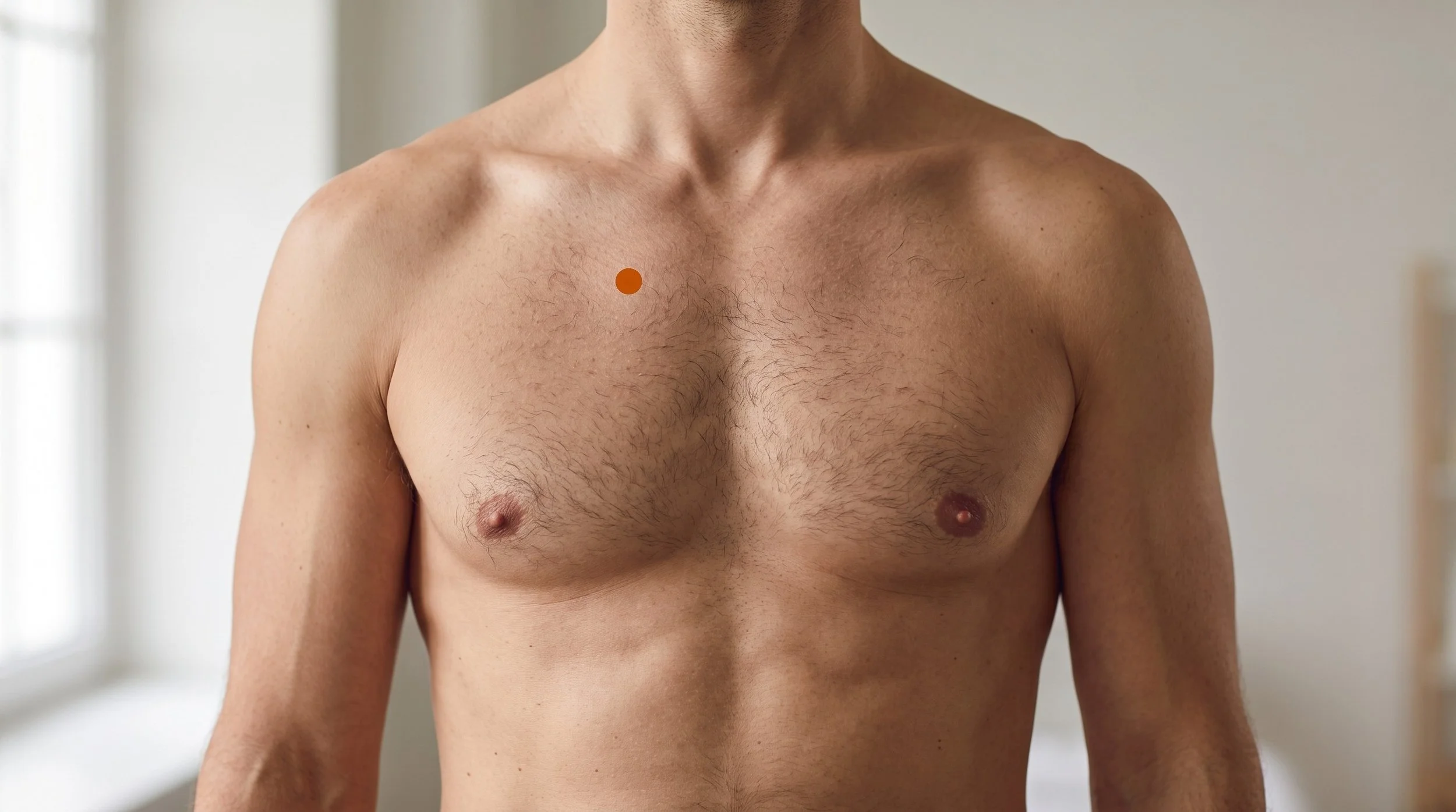
KI26 Acupuncture Point (Yuzhong)
Comfortable Chest Beneath the Collarbone: Anatomy, Mechanism, and Why This First Intercostal Space Point Earns Its Place in Cough and Chest Tightness Treatment
KI26 (Yuzhong), often translated as Comfortable Chest, is the second-to-last point on the Kidney channel and sits high on the front of the chest, in the first intercostal space about 2 cun lateral to the midline, roughly midway between the breastbone and the nipple line. It belongs to the vertical row of Kidney points that climbs the chest wall from KI22 up to KI27, and it's the one classical texts single out for phlegm and productive cough alongside the usual chest-opening functions.
Clinically, the ki26 acupuncture point matters because it lands over the upper pectoral and intercostal tissue at a segmental level (T1 to T2) that shares spinal cord territory with airway and upper thoracic visceral afferents, which is why practitioners reach for it in stubborn cough, upper chest tightness, and the shallow, guarded breathing that comes with stress or chronic respiratory disease. It's also a point that demands respect: the lung apex sits directly beneath, so needling is shallow and angled, never straight down.
- KI26 sits in the first intercostal space, 2 cun from the midline, layered over skin, subcutaneous fat, the clavicular fibers of pectoralis major, and the intercostal muscles, with pleura and lung immediately deeper (Deadman et al., 2001). Everything about the needling technique follows from that last fact.
- Classical sources attribute to KI26 the traditional actions of unbinding the chest, benefiting the breasts, transforming phlegm, and directing rebellious Lung and Stomach qi downward, with indications spanning cough, wheezing, chest and rib fullness, vomiting, and copious saliva (Deadman et al., 2001). Read as a clinical picture rather than a literal energetic claim, that's a description of upper chest constriction, productive cough, and upper digestive symptoms clustering together.
- The area is innervated by anterior cutaneous branches of the upper intercostal nerves (T1 to T2) with pectoral nerve supply to the underlying muscle, so needling here feeds afferent input into upper thoracic segments that also receive visceral input from the airways and mediastinum, a convergence pattern that helps explain segmental point selection (Zhao, 2008).
- Needle stimulation recruits A-delta and C fiber pathways that engage descending inhibitory control from the periaqueductal gray and rostral ventromedial medulla, along with local vascular and autonomic changes (Zhao, 2008), and pooled trial data suggest acupuncture may modestly reduce chest wall and musculoskeletal pain (Vickers et al., 2018).
- Respiratory research has never isolated KI26. Reviews of acupuncture for asthma found the trials too inconsistent to support recommendations (McCarney et al., 2004), while COPD work is more encouraging but low in certainty: a sham-controlled trial reported reduced exertional breathlessness (Suzuki et al., 2012) and a meta-analysis of filiform needle acupuncture suggested possible benefit for dyspnea and quality of life with cautious interpretation (Fernández-Jané et al., 2019).
- De qi at KI26 is usually a dull, spreading heaviness under the collarbone, sometimes with a sense that the breath sits easier. Sharp, electric, or cough-provoking sensation is a signal to stop and reposition, not to push deeper.
Chest Tightness, Lingering Cough, or Breath That Never Feels Full?
If your chest feels braced and your breath stops short of the top, we look at the whole apparatus: the upper ribs, the pectoral wall, the intercostals, and the autonomic tone driving your breathing pattern. KI26 is one of the chest points we use for that presentation, needled shallow and along the intercostal space, usually within a broader prescription rather than alone. Our licensed acupuncturists combine channel points with precise myofascial needling so the ribcage can actually move again. Book an evaluation and let's see what's limiting your breath.
Schedule NowAnatomy of KI26: Why the First Intercostal Space Is Such an Important Location
KI26 lies just below the clavicle, in the narrow gap between the first and second ribs, about 2 cun out from the midline (Deadman et al., 2001). Under the needle you pass through thin skin and subcutaneous fat, then the clavicular fibers of pectoralis major, then the external and internal intercostal muscles bridging the first space. This is high-traffic tissue. It loads every time you reach forward, carry a bag on one shoulder, hunch over a laptop, or breathe with the upper chest instead of the diaphragm.
In people who spend the day rounded forward, the upper pectoral and intercostal layer becomes short and tender, and the first two ribs stop gliding the way they should during inhalation.
The skin here is supplied by anterior cutaneous branches of the upper intercostal nerves, with supraclavicular branches from the cervical plexus contributing near the clavicle, while pectoralis major receives the medial and lateral pectoral nerves. That places KI26 squarely in the T1 to T2 segmental field, the same upper thoracic levels that receive sympathetic and visceral afferent traffic from the airways, mediastinum, and heart.
Needle input at these segments enters dorsal horn territory shared with those visceral inputs, and it also drives supraspinal responses: A-delta and C fiber activation engages descending inhibitory pathways through the periaqueductal gray and brainstem, releasing endogenous opioids and monoamines that dampen dorsal horn transmission (Zhao, 2008). In practice, that's the neurophysiological reading of what classical texts described as unbinding the chest.
Depth discipline is the whole story at KI26. The parietal pleura and the apical lung tissue sit just beneath the intercostal muscles, the intercostal vessels and nerve run along the inferior border of each rib, and the internal thoracic vessels descend deep to the costal cartilages near the sternal border. Standard technique is therefore transverse-oblique insertion directed laterally along the intercostal space, roughly 0.5 to 1 cun, with explicit cautions against deep perpendicular or oblique angling because of pneumothorax risk (Deadman et al., 2001).
Prospective safety data place serious adverse events after acupuncture at a very low rate overall, with pneumothorax among the rare but recognized events (Bäumler et al., 2021), which is exactly why chest points are the domain of trained, licensed practitioners.
Related Intercostal Muscles Trigger Points Related Pectoralis Major Trigger PointsKI26 at a Glance: Classification, Location, and Clinical Use
| Category | Detail |
|---|---|
| Traditional Name | Yuzhong (Comfortable Chest), also rendered as Amid Elegance or Flourishing Center |
| Channel Classification | Kidney channel of Foot Shaoyin, twenty-sixth point, second from the end of the channel |
| Point Categories | No five-shu, luo, xi-cleft, or extraordinary vessel designation is assigned in the reference sources. KI26 is classified within the row of Kidney chest points (KI22 through KI27) that ascend the intercostal spaces, and it is the member of that row given the added traditional emphasis on transforming phlegm and directing rebellious Lung and Stomach qi downward (Deadman et al., 2001). |
| Precise Location | On the anterior chest in the first intercostal space, 2 cun lateral to the anterior midline, midway between the midline and the mamillary (nipple) line. Locate the sternal angle and the second costal cartilage, then move to the space directly above it. |
| Tissue Stimulated | Skin and subcutaneous tissue of the upper chest, clavicular fibers of pectoralis major, the external and internal intercostal muscles of the first space, with pectoralis minor lying more laterally and deeper |
| Needle Depth / Direction | Transverse-oblique insertion directed laterally along the intercostal space, 0.5 to 1 cun. Deep perpendicular or oblique needling is contraindicated because of the underlying lung. Moxibustion is traditionally permitted. |
| De Qi Sensation | Dull heaviness or a spreading, warm ache under the collarbone, occasionally travelling laterally along the rib space, sometimes with a subjective sense of the chest loosening. Sharp, electric, or cough-provoking sensations mean the needle should be withdrawn and redirected. |
| Primary Clinical Uses | Cough and wheezing with phlegm, fullness and distention of the chest and lateral ribs, upper chest tightness with anxious or shallow breathing, chest wall and intercostal pain, and traditionally recorded breast disorders and drooling with copious saliva |
| Common Point Combinations |
|
Deadman, Al-Khafaji, and Baker's A Manual of Acupuncture presents KI26 with two traditional action headings: unbinding the chest and benefiting the breasts, and transforming phlegm while directing rebellious Lung and Stomach qi downward (Deadman et al., 2001). The classical indication list that follows is worth compressing into three themes.
First, a respiratory group: cough, wheezing, laboured breathing, coughing of blood, and palpitations with fullness through the chest and the sides of the ribs. Second, a phlegm and upper digestive group: accumulated phlegm, breathlessness and cough severe enough to interfere with eating, vomiting, and drooling with copious saliva.
Third, a local surface group covering breast abscess and a skin condition of the trunk. These are traditional attributions, recorded within a pre-modern diagnostic framework rather than as diagnoses in the contemporary sense. What makes the pattern striking is its coherence: a single point on the upper chest was expected to address breathing, swallowing, secretions, and appetite together, which is a fair pre-modern description of what happens when the upper thoracic region is chronically tight and autonomically braced.
Why KI26 Is Used for Stress-Related Chest Tightness and Shallow Breathing
Patients rarely walk in asking for a chest point. They describe a band of tightness under the collarbones, a breath that won't finish, a cough that lingers weeks after an infection cleared, or a sense that they've been bracing their upper body for months. Anatomically, all of that converges on the same tissue KI26 sits in: the upper pectoral wall and the first intercostal space.
Because the skin and muscle here are supplied by upper thoracic segments (T1 to T2) that also receive afferent input from the airways and mediastinum, needle stimulation at this site reaches dorsal horn neurons that are already processing visceral traffic, a convergence principle that underpins segmental point selection (Zhao, 2008).
Beyond the segment, needling engages system-wide machinery. Afferent volleys recruit descending inhibitory pathways from the midbrain and brainstem, along with opioid and monoaminergic modulation that reduces the excitability of pain-transmitting neurons (Zhao, 2008). There's also an autonomic dimension that patients feel directly. A systematic review and meta-analysis of heart rate variability trials reported that needle acupuncture increased markers of parasympathetic tone compared with placebo needling, though the number of trials was small and the findings need confirmation (Hamvas et al., 2023). Slower, deeper breathing tends to follow a calmer autonomic state, and a chest wall that isn't guarding mechanically makes that easier.
None of this means KI26 is a specific treatment for any lung disease. It means that a shallow needle in the first intercostal space plausibly influences local muscle tone, segmental processing, and autonomic balance at once, which lines up reasonably well with what classical authors described as unbinding the chest. We use it as part of a treatment, alongside distal points and, where indicated, direct work on the pectoral and intercostal muscles.
What the Research Shows for KI26
A realistic note before the table: no clinical trial has tested KI26 on its own. Respiratory and chest-related acupuncture research uses multi-point protocols, often built around back shu points, Lung channel points, and distal limb points, so KI26 can only be evaluated as one contributor within a prescription. The overall respiratory evidence is mixed and generally low in certainty, stronger for symptom outcomes such as breathlessness and quality of life than for objective lung function. What follows is a summary of the most relevant reviews and trials, not evidence that this specific point does any of these things by itself.
| Study | Type | Focus | Key Finding |
|---|---|---|---|
| McCarney et al., 2004 | Cochrane systematic review | Acupuncture for chronic asthma | The included trials varied in quality and produced inconsistent results, and reviewers concluded there wasn't enough evidence to make recommendations about acupuncture for asthma. |
| Suzuki et al., 2012 | Randomized placebo-controlled trial | Dyspnea on exertion in COPD (COPD-Acupuncture Trial) | Acupuncture added to standard medication was reported to reduce exertional breathlessness compared with placebo needling, though blinding and generalizability were debated in subsequent correspondence. |
| Fernández-Jané et al., 2019 | Systematic review and meta-analysis | Filiform needle acupuncture for COPD | Results suggested possible improvement in dyspnea, quality of life, and exercise capacity when acupuncture was added to usual care, but the authors emphasized low study quality and cautious interpretation. |
| Hamvas et al., 2023 | Systematic review and meta-analysis | Acupuncture and heart rate variability | Pooled data from a small set of trials suggested real acupuncture may increase parasympathetic tone relative to placebo needling, a plausible mechanism for the settling effect patients report. |
| Vickers et al., 2018 | Individual patient data meta-analysis | Chronic musculoskeletal pain | Acupuncture outperformed both sham and no-acupuncture controls for chronic pain conditions, with effects that persisted over time, supporting its use for musculoskeletal chest wall complaints. |
| Bäumler et al., 2021 | Systematic review and meta-analysis of prospective studies | Acupuncture-related adverse events | Serious adverse events were rare across large prospective datasets, with pneumothorax recognized as an uncommon risk that supports strict depth limits at chest points. |
Upper Chest and Rib Pain That Movement Alone Hasn't Fixed?
Chest wall pain that lingers after imaging comes back clean is often myofascial, and the upper pectoral and intercostal tissue near KI26 is a common culprit. We map your pain pattern, treat the involved muscles with dry needling, and add classical chest and distal points where they fit the picture. Most patients notice a change in how their chest loads with breathing within a few visits. Schedule a visit to get a clear plan instead of guesswork.
Schedule NowKI26 in the Context of Trigger Point Work
Acupuncture, in our definition, is the use of an acupuncture needle, and that covers hundreds of styles including dry needling. KI26 happens to sit in tissue that trigger point clinicians treat constantly. The clavicular fibers of pectoralis major and the upper intercostals both harbor taut bands that refer pain across the front of the chest and into the shoulder and arm, and intercostal trigger points can produce localized rib pain that patients often interpret as something internal (Simons et al., 1999).
When the referral pattern matches, needling those bands directly, rather than treating the chest as a purely visceral problem, is usually the faster route.
In a typical session we'll use KI26 as a shallow, laterally directed needle in the first intercostal space, then treat pectoralis major and pectoralis minor with dry needling where taut bands and reproducible referral are present, and finish with distal points such as LU7, PC6, or LV3 depending on whether the presentation is more respiratory, more anxious, or more musculoskeletal.
All chest and anterior rib needling at Morningside is performed with strict angle and depth control given the pleura beneath, and pooled trial evidence supports acupuncture's role in chronic musculoskeletal pain generally (Vickers et al., 2018). If your chest wall pain is new, severe, or accompanied by shortness of breath, fever, or exertional symptoms, get medical evaluation first.
KI26 Chest and Breathing Treatment at NYC's Highest-Rated Acupuncture Clinic
Morningside Acupuncture is the highest-rated acupuncture and dry needling clinic in New York City with over 500 five-star Google reviews, and our approach to the chest is deliberately conservative and anatomy-driven. We use ki 26 chest needling with shallow transverse-oblique technique, combined with treatment of the pectoral and intercostal muscles and with points that support parasympathetic tone. Every session is delivered by a licensed acupuncturist trained in both classical point selection and modern myofascial technique. Schedule your appointment on the Upper West Side today.
Schedule NowFrequently Asked Questions
What does KI26 feel like when needled?
Most people feel a dull, heavy ache or a spreading warmth just below the collarbone, sometimes travelling a short way along the rib space. Because the needle goes in at a shallow lateral angle rather than straight down, the sensation stays superficial. Some patients notice their breath dropping lower in the chest within a minute or two. Sharp, burning, or electric sensations, or any urge to cough, aren't normal here and mean the needle should be adjusted immediately.
Why treat a chest point instead of just needling my back or my legs?
Both approaches have a rationale, and we usually combine them. Distal points on the arms and legs work through spinal and supraspinal pathways, including descending inhibition (Zhao, 2008), while a local point like KI26 delivers input into the same upper thoracic segments (T1 to T2) that receive afferent traffic from the airways and upper chest structures. It also lets us address the mechanical side directly, since the pectoral and intercostal tissue over the point is often short and tender in people who breathe with the upper chest. Local plus distal is the standard clinical pattern, not a compromise.
Can I press KI26 myself between sessions?
Yes, acupressure here is safe and easy to self-administer. Find the notch where your collarbone meets the breastbone, drop about two finger widths down and one to one and a half inches out from the midline, and feel for the soft gap between the first two ribs below the clavicle. Press with a flat fingertip using firm but comfortable pressure, roughly a 4 or 5 out of 10, and hold for 30 to 60 seconds while breathing slowly into your lower ribs. Do both sides, two or three rounds, once or twice a day. Small circular massage along the space, moving laterally rather than pressing inward, often works better than static pressure. Stop if you feel sharp pain, dizziness, or breathlessness.
Is KI26 safe to needle?
It's safe in trained hands and inappropriate for self-needling or untrained practitioners. The lung apex lies directly beneath the intercostal muscles, so standard technique is transverse-oblique insertion directed laterally along the rib space to a depth of about 0.5 to 1 cun, with deep perpendicular or oblique angling specifically cautioned against (Deadman et al., 2001). Large prospective safety datasets show serious adverse events after acupuncture are rare, with pneumothorax recognized as an uncommon but real risk (Bäumler et al., 2021). Tell your practitioner if you have emphysema, a history of pneumothorax, a pacemaker or implanted device, chest surgery, or a bleeding disorder, and always seek medical evaluation for new or unexplained chest symptoms.
Where exactly is KI26 located?
KI26 is on the front of the chest in the first intercostal space, 2 cun lateral to the anterior midline, which puts it about midway between the midline and the nipple line. The most reliable way to find it is to locate the sternal angle, the ridge where the manubrium meets the body of the sternum, which is level with the second costal cartilage. The space immediately above that cartilage is the first intercostal space. In men the nipple typically sits in the fourth intercostal space, which can help orient the vertical line (Deadman et al., 2001). KI27 sits above it beneath the clavicle, and KI25 sits below it in the second intercostal space.
References
- Deadman, P., Al-Khafaji, M., & Baker, K. (2009). A manual of acupuncture. Journal of Chinese Medicine Publications.
- Maciocia, G. (2006). The channels of acupuncture: Clinical use of the secondary channels and eight extraordinary vessels. Churchill Livingstone Elsevier.
- Simons, D. G., Travell, J. G., & Simons, L. S. (1999). Travell & Simons' myofascial pain and dysfunction: The trigger point manual, Vol. 1: Upper half of body (2nd ed.). Williams & Wilkins.
- Zhao, Z. Q. (2008). Neural mechanism underlying acupuncture analgesia. Progress in Neurobiology, 85(4), 355-375. https://doi.org/10.1016/j.pneurobio.2008.05.004
- Vickers, A. J., Vertosick, E. A., Lewith, G., MacPherson, H., Foster, N. E., Sherman, K. J., Irnich, D., Witt, C. M., & Linde, K. (2018). Acupuncture for chronic pain: Update of an individual patient data meta-analysis. Journal of Pain, 19(5), 455-474. https://doi.org/10.1016/j.jpain.2017.11.005
- McCarney, R. W., Brinkhaus, B., Lasserson, T. J., & Linde, K. (2004). Acupuncture for chronic asthma. Cochrane Database of Systematic Reviews, 2004(1), CD000008. https://doi.org/10.1002/14651858.CD000008.pub2 [VERIFY BEFORE PUBLISHING]
- Suzuki, M., Muro, S., Ando, Y., Omori, T., Shiota, T., Endo, K., Sato, S., Aihara, K., Matsumoto, M., Suzuki, S., Itotani, R., Ishitoko, M., Hara, Y., Takemura, M., Ueda, T., Kagioka, H., Hirabayashi, M., Fukui, M., & Mishima, M. (2012). A randomized, placebo-controlled trial of acupuncture in patients with chronic obstructive pulmonary disease (COPD): The COPD-acupuncture trial (CAT). Archives of Internal Medicine, 172(11), 878-886. https://doi.org/10.1001/archinternmed.2012.1233
- Fernández-Jané, C., Vilaró, J., Fei, Y., Wang, C., Liu, J., Huang, N., Xia, R., Tian, X., Hu, R., Yu, M., Gómara-Toldrà, N., Solà-Madurell, M., & Sitjà-Rabert, M. (2019). Filiform needle acupuncture for COPD: A systematic review and meta-analysis. Complementary Therapies in Medicine, 47, 102182. https://doi.org/10.1016/j.ctim.2019.08.016
- Hamvas, S., Hegyi, P., Kiss, S., Lohner, S., McQueen, D., & Havasi, M. (2023). Acupuncture increases parasympathetic tone, modulating HRV: Systematic review and meta-analysis. Complementary Therapies in Medicine, 72, 102905. https://doi.org/10.1016/j.ctim.2022.102905
- Bäumler, P., Zhang, W., Stübinger, T., & Irnich, D. (2021). Acupuncture-related adverse events: Systematic review and meta-analyses of prospective clinical studies. BMJ Open, 11(9), e045961. https://doi.org/10.1136/bmjopen-2020-045961
Disclaimer: This web site is intended for educational and informational purposes only. Reading this website does not constitute providing medical advice or any professional services. This information should not be used for diagnosing or treating any health issue or disease. Those seeking medical advice should consult with a licensed physician. Seek the advice of a medical doctor or other qualified health professional for any medical condition. If you think you have a medical emergency, call 911 or go to the emergency room. No acupuncturist-patient relationship is created by reading this website or using the information. Morningside Acupuncture PLLC and its employees and contributors do not make any express or implied representations with respect to the information on this site or its use. For any legal interpretation of scope of practice in your state, consult a licensed attorney or regulatory authority.
Read more from our blog



