BL51 Acupuncture Point (Huangmen)
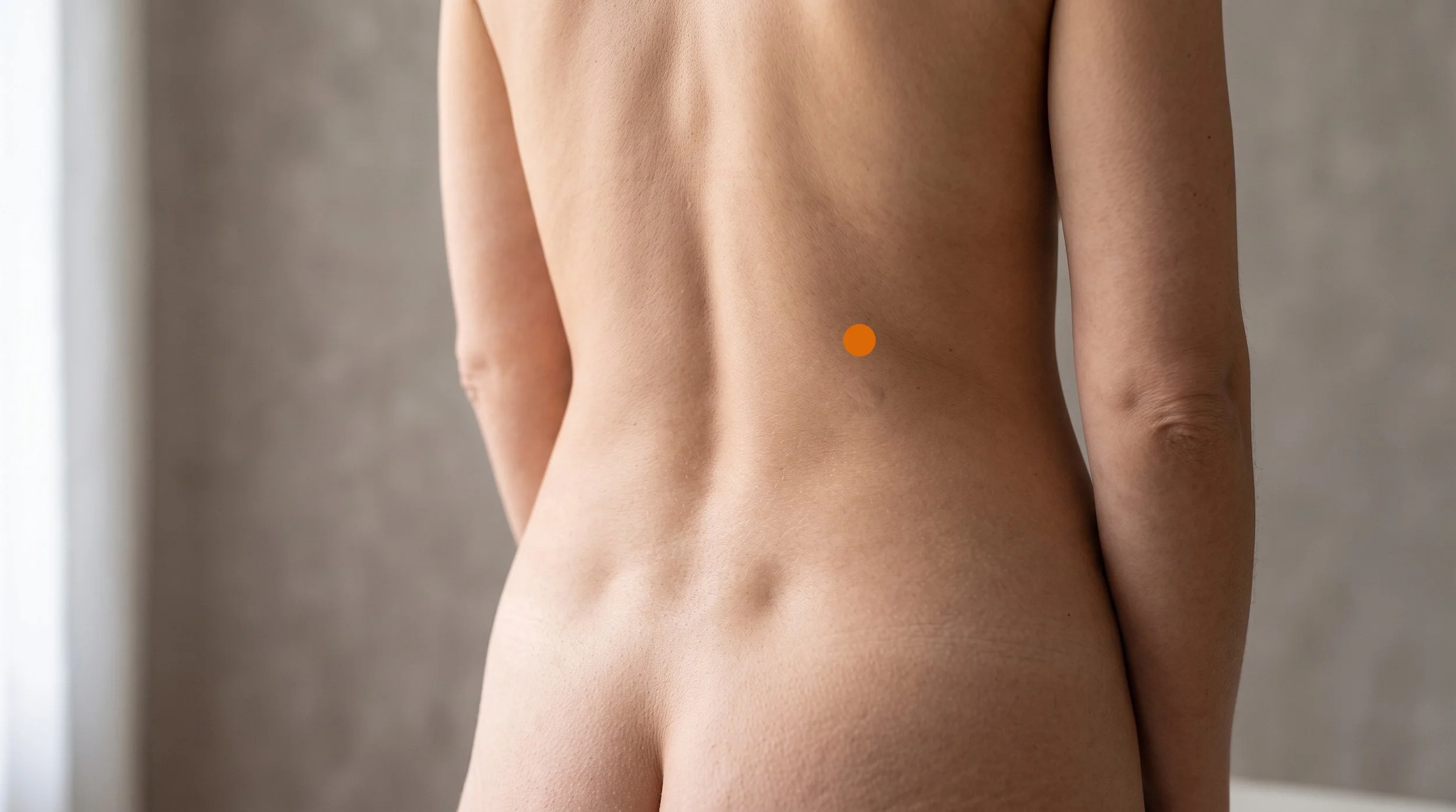
BL51 Acupuncture Point (Huangmen)
The Vitals Gate at the Thoracolumbar Junction: Anatomy, Mechanism, and Why This Outer Bladder Line Point Bridges Low Back Tension and Abdominal Complaints
BL51, known as Huangmen and usually translated as Vitals Gate or Door of the Huang, sits on the outer branch of the Bladder channel in the lower back, three cun to the side of the spine at the level of the bottom of the first lumbar spinous process.
In plain terms, it's about a hand's width lateral to the midline in the soft muscular valley just below the last rib, level with BL22 on the inner Bladder line. That address matters clinically, because the thoracolumbar junction is where the stiff, rib-bearing thoracic spine hands off to the mobile lumbar spine, where the diaphragm anchors behind, and where the quadratus lumborum and lateral erector spinae take a beating during lifting, twisting, and long hours at a desk.
The bl51 acupuncture point is used mainly as a local point for that band of tension, and classical texts also list it for upper abdominal fullness, constipation, and breast discomfort, which makes bladder 51 a useful example of how one segmental level can carry both musculoskeletal and visceral referral patterns.
- BL51 lies 3 cun lateral to the midline at the lower border of the L1 spinous process, level with BL22 and with GV5, placing it over thoracolumbar fascia, the lateral erector spinae, and the quadratus lumborum, with the twelfth rib and kidney deeper still.
- Traditional sources describe Huangmen as a point that disperses accumulation and benefits the breasts, and Chinese texts add regulation of the Triple Burner region; presented as traditional attribution, these map onto a modern picture of local muscle tone change plus segmental autonomic influence at T12 and L1.
- The overlying tissue is supplied by the lateral branch of the posterior ramus of the twelfth thoracic nerve, so needling here feeds into dorsal horn segments that also receive input from deep abdominal and retroperitoneal structures, a convergence pattern that plausibly explains the mixed back and abdominal indication list (Zhao, 2008).
- Needling drives both segmental gating and descending inhibition from brainstem circuits, and pooled patient-level data across chronic pain conditions suggest modest but durable effects beyond sham and no-acupuncture controls (Vickers et al., 2018; Zhao, 2008).
- For low back pain specifically, Cochrane evidence is cautious rather than emphatic: acupuncture may improve pain and function compared with no treatment or usual care, while sham comparisons are less clear-cut (Mu et al., 2020; Rizzo et al., 2025).
- De qi at bl 51 lower back positions is typically a deep, heavy, spreading ache that fans toward the last rib and flank, and because the kidney lies beneath the muscle layers, insertion stays oblique and shallow rather than deep and perpendicular (Cho et al., 2022).
Stuck With Low Back Tension That Sits Just Below Your Ribs?
Pain at the thoracolumbar junction often gets blamed on the lumbar spine when the real problem is a tight, overloaded quadratus lumborum and lateral erector spinae. At Morningside Acupuncture, we use BL51 alongside careful palpation of the L1 and L2 paraspinals to treat that band directly, with shallow oblique needling that respects the kidney below. We pair it with movement screening so you know what's loading the area between visits. Schedule a session and let's map where your back pain actually lives.
Schedule NowAnatomy of BL51: Why the Thoracolumbar Junction Is Such an Important Location
Working from the surface inward, a needle at BL51 passes through skin and subcutaneous fat into the posterior layer of thoracolumbar fascia, then into the lateral fibers of the erector spinae group, chiefly iliocostalis lumborum, with quadratus lumborum sitting deeper and more medial toward the transverse processes. This is the outer bladder line lumbar territory, roughly along the line that corresponds to the medial border of the scapula when the shoulder is relaxed.
It's a high-load region: the twelfth rib ends here, the diaphragm's arcuate ligaments anchor to the L1 transverse processes and the twelfth ribs, and the transition from thoracic to lumbar mechanics concentrates rotational and side-bending stress. People who lift asymmetrically, sit rotated toward a monitor, or run with a dropped pelvis frequently develop palpable ropiness right where BL51 is located.
The tissue at this level is innervated by the lateral branch of the posterior ramus of the twelfth thoracic nerve, with the first lumbar segment contributing just below. Those same spinal segments receive afferent traffic from deep structures in the upper retroperitoneum and abdomen, which is the anatomical basis for segmental convergence: distinct inputs sharing dorsal horn neurons can produce overlapping pain maps and shared reflex responses.
Needling here recruits A-delta and C fibers along with muscle afferents, which triggers local segmental inhibition and activates descending pain-modulating pathways involving the periaqueductal gray, rostral ventromedial medulla, and endogenous opioid and monoamine systems (Zhao, 2008). Clinically that means BL51 may reduce guarding in the paraspinals while also nudging autonomic tone at a level that services abdominal structures, which is a more useful framing than any single-muscle explanation.
Depth discipline is the whole story at this level. The kidney sits beneath the muscle layers near L1, and a systematic review of back-shu point anatomy and needling technique found that texts vary considerably in recommended depth and that individual body habitus changes the safety margin substantially (Cho et al., 2022). Standard practice is oblique insertion of roughly 0.5 to 1 cun, angled medially toward the spine or along the muscle belly rather than straight down; some sources recommend even shallower depths.
Deep perpendicular needling at BL51 carries a real risk of reaching the kidney, so a trained practitioner keeps the angle flat, uses shorter needles in lean patients, and stays out of that trajectory entirely. Moxibustion is traditionally described as applicable here, which is one reason the point shows up in cold, achy, chronic low back presentations.
Related Acupuncture For Low Back Pain Related Quadratus Lumborum Trigger PointsBL51 at a Glance: Classification, Location, and Clinical Use
| Category | Detail |
|---|---|
| Traditional Name | Huangmen (Vitals Gate, also translated as Door of the Huang or Vital's Door) |
| Channel Classification | Bladder channel of Foot Taiyang, outer (third) line of the back, point 51 |
| Point Categories | No five-shu, back-shu, luo, xi-cleft, or extraordinary vessel designations are given in the reference texts. BL51 is classified as an outer Bladder line point at L1, positioned level with the Triple Burner back-shu point BL22 and with GV5 on the midline. Maciocia's channel text groups it with the other 'huang' points (BL43, BL51, BL53, and KI16), a classical grouping said to link the back and the abdomen. |
| Precise Location | On the lower back, 3 cun lateral to the posterior midline at the level of the lower border of the L1 spinous process, level with BL22 on the inner Bladder line and with GV5 on the midline. With the shoulder relaxed, the 3 cun line corresponds roughly to the medial border of the scapula. |
| Tissue Stimulated | Skin and thoracolumbar fascia over the lateral erector spinae (iliocostalis lumborum) and the upper quadratus lumborum region at L1, with the twelfth rib, diaphragmatic attachments, and kidney lying deeper. |
| Needle Depth / Direction | Oblique insertion 0.5 to 1 cun, angled medially or along the muscle belly; some texts recommend 0.3 to 0.5 cun. Deep perpendicular needling is avoided because of the underlying kidney. Moxibustion is traditionally applicable. |
| De Qi Sensation | A deep, heavy, dull ache with a spreading quality across the flank, sometimes traveling toward the last rib or forward around the waist. Sharp, electric, or radiating sensations are not the goal and prompt the practitioner to adjust. |
| Primary Clinical Uses | Low back tension and stiffness at the thoracolumbar junction; flank and twelfth rib region tightness; traditionally listed for epigastric pain, hardness below the ribs, abdominal masses, constipation, and breast fullness and pain. |
| Common Point Combinations |
|
Deadman, Al-Khafaji, and Baker's point manual gives BL51 a compact traditional profile: it's credited with dispersing accumulation and benefiting the breasts, and its listed indications cluster around epigastric pain, a sensation of great hardness below the heart, constipation, and breast disorders with fullness and pain. Chinese texts add abdominal pain, abdominal masses, and low back pain, while Korean and Chinese sources describe it as regulating the Triple Burner region and easing the passage of qi upward toward the chest.
These are traditional attributions rather than physiological claims. Cunningham's commentary offers an anatomical rationale worth noting: the name huang refers to the diaphragm and the membranes around it, and the diaphragm anchors posteriorly at exactly this level, so a point that relaxes tissue here was said to smooth movement through the region where the esophagus passes and where intra-abdominal pressure gets generated.
What's striking about the classical pattern is its consistency: a lower back point with almost no lower back indications in the oldest lists, credited instead with moving accumulation in the chest and abdomen, as though the compilers were describing a segmental relationship long before anyone had a word for it.
Why BL51 Is Used for Constipation and Upper Abdominal Fullness, Not Just Low Back Pain
The bridge between a lower back point and abdominal symptoms is segmental convergence. Sensory nerves from skin and muscle at the T12 and L1 level enter the spinal cord at the same segments that receive afferent input from deep structures in the upper abdomen and retroperitoneum. Those inputs share dorsal horn neurons, so a strong somatic stimulus can change how that segment processes and outputs signals, including sympathetic outflow to the vasculature and gut at the same level (Zhao, 2008).
This is also why chronic visceral irritation can leave a band of tender, tight paraspinal tissue in the same region, and why practitioners have palpated the back for centuries as a diagnostic surface. It doesn't mean needling BL51 controls the bowel; it means the point sits at a plausible address for influencing tone and sensitivity in a shared segment.
The second mechanism is broader. Needle stimulation that produces de qi activates ascending pathways to the brainstem and midbrain, engaging descending inhibitory circuits that release endogenous opioids, serotonin, and norepinephrine at the spinal level, which raises pain thresholds well beyond the needled segment (Zhao, 2008). Individual patient data pooled from high-quality chronic pain trials show that acupuncture outperforms both sham and no-acupuncture controls, with effects that persist over months rather than fading immediately after treatment (Vickers et al., 2018).
For a patient, the practical implication is that BL51 rarely works alone: it contributes local tissue effects and segmental input while the rest of the prescription supplies distal and systemic modulation.
There's also a straightforward mechanical story. The quadratus lumborum and lateral erector spinae at L1 are among the most common sources of deep, boring low back pain, and their referral patterns spread into the flank, the iliac crest, and occasionally around toward the abdomen, which can mimic visceral discomfort (Simons et al., 1999). Needling taut tissue in this band may reduce local nociceptor sensitization and restore side-bending and rotation range.
When patients report that their back pain and their bloating both improve, the most parsimonious explanation is usually a mix of reduced muscle guarding, better breathing mechanics at the diaphragm's attachment level, and a general downshift in sympathetic tone.
What the Research Shows for BL51
There's no clinical trial of BL51 in isolation, and that's true for most points on the outer Bladder line. What the literature tests is whole protocols for defined conditions, usually chronic low back pain, in which lumbar local points, back-shu points, and distal points are combined. The honest way to read the evidence is that it supports acupuncture as a reasonable option for chronic low back pain with modest effect sizes and a good safety profile, and that BL51's role is as one local component within those protocols rather than an independently validated intervention.
Reviews also differ depending on the comparator: results against usual care or no treatment look better than results against sham needling, a pattern that has driven ongoing debate about what sham controls actually control for.
| Study | Type | Focus | Key Finding |
|---|---|---|---|
| Mu et al., 2020 | Cochrane systematic review | Acupuncture for chronic nonspecific low back pain, 33 trials with 8,270 participants | Acupuncture may reduce pain and improve function compared with no treatment or usual care, while differences from sham were small and of low certainty. |
| Rizzo et al., 2025 | Cochrane overview of reviews | Non-pharmacological and non-surgical treatments for low back pain across 31 Cochrane reviews and 644 trials | Acupuncture appears among the non-drug options with supportive evidence for chronic low back pain, though certainty varies by comparator and outcome. |
| Vickers et al., 2018 | Individual patient data meta-analysis | Acupuncture for chronic musculoskeletal, headache, and osteoarthritis pain | Acupuncture produced statistically significant benefits over both sham and no-acupuncture controls, with effects largely maintained at one year. |
| Zhao, 2008 | Narrative review of neurophysiology | Neural mechanisms of acupuncture analgesia | Analgesic effects are attributed to segmental spinal inhibition plus descending opioid and monoaminergic modulation rather than to channel-specific transmission. |
| Cho et al., 2022 | PRISMA-compliant systematic review of acupoint anatomy | Anatomical structures and safe needling methods for back-shu points including BL22, the inner-line neighbor of BL51 | Recommended depths vary widely across texts and body types, supporting conservative oblique needling near organ-adjacent lumbar levels. |
Back Pain and Sluggish Digestion Showing Up Together?
Patients often mention that their low back tightness travels with bloating, upper abdominal fullness, or irregular bowels, and classical texts listed those complaints alongside back pain for Huangmen. We treat BL51 in combination with abdominal points when that pattern appears, using segmental reasoning rather than promises. Nothing here replaces medical workup for new or changing digestive symptoms. Book a visit and we'll build a plan around both parts of the picture.
Schedule NowBL51 in the Context of Trigger Point Work
At Morningside, treatment at BL51 usually starts with palpation rather than measurement. The 3 cun line at L1 sits over the lateral erector spinae and the upper edge of the quadratus lumborum, and in patients with chronic low back pain that tissue is often taut, tender, and slow to release. Trigger points in quadratus lumborum refer deeply into the flank, the iliac crest, and the sacroiliac region, while iliocostalis lumborum trigger points can refer downward into the buttock and forward around the abdomen, patterns that overlap noticeably with the classical indication list for this point (Simons et al., 1999).
When the tender spot and the point location coincide, we treat it as one target and use the same shallow oblique angle, since dry needling is simply another style of acupuncture needle technique and carries the same anatomical obligations near the kidney.
In a typical session, BL51 might be combined with dry needling of quadratus lumborum from a safer medial approach, iliocostalis lumborum at L2 and L3, and the gluteal muscles when the pain pattern extends below the crest. Electroacupuncture is sometimes added across the lumbar paraspinals at low frequency for chronic presentations. We then follow with loaded movement work, since needling reduces sensitivity and guarding but doesn't build the side-bending and rotational capacity the thoracolumbar junction needs. Patients who lift, row, run, or sit rotated for long stretches tend to do best when the needling and the loading strategy are planned together.
BL51 Low Back Pain Treatment at NYC's Highest-Rated Acupuncture Clinic
Morningside Acupuncture is the highest-rated acupuncture and dry needling clinic in New York City with over 500 five-star Google reviews, and low back pain is one of the most common reasons patients walk through our door. We combine classical point selection like BL51 and BL23 with trigger point dry needling of the quadratus lumborum and iliocostalis lumborum, plus electroacupuncture when it fits the case. Every treatment plan comes with home exercise so gains hold between sessions. Schedule your appointment today.
Schedule NowFrequently Asked Questions
What does BL51 feel like when needled?
Most patients describe a deep, heavy, slightly dull ache that spreads sideways toward the last rib or forward around the waist, sometimes with a sense of warmth or of the muscle letting go. Because the needle is angled obliquely into a thick muscular layer, the sensation tends to build over a few seconds rather than arriving sharply. Brief soreness afterward is common and usually fades within a day. Sharp, electric, or radiating sensations aren't the target, and a practitioner will withdraw and redirect if you report them.
Why needle a point on the back for constipation or upper abdominal fullness?
Because the nerves supplying the tissue at BL51 enter the spinal cord at the T12 and L1 segments, which also receive input from deep abdominal and retroperitoneal structures. That shared segmental wiring means a strong somatic input can influence sympathetic tone and pain processing at the same level, which is the modern reading of why classical texts listed a lumbar point for epigastric hardness and constipation (Zhao, 2008). It's a plausible mechanism, not a guarantee of results, and new or persistent digestive symptoms always deserve a medical evaluation first.
Can I press BL51 myself between sessions?
Yes, acupressure here is safe because finger pressure can't reach the depths that make needling a technique for professionals. Find the bottom of your last rib in back, then slide about a hand's width out from your spine into the soft muscular groove at that level. Press with a thumb, knuckle, or a lacrosse ball against a wall using steady, moderate pressure for 30 to 60 seconds per side, breathing slowly and letting the exhale soften the tissue. Repeat two or three rounds, once or twice a day. Stop if pressure produces sharp pain, radiating symptoms, or any flank tenderness that feels different from muscle soreness.
Is BL51 safe to needle?
It's safe in trained hands and requires respect for what lies beneath it. The kidney sits deep to the muscle layers at the L1 level, so deep perpendicular insertion is avoided and standard technique is oblique insertion of roughly 0.5 to 1 cun, shallower in lean patients. Reviews of back-shu point anatomy show that recommended depths vary widely between texts and that body composition changes the margin considerably, which is exactly why depth and angle stay conservative here (Cho et al., 2022). Tell your practitioner about kidney conditions, prior flank surgery, bleeding disorders, or blood-thinning medication before treatment.
Where exactly is BL51 located?
On the lower back, 3 cun (about four finger widths, or roughly the distance from your spine to the inner edge of your shoulder blade when relaxed) lateral to the midline, at the level of the lower border of the first lumbar spinous process. That level is easiest to find by locating the bottom edge of the twelfth rib in back and following it toward the spine. BL51 sits directly lateral to BL22 on the inner Bladder line and level with GV5 on the midline, in the muscular groove of the outer bladder line lumbar region.
References
- Deadman, P., Al-Khafaji, M., & Baker, K. (2009). A manual of acupuncture. Journal of Chinese Medicine Publications.
- Cheng, X. (Ed.). (1999). Chinese acupuncture and moxibustion (Rev. ed.). Foreign Languages Press.
- O'Connor, J., & Bensky, D. (Eds. & Trans.). (1981). Acupuncture: A comprehensive text. Shanghai College of Traditional Medicine. Eastland Press.
- Kim, H. (2008). Handbook of Oriental medicine (3rd ed.). Harmony & Balance Press.
- Maciocia, G. (2006). The channels of acupuncture: Clinical use of the secondary channels and eight extraordinary vessels. Churchill Livingstone Elsevier.
- Cunningham, P. M. (2000). Acupuncture points: A practical guide to classical and modern usage. Odyssey Press.
- Simons, D. G., Travell, J. G., & Simons, L. S. (1999). Travell & Simons' myofascial pain and dysfunction: The trigger point manual, Vol. 1: Upper half of body (2nd ed.). Williams & Wilkins.
- Mu, J., Furlan, A. D., Lam, W. Y., Hsu, M. Y., Ning, Z., & Lao, L. (2020). Acupuncture for chronic nonspecific low back pain. Cochrane Database of Systematic Reviews, 12(12), CD013814. https://doi.org/10.1002/14651858.CD013814
- Rizzo, R. R. N., Cashin, A. G., Wand, B. M., Ferraro, M. C., Sharma, S., Lee, H., O'Hagan, E., Maher, C. G., Furlan, A. D., van Tulder, M. W., & McAuley, J. H. (2025). Non-pharmacological and non-surgical treatments for low back pain in adults: An overview of Cochrane reviews. Cochrane Database of Systematic Reviews, 2025(3), CD014691. https://doi.org/10.1002/14651858.CD014691.pub2
- Vickers, A. J., Vertosick, E. A., Lewith, G., MacPherson, H., Foster, N. E., Sherman, K. J., Irnich, D., Witt, C. M., & Linde, K. (2018). Acupuncture for chronic pain: Update of an individual patient data meta-analysis. Journal of Pain, 19(5), 455-474. https://doi.org/10.1016/j.jpain.2017.11.005
- Zhao, Z. Q. (2008). Neural mechanism underlying acupuncture analgesia. Progress in Neurobiology, 85(4), 355-375. https://doi.org/10.1016/j.pneurobio.2008.05.004
- Cho, Y., Han, Y., Kim, Y., Han, S., Oh, K., Chae, H., Chu, H., & Ryu, M. (2022). Anatomical structures and needling method of the back-shu points BL18, BL20, and BL22 related to gastrointestinal organs: A PRISMA-compliant systematic review of acupoints and exploratory mechanism analysis. Medicine, 101(43), e29878. https://doi.org/10.1097/MD.0000000000029878
Disclaimer: This web site is intended for educational and informational purposes only. Reading this website does not constitute providing medical advice or any professional services. This information should not be used for diagnosing or treating any health issue or disease. Those seeking medical advice should consult with a licensed physician. Seek the advice of a medical doctor or other qualified health professional for any medical condition. If you think you have a medical emergency, call 911 or go to the emergency room. No acupuncturist-patient relationship is created by reading this website or using the information. Morningside Acupuncture PLLC and its employees and contributors do not make any express or implied representations with respect to the information on this site or its use. For any legal interpretation of scope of practice in your state, consult a licensed attorney or regulatory authority.
Read more from our blog