BL55 Acupuncture Point (Heyang)
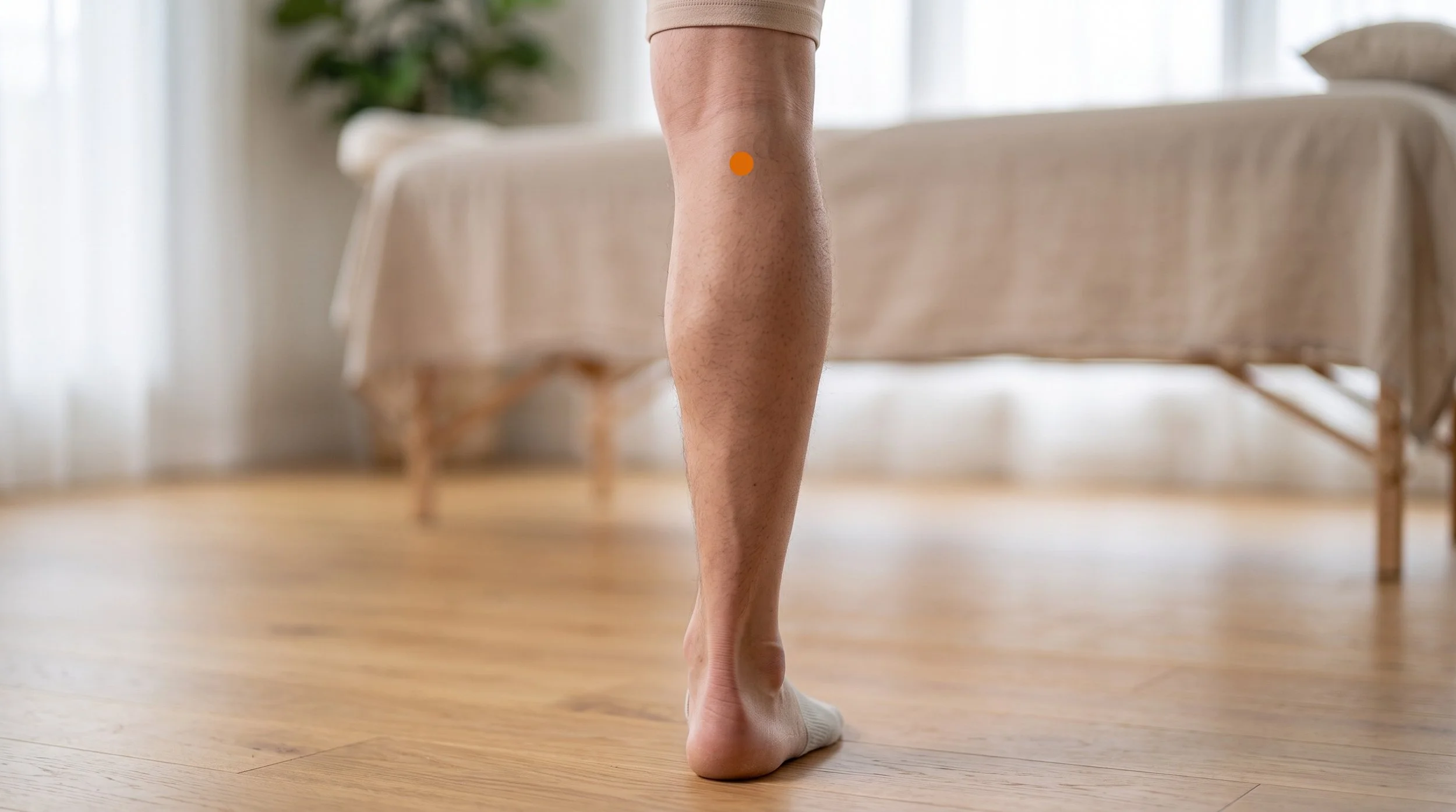
BL55 Acupuncture Point (Heyang)
The Confluence of Yang Below the Knee: Anatomy, Mechanism, and Why This Upper Calf Point Bridges Back Pain and Leg Pain Treatment
BL55, known in Chinese as Heyang and usually translated as Confluence of Yang, sits on the back of the upper calf, about two finger widths (2 cun) below the crease of the knee, in the soft valley between the two bellies of the gastrocnemius. The name refers to the classical idea that the two branches of the Bladder channel, which run as separate lines down the back, come back together here into a single path (Cunningham, 2001).
Clinically the bl55 acupuncture point is a workhorse rather than a headline point: it gives direct access to the upper gastrocnemius and the tissue planes just below the popliteal fossa, which is exactly where runners, cyclists, dancers, and people who walk New York City in stiff shoes tend to accumulate tightness. Traditional texts also credit bladder 55 with actions well beyond the leg, including stopping uterine bleeding and easing genital pain, indications that say a great deal about how classical practitioners thought about the Bladder channel's reach.
- Location and layers: BL55 is found 2 cun below BL40 on the line toward BL57, in the depression between the medial and lateral heads of gastrocnemius, with needling described as perpendicular insertion of 1 to 1.5 cun (Deadman & Al-Khafaji, 2007). The needle passes through skin and subcutaneous tissue into the upper gastrocnemius, close to the intermuscular groove.
- Traditional actions translated: classical sources describe BL55 as activating the channel and relieving pain, and as stopping uterine bleeding and treating genital pain (Deadman & Al-Khafaji, 2007; Kim, 2010). In modern terms those are best read as effects on a segmentally shared pool of spinal cord neurons rather than as literal movement of qi.
- Nerve geography: the region is supplied superficially by the medial sural cutaneous nerve and more deeply by the tibial nerve, with the popliteal vessels lying deep to the point (Cheng, 1987). Needle stimulation here recruits A-delta and group III muscle afferents that feed L5 to S2 segments, the same levels that carry sensation from the low back, buttock, and posterior thigh (Zhao, 2008).
- Mechanism story: needling that produces de qi has been shown to raise local skin and muscle blood flow, an effect attributed to local axon reflexes and vasoactive peptide release (Sandberg et al., 2003). Central mechanisms, including opioid mediated descending inhibition from the periaqueductal gray and rostral ventromedial medulla, help explain relief felt beyond the needled leg (Zhao, 2008).
- Research picture: no trial has isolated BL55 by itself, so the evidence comes from multi-point protocols for low back pain, knee osteoarthritis, and calf myofascial pain in which points like this one commonly appear (Mu et al., 2020; Manheimer et al., 2010; Vickers et al., 2018). Effects on pain tend to be modest but consistent, and gastrocnemius-specific needling studies suggest measurable short-term reductions in resting muscle stiffness (Albin et al., 2020).
- What the needle feels like: most people report a deep, dull heaviness or spreading ache in the upper calf, sometimes travelling toward the heel. A sharp electric sensation into the foot suggests contact with the tibial nerve and means the needle should be withdrawn and redirected, so we treat that sensation as a signal, not a goal.
Tight Calves or Nagging Pain Behind the Knee?
Upper calf tightness rarely stays local: it changes how you push off, loads the Achilles, and often keeps posterior knee pain simmering for months. At Morningside Acupuncture we use BL55 alongside BL40 and BL57 to reach the gastrocnemius where it is thickest, and we pair that needling with movement assessment so the change holds between visits. Patients often notice easier stair descent and less morning stiffness within a few sessions. Book a visit and we'll map out what your calf is actually doing.
Schedule NowAnatomy of BL55: Why the Groove Between the Gastrocnemius Heads Is Such an Important Location
Directly under the skin at BL55 lie thin subcutaneous fat and fascia, then the upper bellies of the medial and lateral heads of gastrocnemius as they separate from their femoral origins just below the knee. This is a high-load zone: the gastrocnemius crosses both the knee and the ankle, so it works during push-off in walking and running, during eccentric control on stairs and hills, and during the constant low-grade bracing that comes with rigid shoes, heels, or long days on hard sidewalks.
Because the muscle is at its bulkiest here, taut bands and tender nodules in this region are common, and the classic gastrocnemius referral pattern can send discomfort up behind the knee or down toward the arch (Simons et al., 1999). Palpation before needling usually finds a distinct soft depression between the two heads, which is the target that the classical texts describe (Deadman & Al-Khafaji, 2007).
The sensory story here is layered. Skin and superficial tissue at BL55 are supplied largely by the medial sural cutaneous nerve, while deeper structures sit in the territory of the tibial nerve, with the popliteal vessels running beneath (Cheng, 1987). Those nerves carry fibers entering the spinal cord at roughly L5 through S2, the same segments that receive input from the lower lumbar spine, sacroiliac region, and posterior thigh.
When a needle stimulates muscle afferents in this zone, the resulting barrage reaches dorsal horn neurons that also receive input from those other structures, and this segmental convergence is one reason a leg point may influence a back complaint. Stimulation also engages supraspinal circuits that release endogenous opioids and monoamines to dampen incoming nociceptive traffic, the descending inhibition model that underpins much of modern acupuncture analgesia research (Zhao, 2008).
Deep to the point sit the popliteal artery and vein as they descend into the calf and become the posterior tibial vessels, along with the small saphenous vein superficially and the tibial nerve running centrally (Cheng, 1987). Standard practice is perpendicular insertion of 1 to 1.5 cun, angling within the muscle rather than driving straight toward the midline neurovascular bundle (Deadman & Al-Khafaji, 2007). Practitioners palpate for pulsation before inserting, withdraw and redirect if the patient reports a sharp electrical sensation shooting into the foot, and use shallower depths in slim patients.
A swollen, warm, unilaterally painful calf is not a case for needling: that presentation needs medical assessment to rule out deep vein thrombosis first, and we refer rather than treat when it appears.
Related Acupuncture For Knee Pain Related Acupuncture For Low Back PainBL55 at a Glance: Classification, Location, and Clinical Use
| Category | Detail |
|---|---|
| Traditional Name | Heyang (Confluence of Yang), also translated as Uniting Yang |
| Channel Classification | Fifty-fifth point of the Bladder channel of Foot Taiyang, on the posterior lower leg |
| Point Categories | No five-shu, luo-connecting, xi-cleft, or extraordinary vessel designation is recorded for this point in the standard references. It is described instead as the place where the two branches of the Bladder channel on the back of the leg rejoin into a single course, which is what the name Confluence of Yang refers to (Cunningham, 2001). |
| Precise Location | On the back of the lower leg, 2 cun below BL40 on the line joining BL40 and BL57, in the depression between the medial and lateral heads of gastrocnemius. A practical method is to locate BL57 first, then find BL55 at the upper quarter of the BL40 to BL57 line (Deadman & Al-Khafaji, 2007). |
| Tissue Stimulated | Skin and fascia of the posterior calf, then the upper bellies of the medial and lateral heads of gastrocnemius; overlaps clinically with gastrocnemius trigger points and broader calf trigger point patterns |
| Needle Depth / Direction | Perpendicular insertion 1 to 1.5 cun into the muscular groove; shallower in slim patients, avoiding the deep midline neurovascular bundle |
| De Qi Sensation | Deep, heavy, spreading ache in the upper calf, sometimes travelling toward the heel or up behind the knee; a sharp electric sensation into the foot means redirect |
| Primary Clinical Uses | Calf tightness and cramping, posterior knee pain, low back pain that radiates into the leg, heaviness and difficulty walking; traditionally also used for uterine bleeding and genital pain |
| Common Point Combinations |
|
Deadman's Manual of Acupuncture presents BL55 with two traditional actions: activating the channel to relieve pain, and stopping uterine bleeding while treating pain of the genitals. Its classical indication list runs from lumbar pain that radiates into the abdomen, heat felt in the inner thigh, and knees that feel hot, heavy, and hard to walk on, through to uterine bleeding, vaginal discharge, sudden severe genital pain, and cold shan disorder (Deadman & Al-Khafaji, 2007).
Cunningham's commentary adds that the main practical use has always been local, for calf pain and spasm, with low back pain responding best when the point is tender to pressure, and lists gynecological complaints as an adjunct role (Cunningham, 2001). These are traditional attributions rather than modern clinical claims. What makes the pattern striking is its geography: a point on the back of the calf, credited with influence over the pelvis and reproductive tract, which fits the classical picture of the Bladder channel as a long posterior circuit connecting the lower limb to the lumbar and pelvic interior.
Why BL55 Is Used for Low Back Pain That Radiates Down the Leg
The classical indication of lumbar pain radiating outward looks strange until you follow the nerves. Sensation from the upper calf enters the spinal cord around L5 to S2, and those same segments receive input from the lower lumbar spine, the sacroiliac region, gluteal muscles, and posterior thigh. Dorsal horn neurons at those levels are not private lines: they pool input from skin, muscle, joint, and viscera, which is why irritation in one structure can be felt in another.
Needling BL55 delivers a strong, well-defined afferent volley into that pool, and in a sensitized system that input can shift how the segment processes everything else arriving there (Zhao, 2008).
The second half of the story is central. Sustained needle stimulation activates midbrain and brainstem circuits that release endorphins, enkephalins, serotonin, and noradrenaline onto the spinal cord, turning down pain transmission more broadly than any one segment can explain (Zhao, 2008). This is why patients sometimes report that a calf needle eased a low back ache, or that the whole leg felt less guarded after treatment.
Individual patient data from nearly 21,000 people across chronic pain trials found acupuncture superior to both sham and no-acupuncture controls, with effects persisting over months rather than fading immediately, which supports the idea that something more than momentary distraction is at work (Vickers et al., 2018).
Locally, needling changes the tissue itself. Measurements using photoplethysmography found that needle stimulation of leg muscle increased both skin and muscle blood flow, with the largest response when de qi was elicited (Sandberg et al., 2003). In a chronically tight upper calf, improved perfusion plus reduced resting muscle stiffness after needling of gastrocnemius trigger points offers a plausible account of why the calf feels looser and lengthens more easily afterward (Albin et al., 2020). We frame this as a window of opportunity: the needling makes movement more comfortable, and the loading you do next is what makes the change stick.
What the Research Shows for BL55
There is no clinical trial testing BL55 on its own, and it would be misleading to suggest otherwise. What exists is evidence for acupuncture protocols in which posterior leg and lumbar points are routinely included, plus mechanistic work on what needling does to muscle and to pain processing. Reviews of this literature consistently describe modest to moderate benefits with meaningful variability between trials, so the honest framing is that BL55 is one component of a reasoned treatment plan rather than a treatment in itself.
| Study | Type | Focus | Key Finding |
|---|---|---|---|
| Mu et al., 2020 | Cochrane systematic review | Acupuncture for chronic nonspecific low back pain (33 studies, 8,270 participants) | Compared with no treatment, acupuncture produced greater pain relief and improved back function, though certainty of evidence ranged from moderate to very low and results against sham were smaller. |
| Manheimer et al., 2010 | Cochrane systematic review | Acupuncture for peripheral joint osteoarthritis, mostly knee | Short-term improvements in pain and function versus sham reached statistical significance but fell below the reviewers' thresholds for clinical relevance, while comparisons against waiting list controls were larger. |
| Vickers et al., 2018 | Individual patient data meta-analysis | Chronic musculoskeletal, headache, and osteoarthritis pain across 39 trials | Acupuncture outperformed both sham and no-acupuncture controls, and treatment effects persisted over roughly a year with only modest decline. |
| Albin et al., 2020 | Randomized controlled trial | Dry needling of latent gastrocnemius trigger points in 102 participants | Resting muscle stiffness at the trigger point site was lower after needling than after sham, while contracted stiffness and strength showed no significant between-group differences. |
| Sandberg et al., 2003 | Experimental physiological study | Skin and muscle blood flow after needling of the lower leg | Needle stimulation increased local skin and muscle blood flow, with the strongest response when needling elicited de qi rather than superficial insertion alone. |
Low Back Pain That Travels Down Your Leg?
When back pain refers into the buttock, hamstring, or calf, treating the lumbar spine alone often leaves part of the picture untouched. We combine local lumbar points such as BL23 with leg points including the bl55 acupuncture point, using the shared L5 to S2 segmental relationship to calm an irritable pathway from both ends. Treatment is paired with practical loading advice so progress carries into your week. Schedule an appointment and let's address the whole line, not just the sore spot.
Schedule NowBL55 in the Context of Trigger Point Work
The bl 55 calf location sits squarely over territory that trigger point clinicians already treat. The proximal medial and lateral gastrocnemius commonly harbor taut bands, and their referral patterns include the back of the knee, the calf itself, and sometimes the instep, which overlaps neatly with the classical indications for this point (Simons et al., 1999).
At Morningside we palpate first and let the tissue decide the exact entry: if a tender band sits a finger width off the textbook spot, we needle the band. Acupuncture, in our framing, is defined by the use of an acupuncture needle, so classical point needling and dry needling of a gastrocnemius trigger point are variations of the same intervention rather than competing systems.
In a typical session for calf and posterior knee complaints, BL55 anchors the upper calf while dry needling addresses the medial gastrocnemius, soleus, and often tibialis posterior when the symptom pattern extends into the medial shin or arch. Needling reduces resting stiffness at the treated site in controlled comparisons, which is useful but temporary on its own (Albin et al., 2020). We therefore follow needling with calf loading, ankle mobility work, and gait or footwear adjustments so that the tissue keeps the length it just gained. If low back pain is driving the picture, lumbar segmental needling joins the plan rather than replacing the leg work.
BL55 Calf and Back Pain Treatment at NYC's Highest-Rated Acupuncture Clinic
Morningside Acupuncture is the highest-rated acupuncture and dry needling clinic in New York City with over 500 five-star Google reviews, and our approach blends classical point selection with sports medicine style assessment. We treat calf tightness, posterior knee pain, and radiating low back pain using points like Heyang together with targeted dry needling of the gastrocnemius and soleus. Every session includes clear reasoning about why each point was chosen and what to do between visits. Schedule your appointment today.
Schedule NowFrequently Asked Questions
What does BL55 feel like when needled?
Most patients describe a deep, heavy, slightly achy fullness in the upper calf that can spread down toward the heel or up behind the knee. That sensation is de qi, and it reflects stimulation of muscle afferents rather than skin receptors. If a taut band is present you may feel a brief twitch, which is normal and usually followed by a sense of release. A sharp, electric sensation shooting into the foot is different: it suggests the tibial nerve, and your practitioner should withdraw and redirect the needle immediately.
Why needle the calf when my pain is in my low back?
Sensation from the upper calf enters the spinal cord at roughly L5 through S2, the same segments that receive input from the lower lumbar spine and buttock. Those neurons pool input from many structures, so stimulating one input can change how the segment handles the rest, a phenomenon called segmental convergence. Needling also recruits descending inhibitory pathways that release endogenous opioids and monoamines, which reduces pain transmission more broadly (Zhao, 2008). Classical texts arrived at a similar conclusion by a different route, listing lumbar pain among Heyang's main indications (Deadman & Al-Khafaji, 2007).
Can I press BL55 myself between sessions?
Yes, and it is one of the easier points to self-treat. Sit with your knee bent and your foot supported, find the crease behind your knee, then move about two thumb widths down into the soft groove between the two muscle bellies. Press with your thumb or a knuckle at a firm but tolerable intensity, hold for 20 to 30 seconds, release, and repeat for two to three minutes per leg. A small massage ball against a wall or on the edge of a chair works well too. Do this once or twice daily, follow it with a gentle calf stretch or a few slow heel raises, and stop if pressure produces numbness, tingling, or sharp pain into the foot.
Is BL55 safe to needle?
In trained hands it is a routine, well-tolerated point. The main considerations are the tibial nerve and popliteal vessels running deep to it, which is why practitioners palpate for pulsation, keep insertion within the muscle, and redirect if an electric sensation occurs. Depth is adjusted for body size rather than applied by formula, and extra caution applies for patients on anticoagulants or with bleeding disorders. Needling is not appropriate over a calf that is swollen, warm, and painful on one side without an explanation, since that presentation needs medical evaluation for deep vein thrombosis first.
Where exactly is BL55 located?
The heyang point location is on the back of the lower leg, 2 cun below BL40 in the middle of the knee crease, on the line running from BL40 to BL57, in the depression between the medial and lateral heads of the gastrocnemius (Deadman & Al-Khafaji, 2007). A reliable shortcut is to find BL57 at the lower border of the calf muscle belly first, then take the upper quarter of the line between BL40 and BL57. To find it on yourself, place a finger in the center of the knee crease, slide roughly two thumb widths straight down, and feel for the soft valley between the two muscle bellies.
References
- Deadman, P., Al-Khafaji, M., & Baker, K. (2009). A manual of acupuncture. Journal of Chinese Medicine Publications.
- Cunningham, P. M. (2000). Acupuncture points: A practical guide to classical and modern usage. Odyssey Press.
- Cheng, X. (Ed.). (1999). Chinese acupuncture and moxibustion (Rev. ed.). Foreign Languages Press.
- Kim, H. (2008). Handbook of Oriental medicine (3rd ed.). Harmony & Balance Press.
- Maciocia, G. (2006). The channels of acupuncture: Clinical use of the secondary channels and eight extraordinary vessels. Churchill Livingstone Elsevier.
- Simons, D. G., Travell, J. G., & Simons, L. S. (1999). Travell & Simons' myofascial pain and dysfunction: The trigger point manual, Vol. 1: Upper half of body (2nd ed.). Williams & Wilkins.
- Mu, J., Furlan, A. D., Lam, W. Y., Hsu, M. Y., Ning, Z., & Lao, L. (2020). Acupuncture for chronic nonspecific low back pain. Cochrane Database of Systematic Reviews, 2020(12), CD013814. https://doi.org/10.1002/14651858.CD013814
- Manheimer, E., Cheng, K., Linde, K., Lao, L., Yoo, J., Wieland, S., van der Windt, D. A. W. M., Berman, B. M., & Bouter, L. M. (2010). Acupuncture for peripheral joint osteoarthritis. Cochrane Database of Systematic Reviews, 2010(1), CD001977. https://doi.org/10.1002/14651858.CD001977.pub2
- Vickers, A. J., Vertosick, E. A., Lewith, G., MacPherson, H., Foster, N. E., Sherman, K. J., Irnich, D., Witt, C. M., & Linde, K. (2018). Acupuncture for chronic pain: Update of an individual patient data meta-analysis. Journal of Pain, 19(5), 455-474. https://doi.org/10.1016/j.jpain.2017.11.005
- Zhao, Z. Q. (2008). Neural mechanism underlying acupuncture analgesia. Progress in Neurobiology, 85(4), 355-375. https://doi.org/10.1016/j.pneurobio.2008.05.004
- Sandberg, M., Lundeberg, T., Lindberg, L. G., & Gerdle, B. (2003). Effects of acupuncture on skin and muscle blood flow in healthy subjects. European Journal of Applied Physiology, 90(1-2), 114-119. https://doi.org/10.1007/s00421-003-0825-3
- Albin, S. R., Koppenhaver, S. L., MacDonald, C. W., Capoccia, S., Ngo, D., Phippen, S., Pineda, R., Wendlandt, A., & Hoffman, L. R. (2020). The effect of dry needling on gastrocnemius muscle stiffness and strength in participants with latent trigger points. Journal of Electromyography and Kinesiology, 55, 102479. https://doi.org/10.1016/j.jelekin.2020.102479
Disclaimer: This web site is intended for educational and informational purposes only. Reading this website does not constitute providing medical advice or any professional services. This information should not be used for diagnosing or treating any health issue or disease. Those seeking medical advice should consult with a licensed physician. Seek the advice of a medical doctor or other qualified health professional for any medical condition. If you think you have a medical emergency, call 911 or go to the emergency room. No acupuncturist-patient relationship is created by reading this website or using the information. Morningside Acupuncture PLLC and its employees and contributors do not make any express or implied representations with respect to the information on this site or its use. For any legal interpretation of scope of practice in your state, consult a licensed attorney or regulatory authority.
Read more from our blog