BL54 Acupuncture Point (Zhibian)
BL54 Acupuncture Point (Zhibian)
The Deepest Point on the Outer Bladder Line: Anatomy, Mechanism, and Why BL54 Anchors Sciatica, Deep Gluteal and Pelvic Floor Treatment
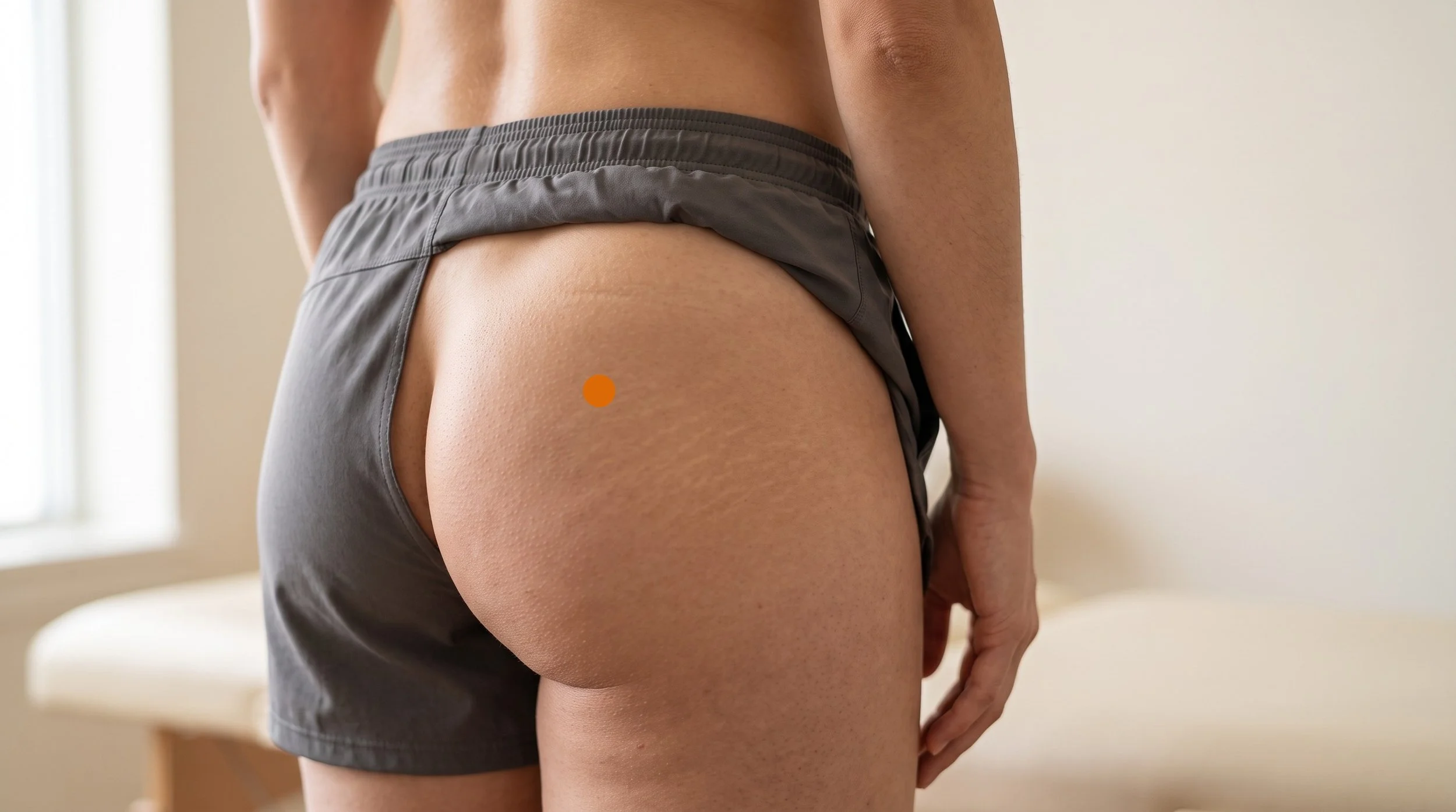
BL54 (Zhibian, often translated as Order's Limit or Sequence Edge) is the last and lowest point of the outer branch of the Bladder channel, sitting in the meat of the buttock 3 cun lateral to the sacro-coccygeal hiatus, roughly level with the fourth sacral foramen.
It's one of the deepest points routinely needled in clinical practice, and that depth is the whole story: a needle at the bl54 acupuncture point passes through gluteus maximus and arrives in the deep gluteal space, close to piriformis, the sciatic nerve as it leaves the greater sciatic foramen, and the inferior gluteal and pudendal neurovascular territories.
Classically, Zhibian was used for lumbar, sacral and buttock pain, sciatic-type leg pain, difficult urination and haemorrhoids (Deadman et al., 2001). In a modern clinic, bladder 54 shows up in almost every deep gluteal syndrome, sciatica and pelvic floor protocol we run, because no other point on the back line reaches that layer so directly.
- Location and layers: BL54 sits on the buttock 3 cun lateral to the sacro-coccygeal hiatus, level with the fourth sacral foramen, and is needled perpendicularly 1.5 to 2.5 cun or angled toward the anus or genitals 2 to 3 cun for pelvic complaints (Deadman et al., 2001). The needle traverses skin, subcutaneous fat and gluteus maximus before entering the deep gluteal layer over piriformis.
- Traditional attributions: classical sources credit Zhibian with benefiting the lumbar region, freeing the channel and easing pain, plus regulating urination and treating haemorrhoids, with indications spanning cold and aching low back pain, buttock and leg pain, difficult urination, retention, and genital pain (Deadman et al., 2001). Later commentary also groups it with points that strengthen the back and drain the lower burner (Cunningham, 1996).
- Mechanism: the point overlies sacral plexus territory (roughly S1 to S3), so needling recruits deep somatic afferents that converge in the same dorsal horn segments as the gluteal muscles, the hip capsule, the rectum and the bladder, which is the plainest explanation for its dual musculoskeletal and pelvic reputation (Zhao, 2008).
- Research picture: acupuncture protocols that include deep gluteal points have outperformed sham for chronic sciatica from disc herniation, with benefit maintained at one year (Tu et al., 2024), while systematic review evidence for sciatica overall remains promising but methodologically limited (Qin et al., 2015).
- Point-specific physiology: an ultrasound-guided study of BL54 found that needling deep enough to reach the pudendal nerve region produced measurable changes in pudendal artery flow, bladder volume and needle sensation compared with superficial needling, which supports the traditional urinary indications in physiological rather than energetic terms (Dai et al., 2024).
- De qi and practice framing: patients typically report a heavy, spreading ache deep in the buttock, sometimes travelling down the back of the thigh, and BL54 is best palpated first and needled when genuinely tender, alongside GB30 and BL53, in any presentation where pain radiates from the buttock into the leg (Deadman et al., 2001).
Sciatica or Deep Buttock Pain That Will Not Settle?
When leg pain starts in the buttock rather than the spine, superficial treatment rarely reaches the problem. We palpate BL54 and GB30 carefully, needle the deep gluteal layer when it reproduces your familiar symptoms, and pair that with dry needling of piriformis and the gluteal muscles. Most patients notice a change in how the buttock loads within the first few sessions. Schedule a consultation and let's map where your pain actually starts.
Schedule NowAnatomy of BL54: Why the Deep Gluteal Space Is Such an Important Location
From the surface, BL54 lies over the thick muscular belly of gluteus maximus, the largest and most powerful hip extensor, which loads heavily during stair climbing, hill running, deadlifting, and getting up from a low chair. Below and deep to it sit the short external rotators, including piriformis, which crosses the greater sciatic foramen and divides that opening into upper and lower compartments.
Prolonged sitting, asymmetric standing habits, hip-dominant training, and post-injury guarding all leave this layer stiff and tender, which is why the point is so often exquisitely sore on palpation in people with buttock-dominant pain (Simons et al., 1999).
The nerve geography here explains most of BL54's clinical range. The sciatic nerve emerges below piriformis, accompanied by the posterior femoral cutaneous nerve and the inferior gluteal nerve and vessels, while the pudendal neurovascular bundle passes nearby on its way toward the perineum. The muscles, joints and viscera of this region share sacral segmental innervation, so afferent input from a needle in the deep gluteal layer converges on the same spinal segments that receive signals from the hip, the sacroiliac joint, the rectum and the bladder.
That convergence, combined with activation of descending inhibitory pathways from the midbrain and brainstem, is the accepted framework for how needling at a point like this modulates both local and referred pain (Zhao, 2008). Broadly, individual patient data from high-quality trials support acupuncture as a real and persistent effect in chronic musculoskeletal pain rather than a purely expectancy-driven one (Vickers et al., 2018).
Because the inferior gluteal artery and the internal pudendal vessels run in this territory, BL54 is a point where depth demands training rather than enthusiasm. Standard practice is perpendicular insertion of 1.5 to 2.5 cun, or angling toward the anus or genitals 2 to 3 cun when the goal is a pelvic or urogenital response (Deadman et al., 2001). Skilled needling aims to produce a deep, spreading ache rather than a sharp electric jolt; if a patient reports a lightning-like sensation shooting to the foot, the needle is withdrawn and redirected.
In heavier patients the target layer sits considerably deeper, so needle length and angle are selected individually, and in our clinic ultrasound-informed anatomical reasoning guides how far we're willing to go (Dai et al., 2024).
Related Acupuncture For Piriformis Trigger Points Related Gluteus Maximus Trigger PointsBL54 at a Glance: Classification, Location, and Clinical Use
| Category | Detail |
|---|---|
| Traditional Name | Zhibian (Order's Limit, also translated as Sequence Edge or Lowermost Edge) |
| Channel Classification | Bladder channel of Foot Taiyang, point 54, the final and lowest point of the outer (second) lateral Bladder line on the back |
| Point Categories | No five-shu, luo-connecting, xi-cleft, hui-meeting or extraordinary vessel designation is recorded for this point in the classical sources consulted; it is defined positionally as the lowest point of the outer Bladder line in the gluteal region (Deadman et al., 2001) |
| Precise Location | On the buttock, in the depression 3 cun lateral to the sacro-coccygeal hiatus, level with the fourth sacral foramen; the hiatus is the dip between the sacral and coccygeal cornua, and the point can also be approximated midway between the midline and the lateral edge of the buttock when that edge is pressed firmly inward |
| Tissue Stimulated | Gluteus maximus at the intermediate layer (gluteus maximus trigger points), then the deep gluteal space over piriformis and the short external rotators (piriformis trigger points), with pudendal and pelvic floor territory nearby (pelvic floor trigger points) |
| Needle Depth / Direction | Perpendicular 1.5 to 2.5 cun for buttock, hip and sciatic complaints; angled toward the anus or genitals 2 to 3 cun for pelvic, anal and urogenital indications; one of the deepest commonly needled points on the body |
| De Qi Sensation | A heavy, dull, distending ache deep in the buttock, often spreading toward the hip or down the back of the thigh; with angled needling the sensation may travel toward the perineum, anus or lower abdomen |
| Primary Clinical Uses | Sciatica and deep buttock pain, low back and sacral pain including chronic aching and cold-type presentations, hip and posterior thigh pain, urinary hesitancy and retention patterns, haemorrhoids and pelvic floor complaints |
| Common Point Combinations |
|
Deadman's A Manual of Acupuncture treats Zhibian as an indispensable point for pain of the lumbar region, sacrum and buttocks, and for sciatic-type leg pain, describing it as one of the points that ought to be pressed and, if sore, needled whenever symptoms radiate from the buttock down the leg. The text also relays a Ming dynasty source, Yan Zhen-shi's Investigation Into Points Along the Channels, which listed the point for lumbar aching arising from Kidney weakness together with seminal emission and turbid vaginal discharge, and it notes that several classics recommended it for swollen haemorrhoids.
Traditionally, then, BL54 was never framed purely as a point for stagnation-type blockage; it was equally a point for the tired, cold, weak low back, and for a cluster of pelvic and urinary complaints in the tissues it lies over. What's striking is how neatly that split maps onto modern anatomy: one classical column corresponds to the deep gluteal muscles and sciatic pathway, and the other to the sacral and pudendal supply of the pelvic organs.
Why BL54 Is Used for Urinary and Pelvic Floor Symptoms as Well as Sciatica
The link between a buttock point and bladder symptoms looks strange until you follow the nerves. The gluteal muscles, the sacroiliac joint, the pelvic floor, the rectum and the bladder all draw sensory and motor supply from the sacral segments, and their signals arrive at overlapping regions of the spinal cord. When afferent fibers from the deep gluteal layer are stimulated, the spinal segments that also process pelvic input receive a strong, competing volley of information, which can change how those segments respond to ongoing irritation from below (Zhao, 2008).
This is the same convergence principle that explains why hip pathology sometimes presents as groin pain and why pelvic floor tension can masquerade as tailbone or buttock ache.
Beyond the segment, needling recruits descending pain control pathways that run from the midbrain and brainstem back down to the dorsal horn, dampening transmission more broadly and contributing to the effects patients often notice on the opposite side or hours after a session (Zhao, 2008). Pooled individual patient data from high-quality randomized trials indicate that these effects in chronic pain are larger than sham comparison alone would predict and persist meaningfully over time (Vickers et al., 2018).
There is also point-specific physiological evidence for BL54. In an ultrasound-guided study, needling deep enough to reach the pudendal nerve region produced greater changes in pudendal artery blood flow velocity, bladder volume and reported needle sensation than superficial needling at the same location (Dai et al., 2024). That doesn't prove clinical benefit for any particular urinary condition, but it does show that depth at this point is not cosmetic: what the needle reaches determines what the body does in response.
What the Research Shows for BL54
A caution worth stating up front: almost no trial isolates a single point. The studies below tested multi-point protocols for sciatica and low back pain in which deep gluteal points like BL54 and GB30 are standard inclusions, so the fair reading is that BL54 is a well-supported component of protocols that have been tested, not an independently proven intervention. The one exception is a small mechanistic study that needled BL54 alone under ultrasound guidance, which tells us about physiology rather than clinical outcomes.
| Study | Type | Focus | Key Finding |
|---|---|---|---|
| Tu et al., 2024 | Multicenter randomized sham-controlled trial | Chronic sciatica from herniated disk, 216 patients, 10 sessions over 4 weeks | Acupuncture produced greater reductions in leg pain and disability than sham at week 4, with benefits reported through week 52, though sham-controlled designs in acupuncture remain debated. |
| Qin et al., 2015 | Systematic review and meta-analysis | Acupuncture for sciatica across 11 randomized controlled trials | Acupuncture may be more effective than drug therapy and may add to it, but the authors judged the evidence limited by the small number of rigorous trials. |
| Rizzo et al., 2025 | Cochrane overview of reviews | Non-pharmacological and non-surgical treatments for low back pain in adults | Acupuncture emerged among the better-supported non-drug options for chronic low back pain on pain and function outcomes. |
| Mu et al., 2020 | Cochrane systematic review | Acupuncture for chronic nonspecific low back pain | Acupuncture improved pain and function versus no treatment or usual care, while differences from sham did not reach the review's threshold for clinical relevance. |
| Dai et al., 2024 | Randomized mechanistic study with ultrasound guidance | Deep versus superficial needling at BL54 in 74 healthy women | Deep needling toward the pudendal nerve region was associated with greater changes in pudendal artery flow, bladder volume and needle sensation than superficial needling. |
| Vickers et al., 2018 | Individual patient data meta-analysis | Acupuncture across roughly 20,000 patients with chronic pain conditions | Effects exceeded both sham and no-acupuncture controls and were largely sustained at one year, supporting acupuncture as more than a short-lived placebo response. |
Pelvic Floor Tension, Urinary Urgency, or Tailbone Pain?
BL54 sits close to the pudendal territory, which is why we use it in pelvic floor protocols alongside sacral points and gentle abdominal work. Treatment is always graded, communicated in advance, and adapted to your comfort level. For many people, calming the deep gluteal and pelvic muscles changes how the whole region feels within a few weeks. Book a session to talk through a plan that fits your history.
Schedule NowBL54 in the Context of Trigger Point Work
The location of BL54 sits squarely in territory that trigger point clinicians already treat. Gluteus maximus refers pain across the buttock and into the sacral region, gluteus medius and minimus refer down the lateral hip and leg in a pattern patients and clinicians alike frequently label sciatica, and piriformis and the short external rotators refer deep into the buttock and posterior thigh while sitting directly on the sciatic nerve (Simons et al., 1999).
At Morningside, we palpate all of these before we needle. If pressing at or near BL54 reproduces the exact pain a patient came in with, we treat that layer, and the classical point and the myofascial target are effectively the same needle.
In practice this means a bl 54 sciatica session often combines a deep gluteal insertion at Zhibian with dry needling of piriformis, gluteus medius and gluteus minimus, plus GB30 when the lateral hip is involved and distal points such as BL40 or GB34 to reach the rest of the pathway. Dry needling is simply one style of acupuncture using the same filiform needle, so there is no meaningful technical divide between the two approaches here, only different reasoning about why the point was chosen.
We add movement retraining for hip extension and rotation, because the deep gluteal layer rarely stays quiet if the mechanics that irritated it go unchanged.
BL54 Sciatica Treatment at NYC's Highest-Rated Acupuncture Clinic
Morningside Acupuncture is the highest-rated acupuncture and dry needling clinic in New York City with over 500 five-star Google reviews, and deep gluteal pain is one of the presentations we see most. Every session combines classical point selection with trigger point needling, movement screening, and clear home guidance. You'll leave knowing what we found and what we're targeting next. Schedule your visit and get a straight answer about your sciatica.
Schedule NowFrequently Asked Questions
What does BL54 feel like when needled?
Most people describe a deep, heavy, spreading ache in the buttock that feels quite different from a surface prick, sometimes with a sense of pressure travelling toward the hip or down the back of the thigh. That dull, distending quality is de qi, and it's what we're aiming for. Sharp, electric, lightning-like sensations shooting to the foot are not the goal, and if that happens the needle is withdrawn and redirected immediately. Some soreness in the buttock for a day afterward, similar to post-workout muscle soreness, is common and settles quickly.
Why needle my buttock when my pain runs down my calf?
Because the calf pain often starts higher up. The sciatic nerve exits the pelvis right under the depth BL54 reaches, and the gluteal muscles at that level refer pain down the leg in patterns that closely mimic nerve pain (Simons et al., 1999). Needling where the pathway is compressed or irritated, rather than only where the symptom is felt, addresses the source. We usually still add distal points on the same pathway, because the classical sciatica groupings combine BL54 with points at the knee and ankle for exactly this reason (Deadman et al., 2001).
Can I press BL54 myself between sessions?
Yes, and it's one of the easier points to self-treat because the target is broad. Find the tailbone, move about a hand's width out into the fleshy part of the buttock, and hunt for the tender spot. Use a thumb, a knuckle, a massage ball or a tennis ball against a wall, and apply steady pressure at a comfortable intensity for 60 to 90 seconds per side, breathing slowly and letting the muscle soften rather than bracing against the pressure. Two or three rounds, once or twice a day, is plenty. Pressure should reproduce a dull ache that eases as you hold; stop if it produces sharp, shooting or numb sensations down the leg, and mention that to your clinician instead.
Is BL54 safe to needle?
In trained hands, yes, but it deserves respect because it's one of the deepest points routinely used. The sciatic nerve, the inferior gluteal vessels and the pudendal neurovascular bundle all sit in this region, so needle length, angle and depth are chosen for each patient's body type rather than applied by formula. Practitioners avoid strong stimulation into the nerve itself and stop advancing at the first sign of an electric sensation. During pregnancy, and for anyone on anticoagulant therapy or with a bleeding disorder, we modify or avoid deep needling here. This is not a point for self-needling under any circumstances.
Where exactly is BL54 located?
On the buttock, 3 cun lateral to the sacro-coccygeal hiatus, level with the fourth sacral foramen (Deadman et al., 2001). To find the zhibian point location, trace down the midline of the sacrum to the small depression between the bony prominences just above the tailbone, then measure out about three thumb-widths to the side into the muscle of the buttock. A practical alternative is to press the outer edge of the buttock firmly inward with the palm and locate the point midway between the midline and that edge. It's level with BL30 and BL34 on the sacrum, and it sits above and lateral to the tailbone, not on it.
References
- Deadman, P., Al-Khafaji, M., & Baker, K. (2009). A manual of acupuncture. Journal of Chinese Medicine Publications.
- Cunningham, P. M. (2000). Acupuncture points: A practical guide to classical and modern usage. Odyssey Press.
- Simons, D. G., Travell, J. G., & Simons, L. S. (1999). Travell & Simons' myofascial pain and dysfunction: The trigger point manual, Vol. 1: Upper half of body (2nd ed.). Williams & Wilkins.
- Tu, J. F., Shi, G. X., Yan, S. Y., Ni, G. X., Yu, F. T., Cai, G. W., Ma, N., Chen, Y., Xie, W., Wang, T., Wang, L. Q., Liu, C. Z., & Zhu, J. (2024). Acupuncture vs sham acupuncture for chronic sciatica from herniated disk: A randomized clinical trial. JAMA Internal Medicine, 184(12), 1417-1424. https://doi.org/10.1001/jamainternmed.2024.5463
- Qin, Z., Liu, X., Wu, J., Zhai, Y., & Liu, Z. (2015). Effectiveness of acupuncture for treating sciatica: A systematic review and meta-analysis. Evidence-Based Complementary and Alternative Medicine, 2015, 425108. https://doi.org/10.1155/2015/425108
- Rizzo, R. R. N., Cashin, A. G., Wand, B. M., Ferraro, M. C., Sharma, S., Lee, H., O'Hagan, E., Maher, C. G., Furlan, A. D., van Tulder, M. W., & McAuley, J. H. (2025). Non-pharmacological and non-surgical treatments for low back pain in adults: An overview of Cochrane reviews. Cochrane Database of Systematic Reviews, 2025(3), CD014691. https://doi.org/10.1002/14651858.CD014691.pub2
- Mu, J., Furlan, A. D., Lam, W. Y., Hsu, M. Y., Ning, Z., & Lao, L. (2020). Acupuncture for chronic nonspecific low back pain. Cochrane Database of Systematic Reviews, 2020(12), CD013814. https://doi.org/10.1002/14651858.CD013814
- Dai, J., Zhang, X., Lian, F., Li, H., Tu, J., Chen, Y., & Jin, Z. (2024). Clinical study on improving the function of female bladder in controlling urine by acupuncture Zhibian (BL54) under ultrasound guidance. World Journal of Urology, 42(1), 300. https://doi.org/10.1007/s00345-024-05004-2
- Vickers, A. J., Vertosick, E. A., Lewith, G., MacPherson, H., Foster, N. E., Sherman, K. J., Irnich, D., Witt, C. M., & Linde, K. (2018). Acupuncture for chronic pain: Update of an individual patient data meta-analysis. Journal of Pain, 19(5), 455-474. https://doi.org/10.1016/j.jpain.2017.11.005
- Zhao, Z. Q. (2008). Neural mechanism underlying acupuncture analgesia. Progress in Neurobiology, 85(4), 355-375. https://doi.org/10.1016/j.pneurobio.2008.05.004
Disclaimer: This web site is intended for educational and informational purposes only. Reading this website does not constitute providing medical advice or any professional services. This information should not be used for diagnosing or treating any health issue or disease. Those seeking medical advice should consult with a licensed physician. Seek the advice of a medical doctor or other qualified health professional for any medical condition. If you think you have a medical emergency, call 911 or go to the emergency room. No acupuncturist-patient relationship is created by reading this website or using the information. Morningside Acupuncture PLLC and its employees and contributors do not make any express or implied representations with respect to the information on this site or its use. For any legal interpretation of scope of practice in your state, consult a licensed attorney or regulatory authority.
Read more from our blog