ST15 Acupuncture Point (Wuyi)
ST15 Acupuncture Point (Wuyi)
The Room Screen Over the Second Rib Space: Anatomy, Mechanism, and Why This Chest Point Matters for Breathing, Rib Pain, and Pectoral Tension
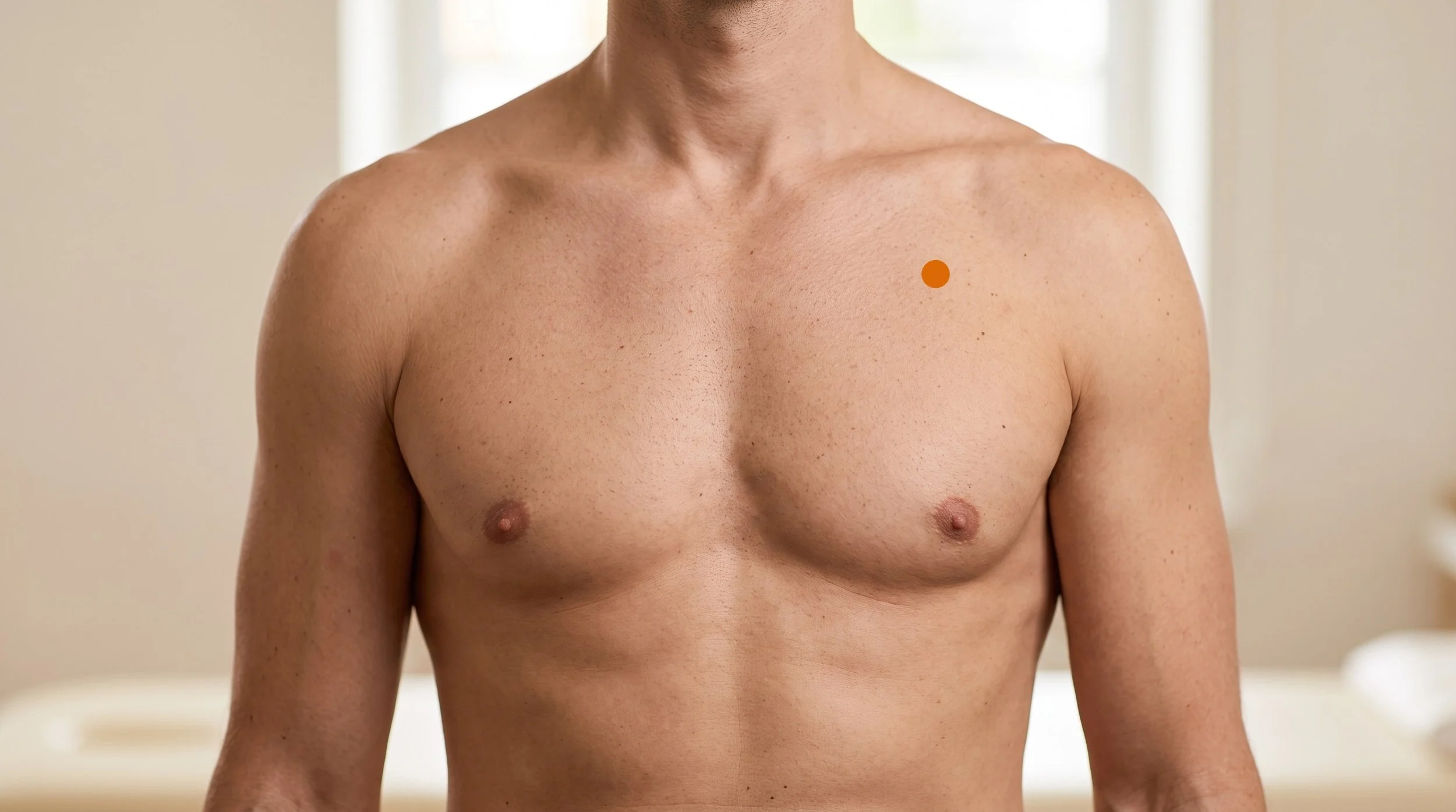
ST15 (Wuyi, often translated as Room Screen) is the third of the Stomach channel's chest points, sitting in the second intercostal space about 4 cun lateral to the midline on the nipple line, roughly two rib spaces above the nipple in most men. It lies directly over the upper fibers of pectoralis major, with pectoralis minor deeper and the intercostal muscles beneath that, which puts the st15 acupuncture point in the middle of the tissue that quietly drives a great deal of anterior chest tightness, shallow breathing, and rib-space soreness.
Classical texts group it with the chest points used for cough, wheeze, and a bound-up feeling in the chest, and they add an unusual set of skin indications (pain and itching of the skin) that make Wuyi one of the more distinctive points on the front of the torso. Clinically, it is a point we use for pectoral tension and breathing-pattern problems rather than for anything deep in the thorax, and it is needled shallowly and along the rib space for safety.
- Location and layers: stomach 15 sits in the second intercostal space on the mamillary line, passing through skin and superficial fascia into the upper pectoralis major, with pectoralis minor, the external and internal intercostals, and then the pleura and lung underneath. Because the lung sits close, the point is needled transverse-obliquely along the rib space, never deep or perpendicular (White, 2004).
- Traditional attributions translated: classical sources credit Wuyi with descending rebellious qi and unbinding the chest, benefiting the breasts, and easing skin pain and itching. In neurophysiological terms these map onto a chest-wall point that modulates thoracic segmental input, alters respiratory muscle tone, and influences autonomic outflow to skin and vasculature (Min et al., 2019).
- Nerve geography: the second and third intercostal nerves supply this territory, and they enter the cord at the same thoracic segments that carry input from the chest wall, upper ribs, and parts of the deep thorax. Segmental convergence at these levels is a plausible route by which needling here changes how chest sensations are processed (Zhao, 2008).
- Myofascial overlap: ST15 sits in the heart of the pectoralis major and pectoralis minor trigger point territory, a referral pattern that spreads across the front of the chest and can travel down the inner arm and mimic other problems (Simons et al., 1999). Trials of dry needling for upper-quarter myofascial pain suggest short-term pain reduction compared with sham (Kietrys et al., 2013).
- Research picture: no trial has isolated ST15, so evidence is indirect. Cochrane review of acupuncture for chronic asthma found the trial evidence too limited and inconsistent to support recommendations (McCarney et al., 2004), while a placebo-controlled trial in COPD reported reduced exertional breathlessness with a multi-point protocol (Suzuki et al., 2012).
- De qi and dosing: needled correctly, the st 15 location produces a mild spreading heaviness along the rib space rather than a sharp sensation, and the pectoral fibers may twitch briefly if a taut band is engaged. Sessions are typically weekly for four to six visits before reassessing, consistent with how chronic pain benefit accrues in the pooled data (Vickers et al., 2018).
Tight Chest, Shallow Breathing, or Front-of-Chest Soreness?
Many people who come to us describing chest tightness, breath-holding, or a band of soreness across the upper chest turn out to have irritable pectoral and intercostal tissue rather than anything wrong inside the thorax.
At Morningside Acupuncture we use ST15 alongside gentle chest-wall needling, breath retraining, and shoulder work to help that tissue let go. Treatment here is shallow, angled along the rib space, and always explained before we start. Book a visit and we'll assess what is actually driving the tightness.
Schedule NowAnatomy of ST15: Why the Second Intercostal Space Is Such an Important Location
Under the skin and superficial fascia at ST15 lie the upper and middle fibers of pectoralis major, with pectoralis minor deeper and slightly lateral, and the external and internal intercostal muscles bridging the second and third ribs beneath that. This is loaded tissue: pectoralis major works in every push, carry, and reach across the body, pectoralis minor tips the scapula forward and gets short in sustained desk and phone postures, and the intercostals work continuously with every breath.
Sustained upper chest breathing, a rounded-shoulder posture, and heavy pressing work all leave this region tender, and palpation over the second rib space frequently finds taut, ropey bands well before any imaging finding shows up.
Sensory supply here comes from the anterior cutaneous and muscular branches of the second and third intercostal nerves, with the pectoral nerves supplying the muscle itself. Those thoracic segments also receive convergent input from deeper thoracic structures, which is one reason chest-wall pain can feel diffuse and difficult to localize. Needling into this segmental field is thought to recruit A-delta and group III afferents that modulate dorsal horn processing and engage descending inhibitory pathways using serotonin, noradrenaline, and endogenous opioids (Zhao, 2008).
Pectoral trigger points also produce a well-mapped referral across the chest and down the inner arm, which explains why patients sometimes describe symptoms far from the tender spot (Simons et al., 1999).
The critical structure at ST15 is what sits deeper: the parietal pleura and lung are only a short distance beneath the intercostal muscles, and the intercostal vessels and nerve run along the lower border of each rib. For this reason the classical and modern texts agree on shallow, transverse-oblique insertion of about 0.5 to 0.8 cun along the rib space or along the channel, and both warn explicitly against deep or perpendicular needling.
Pneumothorax is the most commonly reported serious adverse event in the acupuncture safety literature and is essentially an anatomy and technique problem (White, 2004), which is why chest points belong in trained hands with the patient supine and the angle kept flat.
Related Pectoralis Major Trigger Points Related Pectoralis Minor Trigger PointsST15 at a Glance: Classification, Location, and Clinical Use
| Category | Detail |
|---|---|
| Traditional Name | Wuyi (Room Screen), the wuyi point of the Stomach channel |
| Channel Classification | Stomach channel of Foot Yangming, third of the chest points (ST13 through ST18) |
| Point Categories | No five-shu, hui-meeting, or extraordinary vessel designation is recorded for this point in the standard references; it is classified simply as a Stomach channel point of the chest. Sterman's divergent channel material lists ST15 among the trajectory points of the Large Intestine divergent channel, linking it toward LU1, ST12, and the abdominal Stomach points. |
| Precise Location | On the chest, in the second intercostal space, 4 cun lateral to the anterior midline on the mamillary line, level with CV19 by measurement but sitting slightly higher because the rib space angles upward laterally |
| Tissue Stimulated | Upper fibers of pectoralis major, with pectoralis minor deep to it and the intercostal muscles bridging the second and third ribs; second and third intercostal nerve territory |
| Needle Depth / Direction | Transverse-oblique insertion 0.5 to 0.8 cun, angled medially or laterally along the intercostal space, or transversely along the channel. Deep or perpendicular needling is contraindicated because of the underlying lung. |
| De Qi Sensation | A dull, spreading heaviness or fullness along the rib space, sometimes tracking toward the sternum or outward toward the axilla; a brief muscular twitch is common if a taut pectoral band is engaged, and a light ache may travel down the inner arm when the pectoral referral pattern is active |
| Primary Clinical Uses | Chest and rib-space discomfort, pectoral tension and breathing-pattern dysfunction, cough and wheeze in classical listings, chest oppression, and the classical skin indications of itching and skin that feels painful to touch |
| Common Point Combinations |
|
In Deadman's Manual of Acupuncture, Wuyi is credited with three traditional actions: sending rebellious qi downward and unbinding the chest, benefiting the breasts, and relieving pain and itching of the skin. Its indication list, presented there as classical attribution rather than modern clinical claim, covers cough, wheeze, breathlessness, coughing of pus or blood, and distention and pain through the chest and lateral costal region, along with breast pain and breast abscess.
What sets the point apart is the third group: skin so painful that clothing becomes intolerable, generalized itching, a sense of heaviness or swelling of the body, and aching, weak limbs. Cunningham's text echoes this, listing Wuyi as an adjunct point for skin that itches or hurts to the touch, including sensitivity to fabrics and chemicals.
It is a striking pattern because a point wedged between the ribs on the front of the chest was expected to reach outward to the skin envelope as a whole, and modern work on acupuncture, autonomic tone, and cutaneous blood flow gives that old grouping at least a plausible physiological frame.
Why ST15 Is Used for Skin Pain and Itching, Not Just Chest Tightness
The first reason is segmental. ST15 sits squarely in the second and third thoracic dermatomes, and the cutaneous branches that supply the skin over the upper chest enter the cord at the same levels as the muscular and deeper thoracic afferents. Needling within a segment gives the nervous system a strong, competing sensory input in the exact territory where the skin, muscle, and rib space all report to the same dorsal horn neurons, which can dampen how amplified signals from that region are processed (Zhao, 2008).
For a patient whose chest wall has become sensitized after a lingering cough, a training injury, or weeks of guarded breathing, that convergence explains a lot.
The second reason involves systems that act well beyond the segment. Needling recruits descending inhibitory pathways from the brainstem that release serotonin, noradrenaline, and endogenous opioids to reduce nociceptive transmission (Zhao, 2008), and the same broad mechanisms are invoked for itch, which shares much of its spinal and supraspinal circuitry with pain.
A sham-controlled crossover study of histamine-induced itch found that acupuncture reduced itch intensity and skin blood perfusion compared with sham, and that responders showed a heart rate variability profile consistent with greater parasympathetic activity (Min et al., 2019). A meta-analysis of randomized trials in itch reported a favorable signal for acupuncture but cautioned that the trial base is small and heterogeneous (Yu et al., 2015).
The practical takeaway is modest and honest. ST15 is not a treatment for a dermatological diagnosis, and we would never present it that way. It is a chest-wall point whose traditional reputation for skin discomfort lines up reasonably well with what we know about segmental modulation and autonomic effects on the skin, and in practice it earns its place most often in patients whose chest tightness, breathing pattern, and surface sensitivity all travel together.
What the Research Shows for ST15
There is no clinical trial that tests ST15 on its own, and any honest account has to start there. Chest points are almost always used inside multi-point protocols, so the research below tells us about acupuncture as a whole intervention for breathing symptoms, chest-wall myofascial pain, and itch, not about this single location. The reviews are also uneven in quality: respiratory trials have historically struggled with blinding and small samples, while the myofascial dry needling literature is stronger on short-term outcomes than on lasting change. Read the table as context that supports a cautious, mechanism-informed use of the point, not as proof of any specific claim about Wuyi.
| Study | Type | Focus | Key Finding |
|---|---|---|---|
| McCarney et al., 2004 | Cochrane systematic review | Acupuncture for chronic asthma | Trial quality was variable and results inconsistent, so the reviewers concluded there was insufficient evidence to recommend acupuncture for asthma. |
| Suzuki et al., 2012 | Randomized placebo-controlled trial | Acupuncture for dyspnea on exertion in COPD | Participants receiving real acupuncture reported less exertional breathlessness and walked further in six minutes than the placebo group, though this was a single multi-point protocol trial. |
| Yu et al., 2015 | Systematic review and meta-analysis | Acupuncture for itch | Pooled results favored acupuncture over placebo needling and no treatment, with the authors themselves calling the conclusion tentative given the small number of trials. |
| Min et al., 2019 | Randomized sham-controlled crossover trial | Histamine-induced itch, heart rate variability, and brain connectivity | Acupuncture reduced itch intensity and skin blood perfusion versus sham, and responders showed heart rate variability changes suggesting parasympathetic activation. |
| Kietrys et al., 2013 | Systematic review and meta-analysis | Dry needling for upper-quarter myofascial pain | Dry needling reduced pain immediately after treatment and at four weeks compared with sham or placebo, with the authors noting the small number of high-quality trials. |
| Vickers et al., 2018 | Individual patient data meta-analysis | Acupuncture for chronic pain across roughly 20,000 patients | Acupuncture outperformed both sham and no-acupuncture controls for chronic pain conditions, with effects persisting over about a year. |
| White, 2004 | Cumulative safety review | Significant adverse events associated with acupuncture | Serious events were rare, with pneumothorax the most commonly reported traumatic complication, reinforcing shallow angled technique over the chest. |
Rib-Space Pain That Physical Therapy Has Not Settled?
Rib-space and anterior chest pain can linger after a cough, a training block, a desk-bound stretch, or a period of stress-driven upper chest breathing. We combine the st15 acupuncture point with dry needling of pectoralis major and minor, intercostal work where appropriate, and postural retraining so the chest wall stops guarding. Our clinicians are licensed acupuncturists trained in both classical point selection and orthopedic needling. Schedule an evaluation and we'll build a plan around your presentation.
Schedule NowST15 in the Context of Trigger Point Work
At Morningside Acupuncture we treat ST15 as both a classical chest point and a practical access point to the upper pectoral region. When a patient presents with front-of-chest tightness, a pulling sensation on reaching overhead, or aching that spreads toward the inner arm, we palpate the upper and middle pectoralis major fibers and pectoralis minor beneath them, and the tender bands often sit within a finger's width of the point itself.
Trigger points in these muscles refer across the anterior chest and down the ulnar side of the arm, a pattern documented in the Travell and Simons material and one that patients regularly describe before anyone has touched them (Simons et al., 1999). Needling is done flat and shallow, with the patient supine, and we favor a small number of precise insertions over aggressive local work.
The technique distinction matters less than people assume. Whether the needle is placed because a classical text names Wuyi or because a taut band was palpated in pectoralis major, it is the same filiform acupuncture needle stimulating the same tissue and the same segmental afferents, and dry needling is simply one of the hundreds of styles in which acupuncture needles are used.
In practice we usually pair ST15 with pectoralis minor release under the coracoid, intercostal work at the adjacent rib spaces when the pain is clearly rib-bound, and posterior shoulder girdle needling so the chest is not the only thing changing. Breath retraining is part of the same visit, because chest tissue that has been recruited for months of shallow upper-chest breathing will retighten if the pattern goes unaddressed.
ST15 Chest Tension Treatment at NYC's Highest-Rated Acupuncture Clinic
Morningside Acupuncture is the highest-rated acupuncture and dry needling clinic in New York City with over 500 five-star Google reviews, and chest, rib, and shoulder-girdle complaints are among the things we see most. We use ST15 as part of a broader plan that may include midline points, distal Stomach channel points, and targeted trigger point needling. Every chest point is needled with a shallow, along-the-rib technique by clinicians who explain each step. Schedule your appointment and let's get your breathing and chest comfort moving in the right direction.
Schedule NowFrequently Asked Questions
What does ST15 feel like when needled?
Most people feel a brief pinch as the needle passes the skin, then a dull, spreading heaviness or fullness along the rib space that may travel toward the sternum or out toward the armpit. If a taut band in pectoralis major is engaged, there can be a quick, involuntary twitch of the muscle followed by a soft ache that eases within a minute. Because the needle is laid nearly flat along the intercostal space, the sensation should stay superficial and broad. Sharp, hot, or radiating pain is not the goal, and you should tell your acupuncturist immediately if you feel it.
Why needle the chest wall when my problem feels like it is in my breathing?
Breathing is a mechanical act performed by muscles, and the chest wall is where a lot of breathing-pattern trouble lives. When the upper chest and accessory muscles take over from the diaphragm, pectoralis major, pectoralis minor, and the intercostals become chronically active, which produces tightness, rib-space soreness, and a sense that a full breath will not come. Needling within the second and third intercostal nerve territory gives that segment strong sensory input and can reduce protective muscle tone (Zhao, 2008). It works best combined with breath retraining rather than as a substitute for it.
Can I press ST15 myself between sessions?
Yes, acupressure at the wuyi point is safe because fingers cannot reach anything a needle would. Sit or lie down, find the second rib space by first locating the sternal angle (the small ridge where the upper sternum meets the body of the sternum), tracing out along the second rib, then dropping into the space just below it, and moving out to the nipple line. Press with a flat fingertip at a moderate, comfortable pressure for 30 to 60 seconds, then hold while you take five slow breaths and let the exhale be longer than the inhale. Repeat two or three times per side, once or twice a day. Skip it over broken skin, recent surgery, or any area that is sharply painful, and stop if pressing provokes anything more than mild soreness.
Is ST15 safe to needle?
In trained hands, yes, but the technique is not optional. The lung lies close beneath the intercostal muscles at this level, so ST15 is needled transverse-obliquely at 0.5 to 0.8 cun along the rib space, never deeply or perpendicular to the chest wall. Pneumothorax is the most frequently reported serious traumatic adverse event in the acupuncture safety literature and is almost always the result of angle and depth errors (White, 2004). We needle chest points with the patient lying down, with the needle angle kept flat, and we discuss the plan before starting. Tell your clinician if you have a lung condition, are very thin, or have had chest surgery.
Where exactly is ST15 located?
The st 15 location is on the chest in the second intercostal space, 4 cun lateral to the anterior midline, on the mamillary line (level with CV19 by measurement). To find it, locate the sternal angle where the manubrium meets the sternal body, follow the second rib laterally, drop into the space just below it, then move out to the nipple line. Two orientation notes help: in men the nipple sits in the fourth intercostal space, so ST15 is two spaces above it, and because rib spaces angle upward as they travel laterally, ST15 will actually sit a little higher than the CV19 level on the midline. ST14 lies one space above, and ST16 one space below.
References
- Deadman, P., Al-Khafaji, M., & Baker, K. (2009). A manual of acupuncture. Journal of Chinese Medicine Publications.
- Cunningham, P. M. (2000). Acupuncture points: A practical guide to classical and modern usage. Odyssey Press.
- O'Connor, J., & Bensky, D. (Eds. & Trans.). (1981). Acupuncture: A comprehensive text. Shanghai College of Traditional Medicine. Eastland Press.
- Cecil-Sterman, A. (2012). Advanced acupuncture: A clinic manual. Classical Wellness Press.
- Simons, D. G., Travell, J. G., & Simons, L. S. (1999). Travell & Simons' myofascial pain and dysfunction: The trigger point manual, Vol. 1: Upper half of body (2nd ed.). Williams & Wilkins.
- McCarney, R. W., Brinkhaus, B., Lasserson, T. J., & Linde, K. (2004). Acupuncture for chronic asthma. Cochrane Database of Systematic Reviews, 2004(1), CD000008. https://doi.org/10.1002/14651858.CD000008.pub2 [VERIFY BEFORE PUBLISHING]
- Suzuki, M., Muro, S., Ando, Y., Omori, T., Shiota, T., Endo, K., Sato, S., Aihara, K., Matsumoto, M., Suzuki, S., Itotani, R., Ishitoko, M., Hara, Y., Takemura, M., Ueda, T., Kagioka, H., Hirabayashi, M., Fukui, M., & Mishima, M. (2012). A randomized, placebo-controlled trial of acupuncture in patients with chronic obstructive pulmonary disease (COPD): The COPD-acupuncture trial (CAT). Archives of Internal Medicine, 172(11), 878-886. https://doi.org/10.1001/archinternmed.2012.1233
- Yu, C., Zhang, P., Lv, Z. T., Li, J. J., Li, H. P., Wu, C. H., Gao, F., Yuan, X. C., Zhang, J., He, W., Jing, X. H., & Li, M. (2015). Efficacy of acupuncture in itch: A systematic review and meta-analysis of clinical randomized controlled trials. Evidence-Based Complementary and Alternative Medicine, 2015, 208690. https://doi.org/10.1155/2015/208690
- Min, S., Kim, K. W., Jung, W. M., Lee, M. J., Kim, Y. K., Chae, Y., Lee, H., & Park, H. J. (2019). Acupuncture for histamine-induced itch: Association with increased parasympathetic tone and connectivity of putamen-midcingulate cortex. Frontiers in Neuroscience, 13, 215. https://doi.org/10.3389/fnins.2019.00215
- Kietrys, D. M., Palombaro, K. M., Azzaretto, E., Hubler, R., Schaller, B., Schlussel, J. M., & Tucker, M. (2013). Effectiveness of dry needling for upper-quarter myofascial pain: A systematic review and meta-analysis. Journal of Orthopaedic & Sports Physical Therapy, 43(9), 620-634. https://doi.org/10.2519/jospt.2013.4668
- White, A. (2004). A cumulative review of the range and incidence of significant adverse events associated with acupuncture. Acupuncture in Medicine, 22(3), 122-133. https://doi.org/10.1136/aim.22.3.122
- Vickers, A. J., Vertosick, E. A., Lewith, G., MacPherson, H., Foster, N. E., Sherman, K. J., Irnich, D., Witt, C. M., & Linde, K. (2018). Acupuncture for chronic pain: Update of an individual patient data meta-analysis. Journal of Pain, 19(5), 455-474. https://doi.org/10.1016/j.jpain.2017.11.005
- Zhao, Z. Q. (2008). Neural mechanism underlying acupuncture analgesia. Progress in Neurobiology, 85(4), 355-375. https://doi.org/10.1016/j.pneurobio.2008.05.004
Disclaimer: This web site is intended for educational and informational purposes only. Reading this website does not constitute providing medical advice or any professional services. This information should not be used for diagnosing or treating any health issue or disease. Those seeking medical advice should consult with a licensed physician. Seek the advice of a medical doctor or other qualified health professional for any medical condition. If you think you have a medical emergency, call 911 or go to the emergency room. No acupuncturist-patient relationship is created by reading this website or using the information. Morningside Acupuncture PLLC and its employees and contributors do not make any express or implied representations with respect to the information on this site or its use. For any legal interpretation of scope of practice in your state, consult a licensed attorney or regulatory authority.
Read more from our blog