ST14 Acupuncture Point (Kufang)
ST14 Acupuncture Point (Kufang)
The Storehouse Below the Collarbone: Anatomy, Mechanism, and Why This Upper Chest Point Belongs in Treatment for Tightness, Rib Pain, and Effortful Breathing
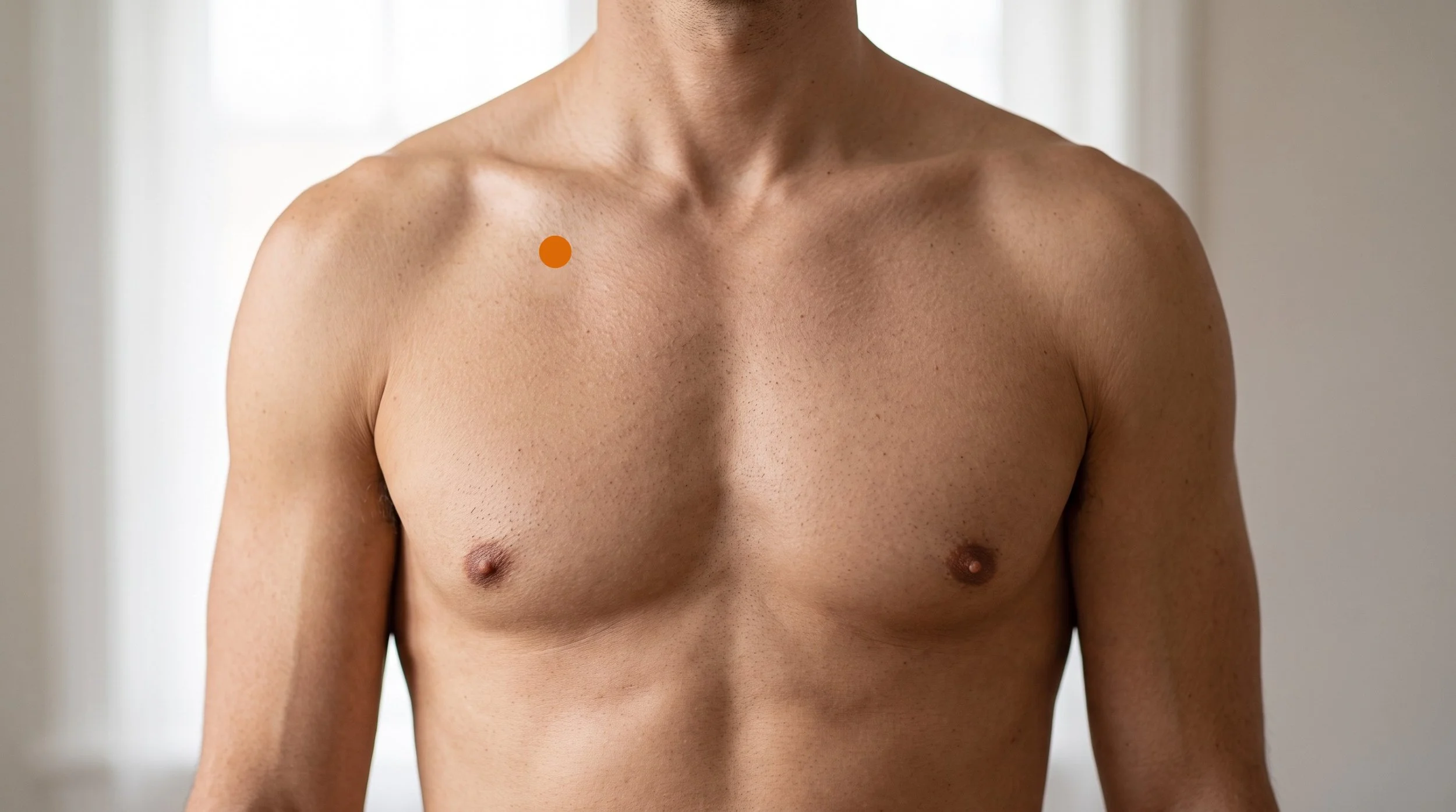
ST14 (Kufang, translated as Storehouse) is the fourteenth point of the Stomach channel and sits high on the front of the chest, in the first intercostal space about four cun out from the midline on the nipple line.
In plain terms, it lies in the soft gap between the first and second ribs, roughly a thumb's width or two below the collarbone and out toward the shoulder, buried under the upper fibers of pectoralis major.
Classical texts group it with its neighbors as a chest point rather than a digestive one, and they credit it with easing fullness, pressure, and cough. In a modern New York City practice, the st14 acupuncture point earns its keep for a very contemporary problem: the tight, braced, forward-rounded upper chest that comes with desk work, stress breathing, and heavy pressing at the gym.
- Location and layers: ST14 sits in the first intercostal space on the mamillary line, four cun lateral to the anterior midline, level with the region of CV20 (Deadman et al., 2007). The needle passes through skin and superficial fascia into the clavicular fibers of pectoralis major, with pectoralis minor, the intercostals, and the rib cage deeper still.
- Traditional attributions, restated: classical sources describe Kufang as descending rebellious qi and unbinding the chest, and list it for distention and fullness of the chest and lateral costal region, cough, and labored breathing (Deadman et al., 2007). In modern language, that reads as a local point for a chest wall that feels compressed and a breathing pattern that feels effortful.
- Nerve story: this territory is supplied by the first and second intercostal nerves, upper thoracic segments that also receive afferent traffic from deeper thoracic structures, so needling here feeds into the same dorsal horn neighborhoods that process chest wall and visceral sensation (Zhao, 2008).
- Mechanism beyond the local: needling recruits A-delta and C fiber input that engages descending inhibitory pathways from the brainstem, and measurable autonomic shifts toward parasympathetic dominance have been recorded during needling in controlled physiological studies (Zhao, 2008; Uchida et al., 2018).
- Research picture: no trial has isolated ST14, so the honest framing is that chest and upper back points appear inside multi-point protocols studied for breathlessness and chronic respiratory disease, where results are modest and heterogeneous (von Trott et al., 2020; Hsieh et al., 2019).
- Clinical framing and de qi: at Morningside we treat this area as much for pectoral myofascial tension as for its classical chest indications, often alongside dry needling of pectoralis major and minor (Simons et al., 1999; Liu et al., 2015). Correct de qi here is a mild, spreading heaviness under the collarbone that may travel along the rib space, never a sharp or breath-catching sensation.
Does Your Chest Feel Tight, Braced, or Hard to Fill?
Chest tightness that shows up with stress, long desk hours, or heavy pressing rarely comes from one structure alone. At Morningside Acupuncture we use ST14 with the surrounding chest wall, then add dry needling of pectoralis major and minor when palpation finds taut bands that reproduce your symptoms. Patients often describe the upper chest as softer and easier to expand within a session or two. Schedule a visit and let us assess how your chest wall and breathing pattern are working together.
Schedule NowAnatomy of ST14: Why the First Intercostal Space Is Such an Important Location
Start at the sternal angle, the small ridge you can feel where the manubrium meets the body of the sternum, then follow the second rib out from it. The space just above that rib is the first intercostal space, and ST14 sits in it on the nipple line, about four cun from the midline. Because rib spaces curve upward as they travel laterally, this point ends up slightly higher than the midline point it is nominally level with, a detail the classical location notes are careful to make.
Under the skin lie the upper clavicular and sternal fibers of pectoralis major, then pectoralis minor and the intercostal muscles, then ribs and pleura. These are the tissues loaded by hours of forward reaching at a keyboard, by heavy bench and push work, by carrying bags on one shoulder, and by the shallow upper chest breathing that anxiety and long stressful days tend to produce.
Cutaneous and deeper sensation in this strip comes from the first and second intercostal nerves, with pectoralis major itself driven by the medial and lateral pectoral nerves. That matters because upper thoracic spinal segments receive convergent input from chest wall structures and from deeper thoracic tissues, which is one reason chest wall pain can feel diffuse, heavy, and hard to localize.
Needling into this segment provides a strong, well-defined afferent volley that can modulate how those shared dorsal horn neurons behave, and that volley also recruits descending inhibitory control from brainstem and midbrain circuits, a mechanism mapped extensively in acupuncture analgesia research (Zhao, 2008). Alongside the pain-modulating effect, needling has been associated with shifts in heart rate variability toward parasympathetic predominance, which fits the settled, slower breathing patients often report after chest and forearm points are used together (Uchida et al., 2018).
Trigger points in pectoralis major and the intercostals produce their own recognizable local and referred patterns across the front of the chest and shoulder, which is why palpation, not just point location, guides the treatment (Simons et al., 1999).
Deep to this point is the lung, and that single fact dictates everything about technique. Classical texts are explicit that deep or perpendicular insertion over this part of the chest carries a real risk of puncturing the lung, so needling stays shallow and runs along the rib space rather than into it (Deadman et al., 2007). The Shanghai text and other standard references give the same instruction with slanted or transverse insertion of roughly 0.3 to 0.8 cun.
Medially, the internal thoracic vessels run close to the sternal border, and the great vessels sit under the manubrium, so the point is located out on the mamillary line and needled tangentially, threading superiorly, inferiorly, medially, or laterally under the skin and into pectoral muscle rather than toward the chest cavity. Practitioners with solid surface anatomy training treat this as a routine, low-risk point; practitioners without it should not needle here at all.
Related Pectoralis Major Trigger Points Related Pectoralis Minor Trigger PointsST14 at a Glance: Classification, Location, and Clinical Use
| Category | Detail |
|---|---|
| Traditional Name | Kufang, Storehouse (ST14, Stomach 14) |
| Channel Classification | Fourteenth point of the Stomach channel of Foot Yangming, on the upper chest |
| Point Categories | No five-shu, luo-connecting, xi-cleft, hui-meeting, or extraordinary vessel intersection designation. A local chest point of the Stomach channel whose traditional actions are given as descending rebellious qi and unbinding the chest (Deadman et al., 2007). |
| Precise Location | On the chest, in the first intercostal space, 4 cun lateral to the anterior midline on the mamillary line. Locate the second costal cartilage at the sternal angle, then move into the space directly above it. Because the rib space rises as it runs laterally, ST14 sits slightly higher than the midline point at the same nominal level. |
| Tissue Stimulated | Clavicular and upper sternal fibers of pectoralis major, with pectoralis minor and the intercostal muscles deeper; innervation from the first and second intercostal nerves and the pectoral nerves |
| Needle Depth / Direction | Transverse-oblique insertion of 0.3 to 0.8 cun along the intercostal space, or transverse insertion along the channel superiorly or inferiorly. Never perpendicular and never deep: deep insertion over the chest risks pneumothorax. |
| De Qi Sensation | A mild, spreading heaviness or dull fullness beneath the collarbone that may travel along the rib space toward the sternum or shoulder. Sharp pain, a cough reflex, or any catch in the breath means the needle should be withdrawn and repositioned. |
| Primary Clinical Uses | Chest tightness and fullness, costal and rib space discomfort, cough in classical listings, and pectoral muscle tension and upper chest bracing in modern practice |
| Common Point Combinations |
|
Deadman, Al-Khafaji, and Baker's A Manual of Acupuncture presents Kufang as a point whose traditional actions are to descend rebellious qi and to unbind the chest, and the classical indication list it records is squarely respiratory and thoracic: fullness and distention across the chest and the sides of the ribs, cough, coughing that brings up pus or blood, and difficult breathing. Older Chinese sources cited there record a treatment grouping for cough that puts ST14 together with its neighbor ST15 and with BL43 on the upper back, an arrangement that sandwiches the upper thorax from front and back.
Standard modern texts, including the Shanghai reference, translate those same indications into biomedical categories such as bronchitis and intercostal neuralgia, while other point manuals note that within this cluster the points just above tend to be favored for cough and wheezing and Kufang itself more for chest pain and fullness.
What is striking about the classical pattern is its restraint: for a point on the Stomach channel, almost nothing in the traditional record concerns digestion. The old sources read the chest position literally and used the point for what sits beneath it.
Why ST14 Is Used for Chest Tightness That Stretching and Breathing Exercises Alone Do Not Release
Many people arrive describing a band of pressure across the upper chest that never quite lets go. They have tried doorway stretches and breathing apps with partial success. Part of the reason is anatomical: the clavicular fibers of pectoralis major and the underlying intercostals are short, dense, and hard to lengthen with stretching alone, and when they hold taut bands they can refer discomfort across the front of the chest and into the shoulder in patterns that feel unsettlingly deep (Simons et al., 1999).
Because chest wall tissue and deeper thoracic structures send afferent traffic into the same upper thoracic spinal segments, that surface tension can register as something heavier and more central than a muscle problem. Needling directly into the first rib space gives the nervous system a clear, well-localized input in exactly that segment, which is the practical meaning of the traditional phrase about unbinding the chest.
The second half of the mechanism is not local at all. Needle stimulation recruits small-diameter afferents that activate descending inhibitory pathways from the periaqueductal gray and rostral ventromedial medulla, which dampen the transmission of nociceptive signals at the dorsal horn and release endogenous opioid and monoaminergic mediators (Zhao, 2008).
The large individual patient data analysis of acupuncture for chronic pain found effects that were modest but persistent and not explained by placebo alone, which is a reasonable calibration for what a point like this contributes within a full treatment (Vickers et al., 2018).
Alongside pain modulation, controlled physiological work has documented reductions in heart rate and shifts in heart rate variability toward parasympathetic dominance during needling, which may help explain why patients frequently report that their breath drops lower in the torso during a session rather than staying stuck at the top of the chest (Uchida et al., 2018).
In clinic, that combination is why we rarely use ST14 by itself. Pairing the local chest point with a distal forearm point such as PC6, and adding dry needling of the pectoral group when the exam calls for it, addresses the tight tissue, the segment, and the whole-system settling in one visit. The classical formula recorded for cough, which links this point to its neighbor and to a point on the upper back, is following the same logic several centuries early: treat the front and the back of the same thoracic region rather than chasing the sensation alone.
What the Research Shows for ST14
A realistic word on evidence: there is no randomized trial testing ST14 on its own, and there probably never will be, because acupuncture is delivered as a prescription of several points rather than as a single-site intervention. What the literature offers instead is evidence about protocols that include chest and thoracic points for breathing-related complaints, evidence about needling into myofascial trigger points for muscular pain, and mechanistic evidence about how needle stimulation influences pain processing and autonomic tone.
Read together, these support a cautious, adjunctive role for the point, not a claim that it treats respiratory disease on its own. Anyone with new chest pain, unexplained breathlessness, or a persistent cough needs a medical evaluation first.
| Study | Type | Focus | Key Finding |
|---|---|---|---|
| von Trott et al., 2020 | Systematic review and meta-analysis | Acupuncture and acupressure for breathlessness in advanced malignant and nonmalignant disease | Pooled results suggested possible benefit for breathlessness severity, though study quality and blinding limitations mean the findings should be read cautiously. |
| Hsieh et al., 2019 | Systematic review and meta-analysis | Acupuncture and health-related quality of life in chronic obstructive pulmonary disease | Acupuncture added to usual care was associated with improvements in quality of life measures, with heterogeneity across the included trials. |
| Li et al., 2025 | Systematic review and meta-analysis | Acupuncture-based treatment in stable and acutely exacerbated COPD | Twenty-five randomized trials were included and pooling was possible only for stable disease, which the authors attribute to inconsistent outcome reporting. |
| Liu et al., 2015 | Systematic review and meta-analysis | Dry needling of myofascial trigger points in neck and shoulder pain | Needling trigger points reduced pain compared with sham or control in the short and medium term, supporting its use for pectoral and chest wall muscle pain. |
| Vickers et al., 2018 | Individual patient data meta-analysis | Acupuncture for chronic musculoskeletal, headache, and osteoarthritis pain | Effects were modest but statistically significant against both sham and no-acupuncture controls, and persisted over twelve months. |
| Uchida et al., 2018 | Controlled physiological study | Heart rate variability during needling of muscle tissue | Needling was associated with a lower heart rate and a shift in frequency-domain measures toward parasympathetic predominance during stimulation. |
| Zhao, 2008 | Narrative review of neurophysiology | Neural mechanisms of acupuncture analgesia | Needle stimulation activates small-diameter afferents and engages descending inhibitory pathways with opioid and monoaminergic mediation. |
Rib Space Soreness That Does Not Settle With Stretching?
Intercostal soreness, costal tenderness, and that nagging pull under the collarbone often respond better to precise needling than to more stretching. ST14 lets us treat the first rib space directly with shallow, angled technique, and we pair it with distal points such as PC6 when the chest feels oppressed rather than simply sore. Every treatment includes a hands-on exam so the plan matches your anatomy, not a template. Book an evaluation and we will map exactly where your discomfort is coming from.
Schedule NowST14 in the Context of Trigger Point Work
The classical location of Kufang sits directly over the upper fibers of pectoralis major, which makes it one of the clearer overlaps between a traditional point and a common myofascial target. Trigger points in the clavicular and sternal divisions of pectoralis major refer discomfort across the front of the chest and into the anterior shoulder and inner arm, and pectoralis minor, lying deeper and slightly lower, can contribute to a tight, pulled-forward feeling at the shoulder along with neurovascular symptoms into the arm (Simons et al., 1999).
At Morningside we palpate before we needle: if a taut band in the pectoral group reproduces the patient's exact complaint, we treat it, using the ST14 territory as the entry landmark and keeping the angle tangential to the rib cage rather than toward it.
In practice, a session for a tight upper chest often combines shallow angled needling at ST14 and the neighboring rib spaces, dry needling of pectoralis major and minor and sometimes the intercostals, and distal points such as PC6 to support the whole-system settling that patients notice as easier breathing. Systematic review evidence supports short and medium term pain reduction from trigger point needling in the neck and shoulder region, which is the closest evidence base to this application (Liu et al., 2015).
We finish with what actually maintains the change: thoracic extension and rotation drills, scapular work, and a breathing pattern that recruits the diaphragm instead of the accessory muscles at the top of the chest.
ST14 Chest Tightness Treatment at NYC's Highest-Rated Acupuncture Clinic
Morningside Acupuncture is the highest-rated acupuncture and dry needling clinic in New York City with over 500 five-star Google reviews, and chest wall and breathing complaints are a regular part of our caseload. We combine classical point selection like Kufang with orthopedic assessment, trigger point dry needling, and breathing retraining so the results hold between visits. Safety comes first over the chest: shallow, angled insertion, careful landmarking, and clear explanation before a needle goes in. Schedule your appointment on the Upper West Side and start treating the tightness at its source.
Schedule NowFrequently Asked Questions
What does ST14 feel like when needled?
Most people feel a brief pinch at the skin followed by a mild, spreading heaviness or fullness under the collarbone. Because the needle is threaded along the rib space rather than pushed inward, the sensation tends to stay superficial and broad, sometimes traveling toward the sternum or out toward the shoulder. If a taut band in pectoralis major is being treated, you may feel a quick twitch and a deep ache that reproduces your familiar chest tightness, which usually eases within seconds. Sharp pain, a cough, or any catch in your breathing is not normal here and means the practitioner should withdraw and adjust the needle.
Why treat the chest directly instead of only using distal points on the arms and legs?
Both approaches have a role, and good treatment usually uses them together. Distal points work largely through descending inhibitory pathways that change how the nervous system processes signals from a whole region (Zhao, 2008), while a local point like ST14 delivers input into the same upper thoracic spinal segments that serve the chest wall itself and gives direct access to tight pectoral and intercostal tissue. When the problem includes palpable taut bands and a physically restricted upper chest, distal points alone tend to soften the sensation without changing the tissue. The classical record makes the same point in its own vocabulary by pairing chest points with points on the forearm and upper back.
Can I press ST14 myself between sessions?
Yes, acupressure over this area is safe and easy to do since fingertip pressure cannot reach the lung. Find the ridge where the upper sternum meets its body, trace out along the rib just below it, then move up into the soft gap above that rib and out to a line dropped from the middle of your collarbone. Press inward with a fingertip or thumb at a comfortable moderate pressure, hold steady for 30 to 60 seconds, and breathe slowly into your lower ribs while you hold. Repeat two or three times on each side, once or twice a day, and combine it with a gentle doorway pectoral stretch. Stop if pressure creates sharp pain, numbness into the arm, or any breathing difficulty, and see a clinician for new or unexplained chest symptoms rather than treating them yourself.
Is ST14 safe to needle?
In trained hands, yes, and the safety margin comes entirely from technique. Classical and modern texts agree that insertion here must be shallow and angled along the rib space, typically 0.3 to 0.8 cun, and they warn explicitly that deep or perpendicular needling over this part of the chest can puncture the lung (Deadman et al., 2007). At Morningside we use short needles, tangential angles, and careful landmarking, and we avoid the area entirely in patients whose anatomy or medical history makes it inadvisable. Tell your practitioner if you have a history of lung disease, emphysema, prior pneumothorax, chest surgery, a pacemaker or implanted device, or if you are on blood thinners.
Where exactly is ST14 located?
ST14 lies in the first intercostal space, four cun lateral to the anterior midline on the mamillary line, which is the vertical line through the nipple. The most reliable way to find the st 14 location is to feel for the sternal angle, the small horizontal ridge on the breastbone a few finger widths below the notch at the base of the neck, then follow the second rib out from it and step up into the space directly above. Keep in mind that in men the nipple usually sits at the fourth intercostal space, so ST14 is three spaces higher, and that rib spaces climb as they run laterally, so the kufang point sits slightly above the midline landmark it is nominally level with.
References
- Deadman, P., Al-Khafaji, M., & Baker, K. (2009). A manual of acupuncture. Journal of Chinese Medicine Publications.
- O'Connor, J., & Bensky, D. (Eds. & Trans.). (1981). Acupuncture: A comprehensive text. Shanghai College of Traditional Medicine. Eastland Press.
- Cunningham, P. M. (2000). Acupuncture points: A practical guide to classical and modern usage. Odyssey Press.
- Kim, H. (2008). Handbook of Oriental medicine (3rd ed.). Harmony & Balance Press.
- Simons, D. G., Travell, J. G., & Simons, L. S. (1999). Travell & Simons' myofascial pain and dysfunction: The trigger point manual, Vol. 1: Upper half of body (2nd ed.). Williams & Wilkins.
- Zhao, Z. Q. (2008). Neural mechanism underlying acupuncture analgesia. Progress in Neurobiology, 85(4), 355-375. https://doi.org/10.1016/j.pneurobio.2008.05.004
- Vickers, A. J., Vertosick, E. A., Lewith, G., MacPherson, H., Foster, N. E., Sherman, K. J., Irnich, D., Witt, C. M., & Linde, K. (2018). Acupuncture for chronic pain: Update of an individual patient data meta-analysis. Journal of Pain, 19(5), 455-474. https://doi.org/10.1016/j.jpain.2017.11.005
- von Trott, P., Oei, S. L., & Ramsenthaler, C. (2020). Acupuncture for breathlessness in advanced diseases: A systematic review and meta-analysis. Journal of Pain and Symptom Management, 59(2), 327-338. https://doi.org/10.1016/j.jpainsymman.2019.09.007
- Hsieh, P. C., Yang, M. C., Wu, Y. K., Chen, H. Y., Tzeng, I. S., Hsu, P. S., Lee, C. T., Chen, C. L., & Lan, C. C. (2019). Acupuncture therapy improves health-related quality of life in patients with chronic obstructive pulmonary disease: A systematic review and meta-analysis. Complementary Therapies in Clinical Practice, 35, 208-218. https://doi.org/10.1016/j.ctcp.2019.02.016
- Li, M., Zheng, S., Lederer, A. K., & Huber, R. (2025). Efficacy of acupuncture-based treatment in chronic obstructive pulmonary disease: A systematic review and meta-analysis. Complementary Therapies in Medicine, 93, 103211. https://doi.org/10.1016/j.ctim.2025.103211
- Liu, L., Huang, Q. M., Liu, Q. G., Ye, G., Bo, C. Z., Chen, M. J., & Li, P. (2015). Effectiveness of dry needling for myofascial trigger points associated with neck and shoulder pain: A systematic review and meta-analysis. Archives of Physical Medicine and Rehabilitation, 96(5), 944-955. https://doi.org/10.1016/j.apmr.2014.12.015
- Uchida, C., Waki, H., Minakawa, Y., Tamai, H., Hisajima, T., & Imai, K. (2018). Evaluation of autonomic nervous system function using heart rate variability analysis during transient heart rate reduction caused by acupuncture. Medical Acupuncture, 30(2), 89-95. https://doi.org/10.1089/acu.2017.1266
Disclaimer: This web site is intended for educational and informational purposes only. Reading this website does not constitute providing medical advice or any professional services. This information should not be used for diagnosing or treating any health issue or disease. Those seeking medical advice should consult with a licensed physician. Seek the advice of a medical doctor or other qualified health professional for any medical condition. If you think you have a medical emergency, call 911 or go to the emergency room. No acupuncturist-patient relationship is created by reading this website or using the information. Morningside Acupuncture PLLC and its employees and contributors do not make any express or implied representations with respect to the information on this site or its use. For any legal interpretation of scope of practice in your state, consult a licensed attorney or regulatory authority.
Read more from our blog