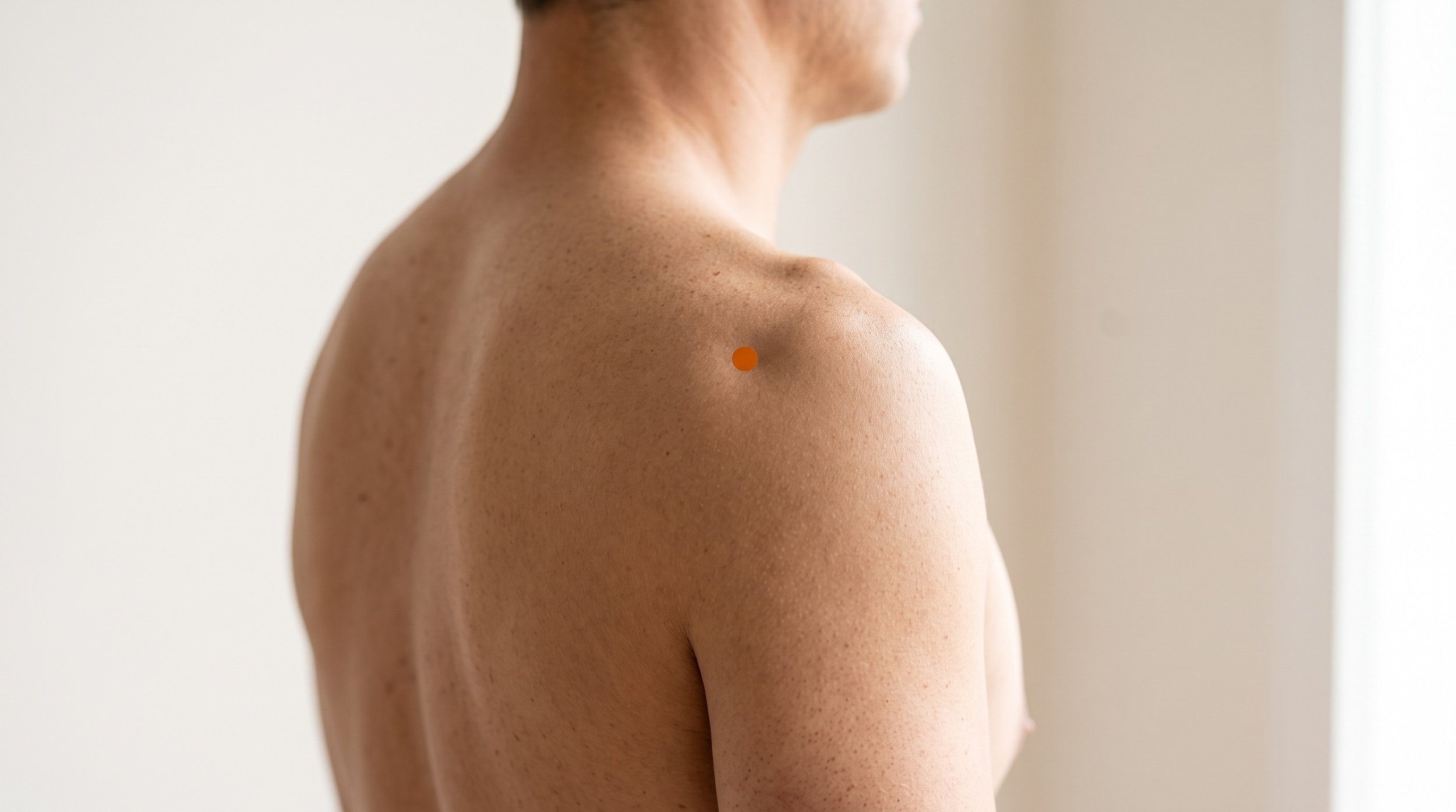
SJ14 Acupuncture Point (Jianliao)
The Shoulder Crevice Behind the Acromion: Anatomy, Mechanism, and Why This Triple Burner Point Anchors Frozen Shoulder and Rotator Cuff Treatment
SJ14 (Jianliao, "Shoulder Crevice"), also written TE14, is the principal shoulder joint point of the Triple Burner channel. You'll find it in the soft hollow just behind and below the outer tip of the acromion, right where the deltoid takes its origin, and the depression opens up noticeably when the arm is lifted out to the side. It's the back-of-the-shoulder counterpart to LI15, which sits in the matching dimple at the front of the acromion, and the two are needled together so routinely that they function as a single unit in most shoulder protocols.
For patients with posterior shoulder pain, a shoulder that feels heavy and won't lift, stiffness after months of guarding, or aching that spreads down the outer arm, the te14 acupuncture point is usually one of the first places a clinician palpates.
- SJ14 sits in the posterior sub-acromial depression at the deltoid origin, with the posterior and middle deltoid fibers under the needle and the supraspinatus and infraspinatus tendons, subacromial bursa, and glenohumeral capsule lying deeper (Deadman et al., 2007). Overhead loading, carrying, side sleeping, and desk posture all concentrate strain in exactly this corner of the joint.
- The traditional attributions for this jianliao shoulder point are to dispel wind-damp, relieve pain, and benefit the shoulder joint, and the classical indication list centers on shoulder pain, heaviness with inability to raise the arm, and numbness or weakness of the arm (Deadman et al., 2007; Kim, 2011). Read neurophysiologically, that's a description of a mechanically irritable, guarded joint with referred symptoms down the limb.
- Tissues around SJ14 are supplied largely from C5 and C6 by the axillary and suprascapular nerves, so needling here feeds afferent input into the same spinal segments that receive nociception from the cuff tendons and joint capsule, a convergence pattern that can dampen dorsal horn excitability (Zhao, 2008).
- Needle stimulation also recruits descending inhibitory pathways and endogenous opioid mechanisms rather than acting only at the site treated, which helps explain why local shoulder needling often reduces pain beyond the immediate area of insertion (Zhao, 2008), and pooled individual patient data support modest but persistent benefit for chronic musculoskeletal pain (Vickers et al., 2018).
- In a meta-analysis of acupuncture for frozen shoulder, SJ14 and LI15 were the two most frequently used points across the included trials, which reflects clinical convention as much as evidence, and the authors rated the overall certainty as very low (Ben-Arie et al., 2020).
- De qi at SJ14 is typically a deep, heavy, spreading ache in the shoulder that can travel down the outer arm toward the elbow, sometimes with a brief twitch of the deltoid when a taut band is engaged (Simons et al., 1999).
Shoulder Pain That Won't Let You Reach Overhead?
SJ14 is one of the points we palpate first when a patient describes deep, posterior shoulder pain or a shoulder that feels heavy to lift. We pair it with LI15 at the front of the acromion, add distal points along the arm, and combine the session with dry needling of the deltoid and posterior cuff when taut bands are present. Every plan is built around what your shoulder actually does when it moves, not a fixed template. Book an evaluation and we'll map your pain pattern in the first visit.
Schedule NowAnatomy of SJ14: Why the Hollow Behind the Acromion Is Such an Important Location
Slide a fingertip along the top ridge of the shoulder blade until you reach the outer tip of the acromion, then drop just behind and below it. That soft notch is SJ14, and it deepens when the arm is abducted. Directly under the skin lie the posterior and middle fibers of the deltoid at their acromial origin. Deeper still are the subacromial and subdeltoid bursa, the tendons of supraspinatus, infraspinatus, and teres minor as they converge on the greater tuberosity, and beneath those the glenohumeral joint capsule and the head of the humerus.
This is the tissue stack that gets loaded by overhead reaching, pressing, carrying bags on one side, sleeping on the shoulder, and long hours of forward-rounded desk posture. It's also the region that becomes exquisitely tender and thickened in adhesive capsulitis, when the posterior capsule loses its glide.
The sensory and motor supply here comes mostly from the C5 and C6 segments. The axillary nerve wraps the surgical neck of the humerus and innervates the deltoid and teres minor plus a patch of overlying skin, while the suprascapular nerve supplies supraspinatus, infraspinatus, and much of the joint capsule. Because nociceptive traffic from a cranky cuff tendon, an inflamed bursa, and a stiff capsule all funnel into those same dorsal horn segments, needling at SJ14 delivers strong, well-localized afferent input into the exact neural neighborhood that's generating the pain.
Segmental convergence of this kind is one of the better-supported mechanisms for how local needling reduces pain, and it operates alongside descending inhibitory control from the brainstem and endogenous opioid release (Zhao, 2008).
In practice that means SJ14 is doing two jobs at once: modulating the segment, and reducing the protective muscle guarding that keeps the shoulder from moving.
Deep to the point, the posterior circumflex humeral vessels and the axillary nerve travel through the quadrangular space, so depth and angle matter. The classical convention is to abduct the arm and insert perpendicularly toward the center of the axilla, roughly 1 to 1.5 cun, or to angle transverse-obliquely down the deltoid toward the elbow at 1.5 to 2 cun, and moxibustion is traditionally permitted (Deadman et al., 2007; Kim, 2011). Shallower depths of around 0.7 to 1 cun are also standard in modern texts (Cheng, 1987).
The lung is not a concern at this location, but sensible practice still applies: no forceful deep manipulation into the joint, extra care in very lean patients or those with shoulder instability, and avoidance of needling over surgical hardware, prosthetic joints, or infected or acutely inflamed skin.
Related Acupuncture And Pt For Frozen Shoulder Related Muscles That Cause Shoulder PainSJ14 (TE14) at a Glance: Classification, Location, and Clinical Use
| Category | Detail |
|---|---|
| Traditional Name | Jianliao (Shoulder Crevice), Triple Burner 14, also written TE14 or TB-14 |
| Channel Classification | Triple Burner (Sanjiao) channel of the Hand Shaoyang; principal local point of the shoulder joint on this channel (SJ14, also written TE14 or TB14; also called the Triple Energizer, the Triple Heater or Triple Warmer) |
| Point Categories | No five-shu, meeting, or extraordinary vessel designation is recorded for this point in the classical sources consulted. It is classified functionally as a local shoulder joint point, with traditional actions given as dispelling wind-damp, relieving pain, and benefiting the shoulder joint (Deadman et al., 2007; Kim, 2011). |
| Precise Location | At the deltoid origin, in the depression posterior and inferior to the lateral tip of the acromion, roughly 1 cun behind LI15; abduct the arm to make the hollow easier to find |
| Tissue Stimulated | Posterior and middle deltoid at its acromial origin; deeper, the subacromial bursa, the posterior rotator cuff tendons (supraspinatus, infraspinatus, teres minor), and the glenohumeral capsule, in axillary and suprascapular nerve territory (C5 to C6) |
| Needle Depth / Direction | With the arm abducted, perpendicular insertion angled toward the center of the axilla, 1 to 1.5 cun; or transverse-oblique insertion directed distally toward the elbow along the deltoid, 1.5 to 2 cun; shallower perpendicular needling of 0.7 to 1 cun is also common. Moxibustion is traditionally applicable. |
| De Qi Sensation | Deep local distension, heaviness, and soreness in the shoulder, often spreading down the outer upper arm toward the elbow; a brief involuntary twitch may occur if a taut band in the deltoid or posterior cuff is engaged |
| Primary Clinical Uses | Posterior and lateral shoulder pain, frozen shoulder and adhesive capsulitis, rotator cuff and subacromial irritation, heaviness of the shoulder with difficulty raising the arm, numbness or weakness of the arm |
| Common Point Combinations |
|
Deadman, Al-Khafaji, and Baker present Jianliao as the key point for disorders of the shoulder joint, with particular usefulness for the posterior aspect, and note that in practice it's almost always combined with Jianyu LI15.
Their commentary is worth reading carefully because it frames shoulder stiffness, pain, immobility, and weakness as arising from three different traditional situations: invasion of the joint by external wind, cold, damp, or heat; stagnation of qi and blood after trauma or repetitive overuse; and depletion of qi and blood from aging, chronic overuse, or long-standing obstruction of the channel. The traditional actions attributed to the point, dispelling wind-damp and relieving pain while benefiting the joint, are held to apply across all three.
What's striking is how closely that three-part sorting maps onto how a modern clinician triages a painful shoulder: an acute inflammatory presentation, a mechanically overloaded one, and a deconditioned chronic one, each needing a different intensity of stimulation and a different rehab timeline, even though the point selected stays the same.
Why SJ14 Is Used for Frozen Shoulder, a Condition Where Stiffness Matters More Than Pain
Most people expect a shoulder point to be about pain relief. With adhesive capsulitis, the harder problem is range: the capsule thickens, the posterior structures stop gliding, and the shoulder gets progressively more guarded. SJ14 sits directly over the posterior capsule and the cuff tendons that seize up first, and its sensory territory belongs to the same C5 and C6 segments that carry nociception from the joint.
Feeding controlled afferent input into that segment can reduce dorsal horn sensitization and lower the reflex muscle guarding that limits motion, which is why patients often report that the arm moves a little more freely at the end of a session even before pain scores change much (Zhao, 2008).
Beyond the segment, needling engages descending inhibitory pathways from the brainstem and endogenous opioid systems, so the effect isn't confined to the tissue under the needle (Zhao, 2008). That systemic component is consistent with the individual patient data meta-analysis of acupuncture for chronic pain, which found effects that were modest in size but larger than sham control and reasonably durable over follow-up (Vickers et al., 2018). It also explains why local points like SJ14 are paired with distal points rather than used alone.
There's a point-specific detail worth knowing. When researchers pooled the frozen shoulder trials and catalogued which points the studies actually used, LI15 and SJ14 turned out to be the two most commonly selected acupoints across the literature (Ben-Arie et al., 2020).
That doesn't prove SJ14 is the active ingredient, since almost every protocol used multi-point combinations, but it does mean the pairing you'll receive in a well-run clinic is the same pairing that has been tested most often, and the reviewers reported improvements in pain, function, and flexion range while rating the certainty of evidence as very low.
What the Research Shows for SJ14 (TE14)
One note on naming before the evidence: in the research literature this point appears as TE14, the WHO standard code, and also as SJ14 or TB14 depending on the authors, so it is worth searching all three if you want to read the studies below in full.
A fair reading of the research requires one caveat up front: essentially no trial isolates SJ14. Shoulder studies test whole protocols, usually four to eight points, often with electroacupuncture, exercise, or manual therapy layered on top, so what follows tells you about the treatment approach SJ14 belongs to rather than the point itself. The overall picture is cautiously encouraging for pain and function in the short to medium term, with consistently low methodological quality across the primary trials and honest uncertainty about how long benefits last.
| Study | Type | Focus | Key Finding |
|---|---|---|---|
| Green et al., 2005 | Cochrane systematic review | Acupuncture for shoulder pain in adults, including rotator cuff disease and adhesive capsulitis | The reviewers concluded there was insufficient evidence to support or refute acupuncture for shoulder pain, with limited data suggesting possible short-term benefit for pain and function at two to four weeks. |
| Ben-Arie et al., 2020 | Systematic review and meta-analysis | Acupuncture for primary frozen shoulder across 13 studies, with acupoint usage catalogued | Acupuncture appeared safe and was associated with reduced pain and improved shoulder function and flexion range in the short and medium term, though the authors rated the certainty of evidence as very low; LI15 and SJ14 were the most frequently used points. |
| Yang et al., 2018 | Systematic review and meta-analysis | Distal needling at ST38 for shoulder adhesive capsulitis across 19 randomized trials | Needling at ST38, alone or combined with local shoulder points, was associated with better clinical effectiveness and Constant-Murley scores, but most included trials were judged low quality. |
| An et al., 2024 | Systematic review and meta-analysis | Manual acupuncture specifically for shoulder impingement syndrome | Pooled data indicated improvement in shoulder function and disability following manual acupuncture, with the authors cautioning that heterogeneity and study quality limit confidence in the estimate. |
| Vickers et al., 2018 | Individual patient data meta-analysis | Acupuncture for chronic musculoskeletal pain, including chronic shoulder pain | Acupuncture outperformed both sham and no-acupuncture controls with modest effect sizes, and benefits declined only gradually after treatment ended. |
| Pérez-Palomares et al., 2017 | Multicenter randomized clinical trial | Dry needling of shoulder trigger points added to individualized physical therapy | Adding dry needling produced no additional benefit over personalized evidence-based physical therapy alone, with both groups improving, a useful reminder that needling is an adjunct rather than a standalone answer. |
Stiff, Frozen Shoulder That Keeps Getting Worse at Night?
Adhesive capsulitis is slow, painful, and exhausting, and range of motion tends to shrink while you wait it out. Our approach uses SJ14 with LI15 and SI9 locally, distal points such as ST38 and SJ5 with gentle active movement during the treatment, and graded mobility work between sessions. Studies suggest acupuncture may reduce pain and improve function in frozen shoulder, though the evidence base is still limited. Schedule a consultation and we'll build a plan alongside your physical therapy or medical care.
Schedule NowSJ14 in the Context of Trigger Point Work
The location of SJ14 overlaps almost exactly with territory that trigger point clinicians care about. Posterior deltoid trigger points refer pain into the back of the shoulder and down the posterior arm, infraspinatus refers deep into the front of the joint and down the lateral arm in a pattern patients often describe as pain "inside" the shoulder, and teres minor produces a focal ache right at the point's location (Simons et al., 1999).
At Morningside we palpate before we needle, so if pressing at or near SJ14 reproduces the exact pain you came in with, that finding drives both the depth and the angle we use rather than a diagram.
In a typical shoulder session we'll needle SJ14 and LI15 as the anchoring local pair, add SI9 or SI11 when the posterior scapula is involved, then dry needle the specific muscles that tested positive, commonly posterior deltoid, infraspinatus, supraspinatus, teres minor, and subscapularis. Distal points such as SJ5 or ST38 are often added with active shoulder movement during retention.
Because acupuncture is defined by the use of an acupuncture needle, dry needling of these muscles is simply one style among the hundreds that exist, and combining channel-based point selection with trigger point targeting tends to be more useful than choosing one framework and ignoring the other. Needling is then paired with loaded range of motion work, since the trial evidence suggests needling adds most when it sits inside a broader rehab plan (Pérez-Palomares et al., 2017).
SJ14 Frozen Shoulder and Rotator Cuff Treatment at NYC's Highest-Rated Acupuncture Clinic
Morningside Acupuncture is the highest-rated acupuncture and dry needling clinic in New York City with over 500 five-star Google reviews. We treat shoulder pain, rotator cuff irritation, and frozen shoulder using SJ14 and the surrounding sub-acromial points combined with trigger point needling and movement retraining. Sessions are precise, comfortable, and built for people who need their shoulder back for work, training, and sleep. Schedule your visit and let's get that arm moving again.
Schedule NowFrequently Asked Questions
Is SJ14 the same point as TE14 or TB14?
Yes. SJ14, TE14, and TB14 are all codes for the same point, Jianliao. SJ stands for San Jiao, the Chinese name of the channel. TE (Triple Energizer) is the WHO standard abbreviation and the one you will see in most Western textbooks and research papers. TB (Triple Burner) and TW (Triple Warmer) are older English renderings of the same name that still appear in many books. You will also come across it written as San Jiao 14 or Triple Energizer 14. Whichever code is used, the location and the uses are the same.
What does SJ14 feel like when needled?
Most people feel a dull, spreading heaviness or a deep ache in the shoulder rather than a sharp sensation. That distension often travels down the outer upper arm toward the elbow, and occasionally further. If the needle contacts a taut band in the deltoid or posterior cuff, you may feel a quick, involuntary twitch followed by a brief cramping ache that settles within seconds. Some mild soreness for a day afterward is normal, similar to how a muscle feels after a good workout.
Why needle SJ14 when my pain feels like it's deep inside the joint?
Pain that feels like it's inside the joint frequently comes from the cuff tendons, bursa, and capsule, and those structures share segmental innervation from C5 and C6 with the tissues right under SJ14. Needling here reaches the same neural territory that's generating the pain and can dampen dorsal horn sensitization and reduce protective guarding (Zhao, 2008). We'll usually add a distal point on the arm or leg as well, since classical protocols and modern trials both pair local shoulder points with distal ones rather than needling only where it hurts.
Can I press SJ14 myself between sessions?
Yes, and it's an easy point to find on yourself. Reach across your body with the opposite hand, trace the bony ridge of the shoulder blade out to the tip of the acromion, then slide just behind and below it into the soft hollow. Lift the arm out to the side a few inches and the notch becomes more obvious. Press with your thumb or two fingertips at a moderate pressure that feels like a firm ache rather than a sharp pain, hold for 30 to 60 seconds, release, and repeat two or three times. One to two rounds a day is plenty. Adding slow, pain-free shoulder circles or a wall slide right afterward tends to be more helpful than pressing alone. Stop if the pressure increases your pain or produces numbness or tingling down the arm.
Is SJ14 safe to needle?
In trained hands, yes. This is a well-tolerated location with no risk of pneumothorax, since the point sits well lateral to the lung field. The main structures to respect are the axillary nerve and posterior circumflex humeral vessels traveling deep near the surgical neck of the humerus, which is why practitioners abduct the arm, control depth, and avoid forceful deep manipulation into the joint. Extra caution applies in very lean patients, in shoulders with known instability, and around shoulder replacements or surgical hardware, where the area is generally avoided. Needling is not performed through infected, broken, or acutely inflamed skin. Always see a licensed practitioner, and mention blood thinners, recent injections, or recent shoulder surgery beforehand.
Where exactly is SJ14 located?
SJ14 lies at the origin of the deltoid, in the depression just posterior and inferior to the lateral tip of the acromion, roughly 1 cun behind LI15. The most reliable way to find it is to abduct the arm, which deepens the hollow and makes both LI15 and SJ14 visible as a pair of dimples straddling the acromion, LI15 in front and SJ14 behind. Palpating with the arm relaxed at the side works too, but the depression is subtler.
References
- Deadman, P., Al-Khafaji, M., & Baker, K. (2009). A manual of acupuncture. Journal of Chinese Medicine Publications.
- Kim, H. (2008). Handbook of Oriental medicine (3rd ed.). Harmony & Balance Press.
- O'Connor, J., & Bensky, D. (Eds. & Trans.). (1981). Acupuncture: A comprehensive text. Shanghai College of Traditional Medicine. Eastland Press.
- Cheng, X. (Ed.). (1999). Chinese acupuncture and moxibustion (Rev. ed.). Foreign Languages Press.
- Maciocia, G. (2006). The channels of acupuncture: Clinical use of the secondary channels and eight extraordinary vessels. Churchill Livingstone Elsevier.
- Cunningham, P. M. (2000). Acupuncture points: A practical guide to classical and modern usage. Odyssey Press.
- Simons, D. G., Travell, J. G., & Simons, L. S. (1999). Travell & Simons' myofascial pain and dysfunction: The trigger point manual, Vol. 1: Upper half of body (2nd ed.). Williams & Wilkins.
- Green, S., Buchbinder, R., & Hetrick, S. (2005). Acupuncture for shoulder pain. Cochrane Database of Systematic Reviews, 2005(2), CD005319. https://doi.org/10.1002/14651858.CD005319
- Ben-Arie, E., Kao, P. Y., Lee, Y. C., Ho, W. C., Chou, L. W., & Liu, H. P. (2020). The effectiveness of acupuncture in the treatment of frozen shoulder: A systematic review and meta-analysis. Evidence-Based Complementary and Alternative Medicine, 2020, 9790470. https://doi.org/10.1155/2020/9790470
- Yang, C., Lv, T. T., Yu, T. Y., Wong, S., Lu, M. Q., & Li, Y. Z. (2018). Acupuncture at Tiaokou (ST38) for shoulder adhesive capsulitis: What strengths does it have? A systematic review and meta-analysis of randomized controlled trials. Evidence-Based Complementary and Alternative Medicine, 2018, 4197659. https://doi.org/10.1155/2018/4197659
- An, S. J., Shin, W. C., Joo, S., Cho, J. H., Chung, W. S., Song, M. Y., & Kim, H. (2024). Effects of acupuncture on shoulder impingement syndrome: A systematic review and meta-analysis. Medicine, 103(37), e39696. https://doi.org/10.1097/MD.0000000000039696
- Pérez-Palomares, S., Oliván-Blázquez, B., Pérez-Palomares, A., Gaspar-Calvo, E., Pérez-Benito, M., López-Lapeña, E., de la Torre-Beldarraín, M. L., & Magallón-Botaya, R. (2017). Contribution of dry needling to individualized physical therapy treatment of shoulder pain: A randomized clinical trial. Journal of Orthopaedic & Sports Physical Therapy, 47(1), 11-20. https://doi.org/10.2519/jospt.2017.6698
- Zhao, Z. Q. (2008). Neural mechanism underlying acupuncture analgesia. Progress in Neurobiology, 85(4), 355-375. https://doi.org/10.1016/j.pneurobio.2008.05.004
- Vickers, A. J., Vertosick, E. A., Lewith, G., MacPherson, H., Foster, N. E., Sherman, K. J., Irnich, D., Witt, C. M., & Linde, K. (2018). Acupuncture for chronic pain: Update of an individual patient data meta-analysis. Journal of Pain, 19(5), 455-474. https://doi.org/10.1016/j.jpain.2017.11.005
Disclaimer: This web site is intended for educational and informational purposes only. Reading this website does not constitute providing medical advice or any professional services. This information should not be used for diagnosing or treating any health issue or disease. Those seeking medical advice should consult with a licensed physician. Seek the advice of a medical doctor or other qualified health professional for any medical condition. If you think you have a medical emergency, call 911 or go to the emergency room. No acupuncturist-patient relationship is created by reading this website or using the information. Morningside Acupuncture PLLC and its employees and contributors do not make any express or implied representations with respect to the information on this site or its use. For any legal interpretation of scope of practice in your state, consult a licensed attorney or regulatory authority.
Read more from our blog



