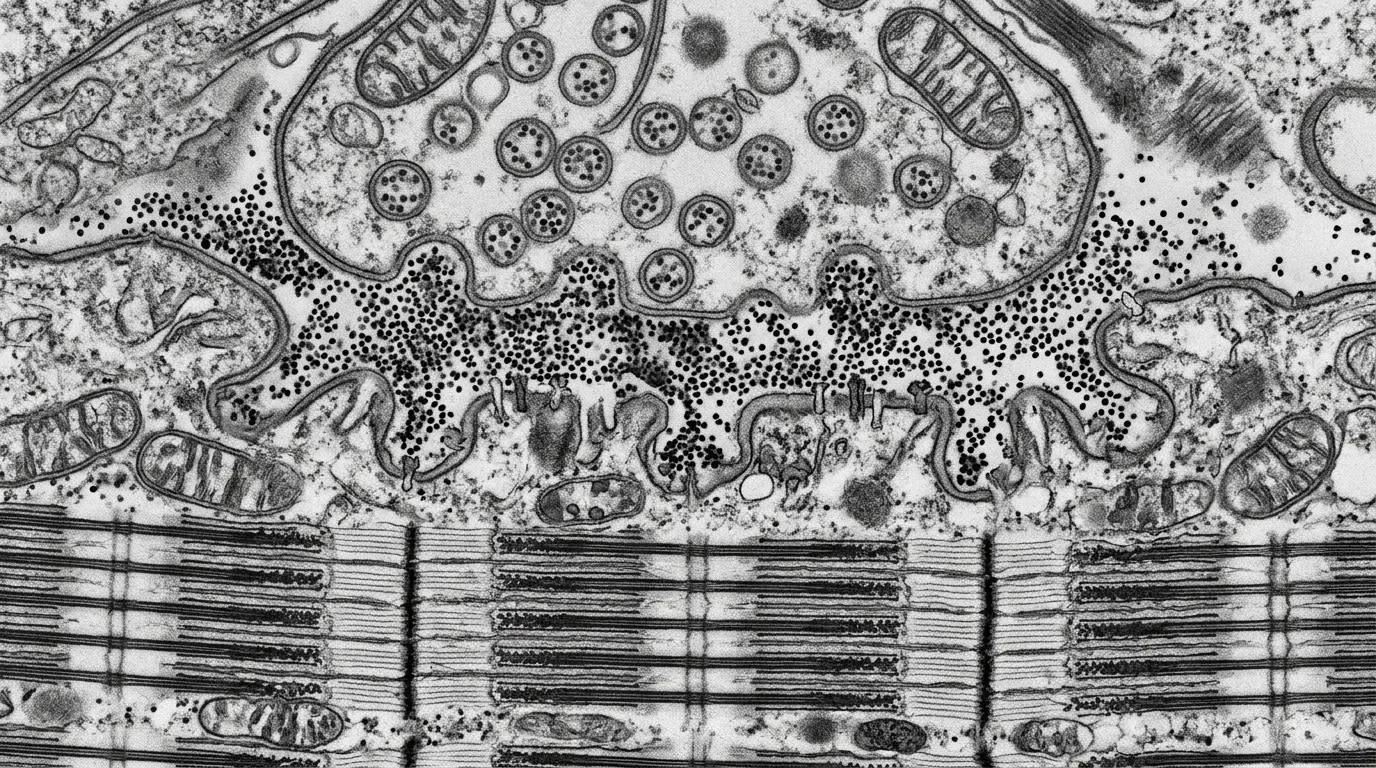
The Motor Endplate Dysfunction Model Explained
The integrated trigger point hypothesis is the most widely accepted scientific framework for explaining how trigger points form, why they persist, and why they cause referred pain. It shifts the focus from the muscle fiber itself to the nerve-muscle junction where the process begins.
- The integrated hypothesis proposes that trigger points originate at dysfunctional motor endplates, where abnormal acetylcholine (ACh) release leads to sustained sarcomere contracture rather than full muscle contraction (Gerwin et al., 2004).
- Sustained sarcomere shortening depletes local ATP, producing an energy crisis. The resulting ischemia causes local hypoxia, pH drop, and release of sensitizing inflammatory chemicals that activate nociceptors (Bron & Dommerholt, 2012).
- Microdialysis research at active trigger point sites has confirmed elevated concentrations of substance P, calcitonin gene-related peptide, bradykinin, serotonin, and hydrogen ions compared to both latent trigger point sites and healthy muscle (Shah et al., 2008).
- The local inflammatory milieu sensitizes peripheral nociceptors, producing local pain; with sustained sensitization, spinal cord wind-up produces referred pain patterns characteristic of specific muscles (Fernández-de-Las-Peñas & Dommerholt, 2018).
- An updated unified theory proposes that failure of both pre-synaptic and post-synaptic feedback mechanisms contributes to abnormal ACh accumulation, calcium dysregulation, and persistent actin-myosin cross-bridging that maintains the contracture (Gerwin, 2023).
- Dry needling targets the trigger point directly, and the local twitch response it elicits is thought to mechanically disrupt the dysfunctional endplate region, normalize ACh dynamics, and break the energy crisis cycle.
Do You Have Trigger Points That Haven't Responded to Other Treatments?
Understanding the mechanism behind trigger points helps explain why some approaches work better than others. At Morningside Acupuncture, we use dry needling to target the dysfunctional motor endplate region directly, eliciting the local twitch response that research associates with effective trigger point release. Many patients find lasting relief after treatments that address the underlying neuromuscular pathology rather than just the surface tension.
Schedule NowFrom Observation to Mechanism
Trigger points were described clinically long before anyone understood why they formed. The characteristic features, a taut band within a muscle, a hypersensitive nodule within that band, predictable referred pain patterns, and the local twitch response elicited by needling, were well-documented by researchers like Janet Travell and David Simons by the mid-20th century. What took decades longer was a satisfactory mechanistic explanation for how these features arose from normal tissue.
David Simons is credited with proposing the integrated trigger point hypothesis, which unified earlier observations under a coherent biological model centered on the neuromuscular junction. His insight was that the problem was not primarily in the muscle fiber itself but in the motor endplate: the site where a motor neuron releases acetylcholine to trigger muscle contraction. When this junction malfunctions in a specific way, it sets in motion a cascade that produces all the features clinicians recognize as a trigger point.
The integrated hypothesis has since been expanded by researchers including Robert Gerwin, Jan Dommerholt, and Jay Shah, whose work has added biochemical evidence, refined the proposed mechanisms, and extended the model to explain both the local pain and the referred pain patterns that define myofascial trigger point syndromes (Gerwin et al., 2004).
Related What Is a Trigger Point? The Clinical Definition and What It Feels LikeThe Core Mechanism: What Goes Wrong at the Motor Endplate
Under normal conditions, the motor endplate releases acetylcholine in response to a nerve impulse. Acetylcholine crosses the synaptic cleft, binds to receptors on the muscle membrane, and triggers the electrical signal that causes the sarcomeres (the basic contractile units of muscle) to shorten. The contraction then resolves as ACh is broken down by acetylcholinesterase, and the sarcomeres return to their resting length.
In trigger point pathology, this sequence breaks down at the release step. Under conditions of sustained or intense muscle use, overload, or possibly repetitive low-level activation, ACh may be released in abnormal quantities outside of normal nerve impulses, or the breakdown of ACh may be impaired. The result is an excess of ACh in the synaptic cleft, producing persistent, low-level depolarization of the muscle membrane in the endplate zone (Gerwin et al., 2004).
This sustained membrane depolarization does not produce a coordinated muscle contraction. It produces something more localized and more problematic: a sustained shortening of individual sarcomeres in the immediate vicinity of the dysfunctional endplate, without the full-muscle neural coordination of voluntary contraction. The affected sarcomeres shorten maximally and remain contracted. This is the sarcomere contracture that produces the taut band palpable on physical examination.
| Step | What Happens | Clinical Result |
|---|---|---|
| 1. Endplate dysfunction | Abnormal ACh release or impaired ACh breakdown leads to excessive ACh in the synaptic cleft | Abnormal endplate electrical noise detectable on EMG; initial stage of dysfunction |
| 2. Sarcomere contracture | Persistent low-level depolarization causes localized, uncoordinated sarcomere shortening | Taut band forms within the muscle; shortened sarcomeres pull on adjacent tissue |
| 3. Energy crisis | Sustained contraction depletes local ATP; sarcomeres cannot release without ATP | Contracture becomes self-perpetuating; normal muscle lengthening cannot occur |
| 4. Local ischemia | Shortened sarcomeres compress local capillaries, reducing blood flow and oxygen delivery | Hypoxic environment develops; metabolic waste products accumulate |
| 5. Inflammatory chemical release | Low pH, ischemia, and cellular stress cause release of sensitizing substances including substance P, bradykinin, and calcitonin gene-related peptide | Local nociceptors become sensitized, producing tenderness and referred pain |
| 6. Central sensitization | Persistent nociceptive input from the trigger point sensitizes dorsal horn neurons | Referred pain in characteristic patterns; widespread allodynia in severe cases |
The Energy Crisis and Why Trigger Points Don't Resolve on Their Own
A key insight of the integrated hypothesis is why trigger points tend to persist once established, rather than resolving as inflammation in other tissue types might. The answer lies in the energy crisis that follows sarcomere contracture.
Relaxing a contracted sarcomere requires ATP. The calcium ions that drove the contraction must be pumped back into the sarcoplasmic reticulum, and this pumping is energy-dependent. When sarcomeres are maximally shortened and compressed, local blood flow is reduced by the mechanical compression of capillaries within the taut band. Reduced blood flow means reduced oxygen delivery and reduced metabolic substrate availability, which means reduced ATP production through oxidative phosphorylation.
The result is a vicious cycle: sarcomere contracture reduces blood flow, reduced blood flow limits ATP production, and limited ATP production prevents the calcium pumping necessary to allow the sarcomere to relax. Without intervention to break this cycle, the contracture is self-sustaining. Rest alone often does not resolve it because the mechanical compression preventing normal circulation persists regardless of activity level (Bron & Dommerholt, 2012).
This also explains why heat, which vasodilates local tissue and may transiently improve circulation, can provide temporary relief, while the underlying endplate dysfunction continues to regenerate the contracture. It explains why stretching has limited efficacy for established trigger points: the contracture is not a muscle under voluntary neural control but a locally maintained mechanical state.
The Biochemical Evidence: What Shah et al. Found
The integrated hypothesis made predictions about what the chemical environment near a trigger point should look like if the model were correct: acidic pH, low oxygen, and elevated concentrations of pain-sensitizing substances. Confirming these predictions required sampling the tissue biochemistry directly, which is technically challenging.
Jay Shah and colleagues at the National Institutes of Health used microdialysis needles to sample the extracellular fluid at active trigger points, latent trigger points, and healthy muscle tissue in the same subjects. The results provided direct support for the model: active trigger points showed significantly elevated concentrations of substance P, calcitonin gene-related peptide, bradykinin, serotonin, norepinephrine, tumor necrosis factor-alpha, interleukin-1 beta, and hydrogen ions (indicating acidic pH) compared to latent trigger points and healthy muscle (Shah et al., 2008).
Several of these substances are well-established peripheral sensitizers. Bradykinin and hydrogen ions directly activate nociceptors. Substance P and calcitonin gene-related peptide facilitate pain transmission and promote neurogenic inflammation. The elevated norepinephrine concentration is consistent with local sympathetic involvement, which may contribute to the perpetuation of sensitization. Taken together, the biochemical milieu at an active trigger point is precisely what would be expected if the integrated hypothesis were correct.
Muscle Pain That Spreads or Radiates? The Trigger Point Mechanism May Explain It.
Referred pain, the hallmark of active trigger points, arises from the same sensitization process described by the integrated hypothesis. Dry needling targets the endplate zone directly, eliciting the local twitch response that is associated with disrupting the contracture and allowing local circulation to normalize. At Morningside Acupuncture, we have extensive experience identifying and treating trigger points in the muscles most commonly associated with your specific pain pattern.
Schedule NowFrom Peripheral Sensitization to Referred Pain
The integrated hypothesis provides a coherent account not just of local trigger point tenderness but of referred pain, the phenomenon where pressing on a trigger point in one location produces pain that is felt in a predictably different location. The mechanism involves the convergence of nociceptive inputs in the spinal cord.
Nociceptive signals from a sensitized trigger point travel via primary afferent neurons to the dorsal horn of the spinal cord, where they synapse with second-order neurons that carry the signal toward the brain. These dorsal horn neurons receive input from multiple peripheral locations. Sustained nociceptive input from a trigger point can sensitize the dorsal horn neurons serving that spinal segment, a process known as central sensitization at the segmental level. Once sensitized, those neurons may misinterpret signals from other nearby tissues as coming from the referred pain location.
This is why the referred pain from an upper trapezius trigger point consistently produces temporal headache, or why a trigger point in the infraspinatus consistently refers to the anterior shoulder. These are not arbitrary patterns but reflect the convergence of afferent fibers at specific spinal levels. The predictability of these patterns, documented in detail by Travell and Simons, is itself evidence that the mechanism is consistent across individuals (Fernández-de-Las-Peñas & Dommerholt, 2018).
| Clinical Feature | Mechanism From the Integrated Hypothesis |
|---|---|
| Taut band | Sustained sarcomere contracture in the endplate zone, with shortened sarcomeres mechanically stretching adjacent fibers |
| Hypersensitive spot | High concentration of sensitizing chemicals at the endplate zone, activating local nociceptors |
| Referred pain pattern | Persistent nociceptive input sensitizes dorsal horn neurons; convergence of afferents explains location-specific referral |
| Local twitch response | Mechanical disruption of the dysfunctional endplate triggers a brief involuntary contraction; associated with clinical improvement |
| Autonomic phenomena (sweating, temperature change) | Elevated norepinephrine and sympathetic activation in the trigger point milieu; central autonomic sensitization |
| Persistence without treatment | Energy crisis prevents sarcomere relaxation; ischemia sustains the sensitizing chemical environment |
The Updated Model: Feedback Control Failure
In a 2023 review, Gerwin proposed an expanded unified theory that builds on the integrated hypothesis to explain why normal protective mechanisms fail to prevent trigger point formation in the first place (Gerwin, 2023). Under normal conditions, the neuromuscular junction has feedback mechanisms operating at both pre-synaptic and post-synaptic levels that regulate ACh release and prevent the kind of dysregulated excessive activity that produces trigger points.
Pre-synaptic feedback involves autoreceptors on the motor nerve terminal that detect ACh concentrations in the synaptic cleft and suppress further release when concentrations become excessive. Post-synaptic feedback involves the muscle membrane's response mechanisms that limit persistent activation. The updated theory proposes that under conditions of intense or repetitive muscle use, these feedback systems fail. The result is abnormal accumulation of intracellular calcium, persistent actin-myosin cross-bridging, and the same energy crisis cycle described in the original integrated hypothesis.
This expanded model has potential implications for understanding individual susceptibility to trigger point formation. People whose neuromuscular junctions have impaired feedback regulation may be more prone to developing trigger points under conditions of muscle loading that healthy individuals tolerate without consequence. It may also point toward why some trigger points are more resistant to treatment: if the feedback failure is severe, re-establishing normal endplate function may require more aggressive intervention.
Related Why Chronic Pain Gets Worse Over TimeWhat This Means for Dry Needling
The integrated trigger point hypothesis provides the mechanistic rationale for why dry needling is an effective treatment for trigger points. By inserting a fine needle into the trigger point and eliciting the local twitch response, the clinician mechanically disrupts the contracted sarcomeres and the dysfunctional endplate zone.
The local twitch response, a brief involuntary contraction of the taut band, is thought to be significant because it represents a sudden release of the sustained contracture. Following the twitch, local circulation can normalize, the energy crisis can resolve, and the sensitizing chemical milieu can be cleared by improved blood flow. Multiple studies have found that eliciting the local twitch response is associated with better clinical outcomes than needling without producing a twitch, which is consistent with the hypothesis that mechanically disrupting the contracture is the therapeutic mechanism.
The hypothesis also explains why acupuncture, which uses the same fine needles placed into the same tissues, produces similar effects on trigger point-related pain. Whether the needle is placed specifically in the trigger point zone or at a nearby tissue site, the mechanical stimulation and the neurophysiological responses it triggers overlap considerably with those proposed to explain dry needling's efficacy.
Ready for Treatment That Targets the Source of Your Trigger Point Pain?
At Morningside Acupuncture, we are the highest-rated acupuncture and dry needling clinic in New York City with over 500 five-star Google reviews. We treat myofascial pain syndromes using dry needling techniques specifically designed to address the motor endplate dysfunction at the core of the integrated trigger point hypothesis. If you have muscle pain that refers, a taut band you can feel, or pain that has not responded to surface-level treatments, we would be glad to assess and treat the underlying trigger point pathology.
Schedule NowFrequently Asked Questions
Is the integrated trigger point hypothesis proven or is it still a theory?
The integrated hypothesis is the most widely accepted model for trigger point pathophysiology, supported by substantial evidence including electromyographic studies demonstrating abnormal endplate activity, microdialysis studies confirming the predicted biochemical milieu, and clinical research on dry needling outcomes. However, as with most complex biological models, aspects of the hypothesis continue to be refined and debated. The 2023 update by Gerwin represents the current state of a model that continues to evolve as new evidence accumulates.
Why does pressing on a trigger point cause pain somewhere else?
Referred pain arises because the spinal cord neurons that carry pain signals from a trigger point region also receive input from other tissues sharing the same spinal level. Sustained nociceptive input from the trigger point sensitizes these dorsal horn neurons, causing them to misattribute signals from the referred zone. The specific referred patterns are consistent across individuals because they reflect fixed anatomical convergence of nerve fibers at specific spinal levels.
What is the local twitch response and why does it matter?
The local twitch response is a brief, involuntary contraction of the taut band that occurs when a needle contacts the active trigger point locus. It is believed to represent mechanical disruption of the contracted sarcomeres and dysfunctional endplate region. Research has associated eliciting the local twitch response with better clinical outcomes from dry needling, suggesting that it is not merely a side effect of needling but an indicator of effective engagement with the trigger point mechanism.
Why don't trigger points resolve with rest or stretching?
The energy crisis model explains this well. The sarcomere contracture is self-sustaining because the ischemia it creates prevents the ATP production needed for the sarcomeres to relax. Rest reduces the mechanical load on the muscle but does not restore the blood flow or ATP levels within the contracted zone. Stretching may temporarily reduce the taut band tension but does not address the endplate dysfunction generating the contracture. Interventions that mechanically disrupt the endplate zone or restore local circulation are more directly effective.
Can trigger points contribute to central sensitization?
Yes. The sustained nociceptive input from active trigger points feeds into spinal cord dorsal horn neurons, which can become sensitized with prolonged exposure. This is the same process described in central sensitization more broadly: dorsal horn neurons become more responsive to all inputs, producing allodynia and widespread pain beyond the original trigger point zone. This is why people with multiple active trigger points or longstanding myofascial pain syndromes often develop widespread sensitivity that requires addressing both the peripheral trigger points and the central sensitization they have contributed to.
References
- Gerwin, R. D., Dommerholt, J., & Shah, J. P. (2004). An expansion of Simons' integrated hypothesis of trigger point formation. Current Pain and Headache Reports, 8(6), 468–475. https://doi.org/10.1007/s11916-004-0069-x
- Shah, J. P., Danoff, J. V., Desai, M. J., Parikh, S., Nakamura, L. Y., Phillips, T. M., & Gerber, L. H. (2008). Biochemicals associated with pain and inflammation are elevated in sites near to and remote from active myofascial trigger points. Archives of Physical Medicine and Rehabilitation, 89(1), 16–23. https://doi.org/10.1016/j.apmr.2007.10.018
- Bron, C., & Dommerholt, J. D. (2012). Etiology of myofascial trigger points. Current Pain and Headache Reports, 16(5), 439–444. https://doi.org/10.1007/s11916-012-0289-4
- Fernández-de-Las-Peñas, C., & Dommerholt, J. (2018). International consensus on diagnostic criteria and clinical considerations of myofascial trigger points: A Delphi study. Pain Medicine, 19(1), 142–150. https://doi.org/10.1093/pm/pnx207
- Gerwin, R. D. (2023). A new unified theory of trigger point formation: Failure of pre- and post-synaptic feedback control mechanisms. International Journal of Molecular Sciences, 24(9), 8142. https://doi.org/10.3390/ijms24098142
Disclaimer: This web site is intended for educational and informational purposes only. Reading this website does not constitute providing medical advice or any professional services. This information should not be used for diagnosing or treating any health issue or disease. Those seeking medical advice should consult with a licensed physician. Seek the advice of a medical doctor or other qualified health professional for any medical condition. If you think you have a medical emergency, call 911 or go to the emergency room. No acupuncturist-patient relationship is created by reading this website or using the information. Morningside Acupuncture PLLC and its employees and contributors do not make any express or implied representations with respect to the information on this site or its use. For any legal interpretation of scope of practice in your state, consult a licensed attorney or regulatory authority.
Read more from our blog