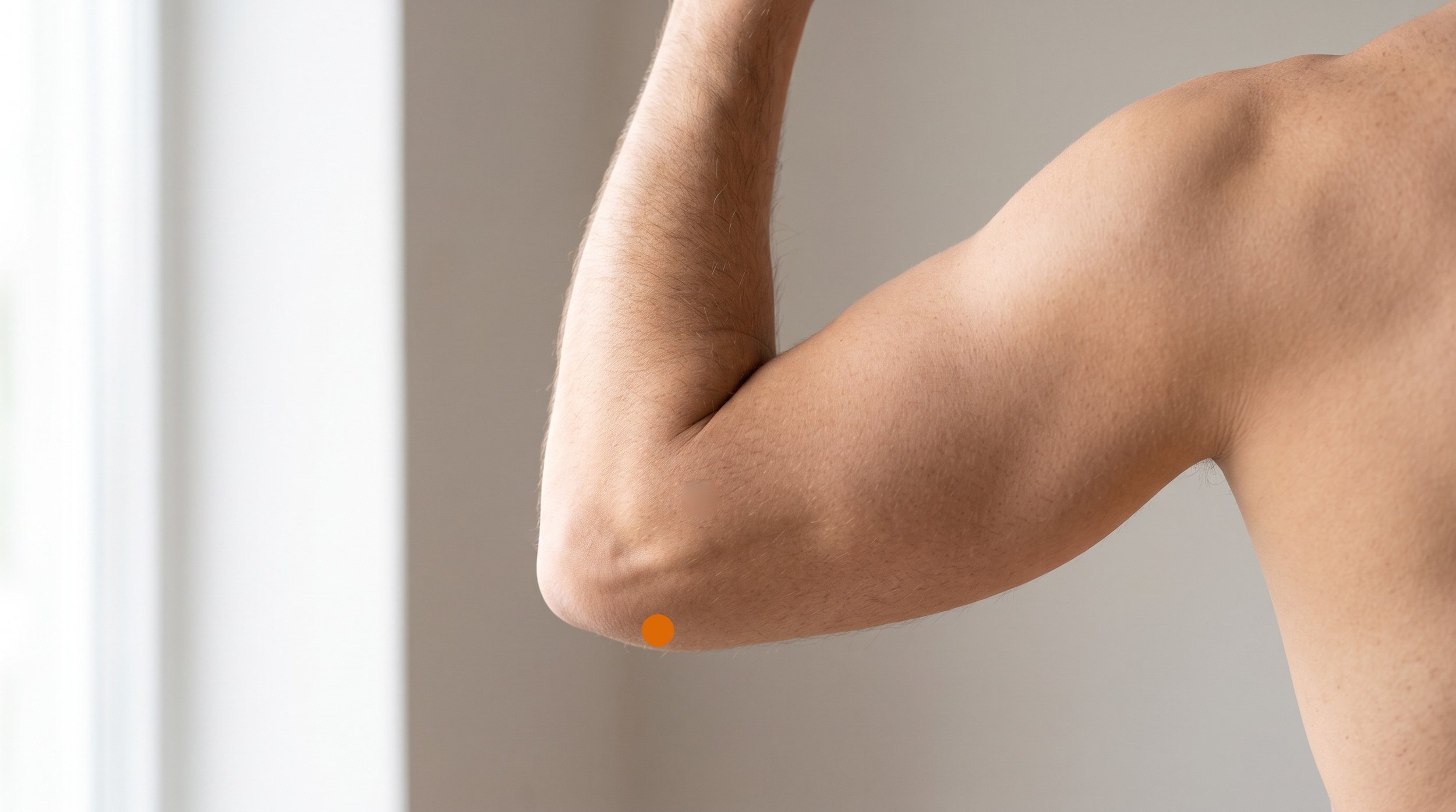
SJ11 Acupuncture Point (Qinglengyuan)
Clear Cold Abyss Above the Elbow: Anatomy, Mechanism, and Why This Triple Burner Point Belongs in Shoulder and Arm Pain Treatment
SJ11 (also written TE11), known in Chinese as Qinglengyuan and usually translated as Clear Cold Abyss, is the eleventh point of the Triple Burner (Sanjiao) channel and sits on the back of the upper arm, one cun above SJ10, located most reliably with the elbow bent.
In plain terms, it is a point in the meat of the lower triceps, a finger's width or so above the bony tip of the elbow, in tissue supplied by branches of the radial nerve. It is a quieter point than its famous neighbors, and it earns its place clinically for a very specific complaint: the shoulder and arm that hurt and will not lift, the pattern classical texts described as being unable to raise the arm to put on clothes. The te11 acupuncture point is best understood as a local posterior arm point with channel reach toward the shoulder, used alongside stronger distal and shoulder points rather than on its own.
- Location and layers: SJ11 is located 1 cun proximal to SJ10 with the elbow flexed, on the posterior upper arm just above the olecranon (Deadman et al., 2001). A needle passes through skin and subcutaneous fascia into the distal triceps, tissue that loads heavily during pressing, pushing, carrying, and long hours of desk and mouse work.
- Traditional categories, translated: classical sources attribute to Qinglengyuan the actions of activating the channel, dispelling wind damp, and clearing damp heat, with indications spanning painful obstruction of the shoulder and arm, difficulty raising the arm, headache, eye pain, and yellow eyes (Deadman et al., 2001). In modern terms, that reads as a regional soft tissue point on a channel whose described pathway climbs from the arm to the shoulder, neck, and side of the head.
- Nerve geography drives the mechanism: the area is innervated by the posterior brachial cutaneous nerve and muscular branches of the radial nerve (Chinese Acupuncture and Moxibustion, 1987). Needling here recruits small diameter afferents that project into cervical cord segments shared with the shoulder girdle, engaging segmental inhibition and descending pain control pathways (Zhao, 2008).
- The research picture is indirect but real: no trial has isolated triple burner 11, though a Cochrane review of acupuncture for shoulder pain found short term signals with limited certainty (Green et al., 2005), and a large individual patient data meta-analysis reported modest but persistent effects of acupuncture for chronic musculoskeletal pain (Vickers et al., 2018).
- Clinical framing: qinglengyuan acupuncture is typically an adjunct rather than a headline point, chosen when the distal triceps is genuinely tender or restricted, and combined with SJ10, SJ14, LI11, and shoulder region points in a full treatment (Deadman et al., 2001).
- De qi at SJ11 is usually a deep, heavy, slightly achy fullness in the back of the arm, sometimes spreading toward the elbow or up toward the shoulder. If a taut band in the triceps is engaged, patients may feel a brief cramping twitch, a response familiar from trigger point needling (Simons et al., 1999).
Struggling to Lift Your Arm Overhead or Reach Behind Your Back?
Restricted shoulder motion is rarely a single tissue problem, and the back of the upper arm is one of the most commonly missed contributors. At Morningside Acupuncture, we assess how the triceps, deltoid, rotator cuff, and cervical segments share the load, then use SJ11 with neighboring Triple Burner points and targeted needling of the arm muscles that limit reach. Most patients notice change in range of motion and comfort over a short course of care rather than a single visit. Schedule an appointment and let us map where your restriction actually lives.
Schedule NowAnatomy of SJ11: Why the Lower Triceps Just Above the Olecranon Is Such an Important Location
With the elbow flexed, SJ11 lies one cun above SJ10 on the back of the upper arm, which places it in the distal belly and musculotendinous region of the triceps brachii just before the muscle converges onto the olecranon (Deadman et al., 2001). The layers under the needle are simple and shallow: thin skin, a mobile subcutaneous layer, the brachial fascia, and then muscle sitting against the back of the humerus. This is loaded tissue.
Every push-up, bench press, dip, overhead carry, and long stretch of typing with unsupported forearms asks the triceps to work eccentrically or hold isometrically, and the distal portion near the tendon is where repetitive strain tends to concentrate. Patients who report a deep, dull soreness behind the elbow that worsens with pressing and improves with rest are often tender exactly where this point sits.
The nerve geography explains why the sj 11 arm point is used for problems that extend beyond the spot itself. The region is supplied by the posterior brachial cutaneous nerve and by muscular branches of the radial nerve, with the radial nerve itself running behind the humerus proximal to this level (Chinese Acupuncture and Moxibustion, 1987). Those afferents enter the spinal cord at roughly the same cervical segments that carry input from the shoulder girdle and lateral arm, so stimulation at SJ11 converges centrally with signals from tissues that patients experience as shoulder pain.
Needling activates A-delta and C fiber afferents, which can dampen dorsal horn transmission segmentally and recruit descending inhibitory pathways involving endogenous opioid and monoaminergic signaling (Zhao, 2008). Local effects matter too: needle insertion produces small vascular and inflammatory changes that may improve circulation in a chronically loaded muscle, and engaging a taut band can reduce local tenderness and improve stretch tolerance (Simons et al., 1999).
The relevant deep structures are the humeral shaft and the median collateral vessels that run with the deep brachial system behind the arm, so needling stays in muscle and does not approach a body cavity. Standard technique is perpendicular insertion of about 0.5 to 1 cun, with textbook ranges spanning roughly 0.3 to 1.5 cun depending on build and the source consulted (Deadman et al., 2001; Shanghai College of Traditional Chinese Medicine, 1981).
Practitioners angle away from bone rather than pressing into periosteum, and if a patient reports a sharp electrical sensation shooting down the forearm or into the hand, the needle should be withdrawn and redirected, since that suggests contact with a neural branch rather than useful de qi. Moxibustion is traditionally permitted at this location.
Related Acupuncture For Shoulder Pain Related Best Acupuncture Points For Shoulder PainSJ11 (TE11) at a Glance: Classification, Location, and Clinical Use
| Category | Detail |
|---|---|
| Traditional Name | Qinglengyuan (Clear Cold Abyss), also rendered as Clear Cold Gulf or Cooling Gulf |
| Channel Classification | Eleventh point of the Triple Burner (Sanjiao) channel of the hand shaoyang, on the posterior upper arm (SJ11, also written TE11 or TB11; also called the Triple Energizer, the Triple Heater or Triple Warmer) |
| Point Categories | No five-shu, xi-cleft, luo-connecting, hui-meeting, or extraordinary vessel designation is recorded for this point in the standard references. It is grouped with the Triple Burner arm points traditionally described as activating the channel, dispelling wind damp, and clearing damp heat (Deadman et al., 2001). |
| Precise Location | On the back of the upper arm, 1 cun proximal to SJ10, on the line from the olecranon toward SJ14, located with the elbow flexed |
| Tissue Stimulated | Skin, subcutaneous fascia, and the distal triceps brachii just above the olecranon, with the neighboring anconeus often relevant to posterior elbow pain |
| Needle Depth / Direction | Perpendicular insertion 0.5 to 1 cun into the triceps, angled away from the humerus; texts range from roughly 0.3 to 1.5 cun. Moxibustion is traditionally applicable. |
| De Qi Sensation | Deep, heavy, dull fullness in the back of the upper arm, sometimes spreading toward the elbow or shoulder; a brief cramping twitch is possible if a taut band in the triceps is engaged |
| Primary Clinical Uses | Painful obstruction of the shoulder and arm, difficulty raising the arm (classically described as being unable to lift the shoulder to put on clothes), posterior elbow and triceps pain, with headache, eye pain, and yellow eyes appearing in classical indication lists |
| Common Point Combinations |
|
In A Manual of Acupuncture, Deadman and colleagues present Qinglengyuan as a point that traditionally activates the channel, dispels wind damp, and clears damp heat, and the indications they list fall into two clusters (Deadman et al., 2001). The first is musculoskeletal and entirely regional: painful obstruction of the shoulder and arm, fixed painful obstruction, and the vivid functional complaint of being unable to raise the shoulder and arm enough to get dressed.
The second is systemic and, to modern eyes, surprising: headache, heaviness of the head with pain below the jaw, eye pain, yellowing of the eyes with pain along the ribs, and jaundice. These are traditional attributions rather than claims of physiological effect, and the older damp heat categories should be read as a classical way of grouping symptoms, not as a mechanism.
What is striking is the coherence within the classical logic itself: the yellow eyes and flank pain sit on the shaoyang description of the channel's course, so a point above the elbow was assigned distant effects along a route the texts already considered continuous.
Why SJ11 Is Used for Shoulder Restriction When the Painful Spot Is Below the Shoulder
Patients are often puzzled when a needle goes into the back of the upper arm for a shoulder complaint. The explanation is convergence. Sensory fibers from the tissue around SJ11 travel in branches of the radial nerve into the lower cervical spinal segments, the same neighborhood that receives input from the deltoid, rotator cuff, and shoulder capsule. Because those inputs share dorsal horn territory, stimulation at one site can influence how the nervous system processes signals arriving from the other, which is a central part of how needling appears to reduce regional pain (Zhao, 2008).
Add the mechanical reality that the triceps crosses the shoulder through its long head, and a tender distal triceps stops being a bystander in overhead restriction.
The second layer is descending modulation. Needling that produces genuine de qi activates ascending pathways that engage brainstem centers releasing endogenous opioids, serotonin, and noradrenaline back down onto the spinal cord, raising pain thresholds beyond the segment treated (Zhao, 2008). This is the mechanism most consistent with what patients describe after a session: not only less soreness in the arm, but a shoulder that feels less guarded and moves further before it protests.
It is also why a modest point like triple burner 11 can contribute meaningfully inside a broader prescription even though it would rarely be the only point selected.
Finally, there is the local tissue itself. When a taut band in the distal triceps reproduces a patient's posterior arm or elbow pain, needling into that band can reduce tenderness and restore stretch tolerance, and SJ11 happens to sit right in that zone (Simons et al., 1999). This overlap between a classical channel point and a common myofascial target is one reason acupuncture and dry needling, both of which use an acupuncture needle, so often converge on the same spot from different reasoning.
What the Research Shows for SJ11 (TE11)
One note on naming before the evidence: in the research literature this point appears as TE11, the WHO standard code, and also as SJ11 or TB11 depending on the authors, so it is worth searching all three if you want to read the studies below in full.
There is no clinical trial that isolates SJ11, and no study has measured what this single point does on its own. That is true of most individual points, since trials test multi-point protocols selected by treating clinicians. The reasonable way to read the evidence is at the level of the conditions SJ11 is used for: shoulder pain, elbow pain, and chronic musculoskeletal pain generally. Reviews in these areas range from cautiously positive to inconclusive, and certainty is frequently limited by small samples, sham design problems, and inconsistent protocols. The findings below help set expectations for a course of care rather than validate any one location on the arm.
| Study | Type | Focus | Key Finding |
|---|---|---|---|
| Green et al., 2005 | Cochrane systematic review | Acupuncture for shoulder pain in adults | The reviewers found too little good quality evidence to reach firm conclusions, while noting possible short term benefits for pain and function over roughly two to four weeks. |
| Vickers et al., 2018 | Individual patient data meta-analysis | Acupuncture for chronic musculoskeletal, headache, and osteoarthritis pain | Acupuncture was associated with modest benefits over both sham and no-acupuncture controls, with effects that largely persisted at twelve months. |
| Zhan et al., 2023 | Systematic review and meta-analysis | Acupuncture compared with rehabilitation therapy for post-stroke shoulder pain | Pooled results suggested acupuncture may reduce shoulder pain and support upper limb function, though the included trials had methodological limitations. |
| Navarro-Santana et al., 2021 | Systematic review and meta-analysis | Manual acupuncture and electroacupuncture for lateral elbow pain | Manual acupuncture showed a moderate short term reduction in pain intensity, with no clear advantage demonstrated for electroacupuncture and limited certainty overall. |
| Zhao, 2008 | Narrative review of neurophysiology | Mechanisms of acupuncture analgesia | Needling appears to act through afferent activation, segmental spinal inhibition, and descending opioid and monoaminergic modulation rather than through any single local effect. |
Elbow and Upper Arm Pain That Flares With Pressing, Typing, or Training?
Posterior elbow and triceps pain often shows up in lifters, climbers, racquet players, and anyone whose desk setup keeps the arm braced all day. SJ11 sits directly in that tissue, which makes it a practical local point when combined with dry needling of the triceps and anconeus and with distal points that may support broader pain modulation. We pair needling with straightforward loading and workstation advice so the relief holds between sessions. Book a visit and we will build a plan around how you actually use your arm.
Schedule NowSJ11 in the Context of Trigger Point Work
SJ11 sits in the distal triceps brachii, which makes it one of the clearest examples of a classical point and a myofascial target occupying the same real estate. Trigger points in the triceps can refer pain toward the posterior elbow, up the back of the arm, and toward the shoulder, and the medial and long head regions are frequent offenders in patients who press, lift, or hold a static desk posture (Simons et al., 1999).
At Morningside Acupuncture we palpate the triceps, anconeus, posterior deltoid, and the rotator cuff before selecting points, and when the tender band is right where SJ11 lies, the point and the trigger point are treated with one needle insertion. That overlap is not a coincidence so much as two systems describing the same clinically relevant tissue.
In practice, a session for restricted overhead reach might combine SJ11 and SJ10 locally, SJ14 at the shoulder, LI11 at the elbow, and dry needling of the triceps and anconeus where taut bands reproduce the patient's familiar pain. Since acupuncture is defined by the use of an acupuncture needle and encompasses hundreds of styles, including dry needling, there is no conflict between channel-based and anatomically driven point selection; they simply answer different questions about the same arm. We finish with loading and mobility work so the tissue tolerates the demands that provoked the problem in the first place.
SJ11 Shoulder and Arm Pain Treatment at NYC's Highest-Rated Acupuncture Clinic
Morningside Acupuncture is the highest-rated acupuncture and dry needling clinic in New York City with over 500 five-star Google reviews, and our practice is built around musculoskeletal pain and function. We use points like SJ11 within a clear anatomical rationale, integrating classical channel theory with modern trigger point and pain science, never as guesswork. Whether your issue is a stiff shoulder, a cranky elbow, or arm pain that flares at your desk, we will explain exactly what we are treating and why. Schedule your appointment today.
Schedule NowFrequently Asked Questions
Is SJ11 the same point as TE11 or TB11?
Yes. SJ11, TE11, and TB11 are all codes for the same point, Qinglengyuan. SJ stands for San Jiao, the Chinese name of the channel. TE (Triple Energizer) is the WHO standard abbreviation and the one you will see in most Western textbooks and research papers. TB (Triple Burner) and TW (Triple Warmer) are older English renderings of the same name that still appear in many books. You will also come across it written as San Jiao 11 or Triple Energizer 11. Whichever code is used, the location and the uses are the same.
What does SJ11 feel like when needled?
Most people feel a brief pinch at the skin, then a deep, heavy, mildly achy fullness in the back of the upper arm. That heaviness is de qi, and it may spread a short distance toward the elbow or up toward the shoulder. If the needle engages a taut band in the triceps, there can be a quick cramping twitch that settles within seconds. A sharp, electric sensation shooting into the forearm or hand is not the goal and should be reported immediately so the practitioner can withdraw and redirect the needle.
Why needle the upper arm for a shoulder problem instead of the shoulder itself?
Two reasons. Mechanically, the long head of the triceps crosses the shoulder joint, so a stiff, tender triceps can limit overhead reach even when the pain is felt higher up. Neurologically, the tissue at SJ11 sends afferents into cervical spinal segments shared with the shoulder girdle, so stimulation here converges with shoulder input and can influence how those signals are processed, alongside descending inhibitory pathways (Zhao, 2008). In practice we usually treat both regions, using SJ11 as part of a fuller prescription rather than as a substitute for local shoulder points.
Can I press SJ11 myself between sessions?
Yes, and it is easy to reach. Bend your elbow to about ninety degrees, find the bony tip of the elbow, then slide about one thumb-width up the back of the arm and another finger-width above that into the soft muscle. Use the opposite thumb or a knuckle to press straight in with steady, moderate pressure until you feel a dull ache rather than sharp pain, and hold for thirty to sixty seconds. Repeat two or three times per side, once or twice daily, and follow with gentle overhead reaching or a doorway triceps stretch. Ease off if pressure produces tingling or numbness into the hand, and skip the area if the skin is broken or bruised.
Is SJ11 safe to needle?
In trained hands it is a low risk point. There is no body cavity nearby, so the main considerations are the humerus underneath and the neural branches supplying the region. Practitioners insert perpendicularly to a moderate depth, angle away from bone rather than striking periosteum, and adjust the needle if a patient reports electric sensations traveling into the forearm or hand. As with any needling, mild soreness or a small bruise can occur. Tell your acupuncturist if you take blood thinners, have a bleeding disorder, or have had recent surgery or hardware placed in the arm.
Where exactly is SJ11 located?
SJ11 is on the back of the upper arm, one cun proximal to SJ10, and it is located with the elbow flexed (Deadman et al., 2001). SJ10 sits in the depression just above the olecranon, the bony tip of the elbow, so SJ11 is roughly one thumb-width further up the arm along the line that runs from the olecranon toward SJ14 at the back of the shoulder. On most people it falls in the soft distal belly of the triceps and is often noticeably tender when the arm has been overloaded.
References
- Deadman, P., Al-Khafaji, M., & Baker, K. (2009). A manual of acupuncture. Journal of Chinese Medicine Publications.
- Cheng, X. (Ed.). (1999). Chinese acupuncture and moxibustion (Rev. ed.). Foreign Languages Press.
- O'Connor, J., & Bensky, D. (Eds. & Trans.). (1981). Acupuncture: A comprehensive text. Shanghai College of Traditional Medicine. Eastland Press.
- Simons, D. G., Travell, J. G., & Simons, L. S. (1999). Travell & Simons' myofascial pain and dysfunction: The trigger point manual, Vol. 1: Upper half of body (2nd ed.). Williams & Wilkins.
- Zhao, Z. Q. (2008). Neural mechanism underlying acupuncture analgesia. Progress in Neurobiology, 85(4), 355-375. https://doi.org/10.1016/j.pneurobio.2008.05.004
- Vickers, A. J., Vertosick, E. A., Lewith, G., MacPherson, H., Foster, N. E., Sherman, K. J., Irnich, D., Witt, C. M., & Linde, K. (2018). Acupuncture for chronic pain: Update of an individual patient data meta-analysis. Journal of Pain, 19(5), 455-474. https://doi.org/10.1016/j.jpain.2017.11.005
- Green, S., Buchbinder, R., & Hetrick, S. (2005). Acupuncture for shoulder pain. Cochrane Database of Systematic Reviews, 2005(2), CD005319. https://doi.org/10.1002/14651858.CD005319
- Zhan, J., Luo, Y., Mao, W., et al. (2023). Efficacy of acupuncture versus rehabilitation therapy on post-stroke shoulder pain: A systematic review and meta-analysis of randomized controlled trials. Medicine, 102(29), e34266. https://doi.org/10.1097/MD.0000000000034266
- Navarro-Santana, M. J., Sanchez-Infante, J., Gómez-Chiguano, G. F., Cummings, M., Fernández-de-las-Peñas, C., & Plaza-Manzano, G. (2021). Effects of manual acupuncture and electroacupuncture for lateral epicondylalgia of musculoskeletal origin: A systematic review and meta-analysis. Acupuncture in Medicine, 39(5), 405-422. https://doi.org/10.1177/0964528420967364
Disclaimer: This web site is intended for educational and informational purposes only. Reading this website does not constitute providing medical advice or any professional services. This information should not be used for diagnosing or treating any health issue or disease. Those seeking medical advice should consult with a licensed physician. Seek the advice of a medical doctor or other qualified health professional for any medical condition. If you think you have a medical emergency, call 911 or go to the emergency room. No acupuncturist-patient relationship is created by reading this website or using the information. Morningside Acupuncture PLLC and its employees and contributors do not make any express or implied representations with respect to the information on this site or its use. For any legal interpretation of scope of practice in your state, consult a licensed attorney or regulatory authority.
Read more from our blog



