Shiqizhuixia Acupuncture Point (M-BW-25)
Below the Seventeenth Vertebra: Anatomy, Mechanism, and Why This Lumbosacral Point Anchors Chronic Low Back Pain Treatment
Shiqizhuixia (M-BW-25, also catalogued as EX-B8) is an extra point whose name translates as Below the Seventeenth Vertebra, a classical way of counting down the spine to the gap beneath the fifth lumbar vertebra.
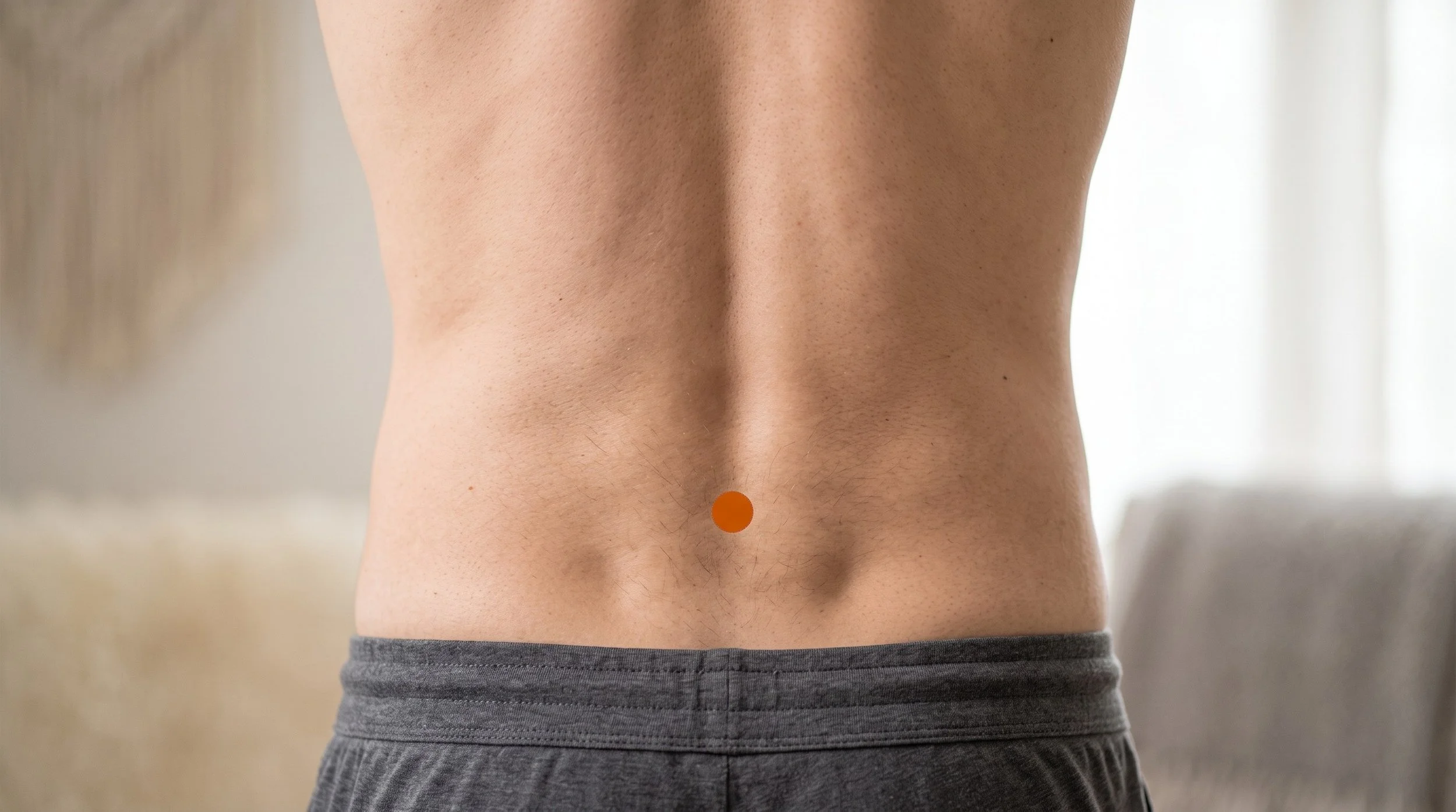
In plain terms, it sits exactly on the midline of the low back, in the small hollow you drop into when you slide a finger up the sacrum and reach the bottom of the lumbar spine. That hollow marks the lumbosacral junction, the single most mechanically loaded segment of the human spine and the region where disc, facet joint, and ligamentous pain most often concentrate. The shiqizhuixia acupuncture point matters clinically because it is frequently the precise spot patients point to when asked where their back hurts, which makes it both a diagnostic landmark and a treatment target in chronic low back pain.
- Location and layers: Shiqizhuixia lies on the posterior midline in the depression below the L5 spinous process, so a needle passes through skin, subcutaneous tissue, the thoracolumbar fascia, and the supraspinous and interspinous ligaments of the L5 to S1 interspace, with the deep paraspinal muscles just lateral to it.
- Traditional attributions, translated: classical sources credit this point with tonifying the Kidneys, promoting urination, and activating the channel to relieve pain. Read neurophysiologically, those descriptions map onto local mechanical and nociceptive input at the most loaded lumbar segment plus reflex effects on autonomic outflow serving the pelvis.
- Mechanism: needling here recruits medial branch and dorsal ramus afferents from the L4 to S1 segments, the same segments that carry input from the lower discs, facet joints, and lumbosacral ligaments, giving a strong segmental basis for local pain modulation (Zhao, 2008).
- Research picture: the Cochrane review of acupuncture for chronic nonspecific low back pain found moderate certainty evidence of clinically important short-term pain relief versus sham, with more modest and less certain results against usual care (Mu et al., 2020), and individual patient data pooling across chronic pain conditions supports effects that persist beyond the treatment period (Vickers et al., 2018).
- Point-specific data: a large trial in primary dysmenorrhea compared needling Shiqizhuixia alone against a multi-point prescription and reported that the single point performed at least as well when treatment was given at pain onset (Ma et al., 2013), an unusual example of a single extra point being tested on its own.
- De qi and practice: patients typically describe a deep, heavy, spreading ache under the needle that may radiate across the sacrum or into the buttock, and clinicians usually palpate first because the tenderest spot in a chronic lumbar case is very often exactly here.
Is Your Low Back Pain Always Worst at the Belt Line?
Pain that concentrates in the midline hollow just above the sacrum usually involves the L5 to S1 segment, and Shiqizhuixia sits directly over it. At Morningside Acupuncture we palpate the lumbosacral junction carefully, then combine gentle needling at this point with segmental and distal points chosen for your pattern. Most patients notice that the local ache softens and the back moves more freely within the first few sessions. Schedule a visit and let us map exactly where your pain lives.
Schedule NowAnatomy of SHIQIZHUIXIA: Why the L5 to S1 Junction Is Such an Important Location
Run a finger up the midline of the sacrum and it will eventually drop into a distinct notch: that is the interspace below the fifth lumbar spinous process, and that is Shiqizhuixia. Beneath the skin and subcutaneous fat, the needle meets the thoracolumbar fascia and then the supraspinous and interspinous ligaments spanning L5 and S1. Just lateral lie the deep fibers of lumbar multifidus, the segmental stabilizer that tends to atrophy and become irritable in long-standing back pain.
This interspace carries more compressive and shear load than any other level of the spine because the mobile lumbar column meets the fixed sacral base here, which is why the lower lumbar discs and facet joints are such frequent pain generators.
The tissues at this point are supplied by the medial branches of the dorsal rami of the lower lumbar spinal nerves, the same small nerves that innervate the facet joints, the interspinous ligaments, and multifidus. Because those afferents enter the cord at L4, L5, and S1, needling here delivers input directly into the segments already receiving nociceptive traffic from painful discs, joints, and ligaments, a convergence that underlies segmental modulation of dorsal horn activity (Zhao, 2008).
Sustained stimulation also engages descending inhibitory pathways from the midbrain and brainstem and opioid-mediated mechanisms, which helps explain why relief often outlasts the needle retention time (Zhao, 2008; Vickers et al., 2018).
A secondary effect worth noting is local vascular and autonomic change in the treated tissue, which may reduce the mechanical sensitivity of guarded paraspinal muscle.
Depth discipline matters here. The spinal canal beneath this interspace sits roughly 1.25 to 1.75 cun from the skin surface depending on body build, so the conventional perpendicular insertion of 0.5 to 1 cun is deliberately conservative and stays within ligament and superficial muscle. Practitioners also work in a plane crossed by branches of the lumbar vessels and the vertebral venous plexus, so slow insertion without deep or forceful thrusting is standard.
Extra caution applies in very slim patients, in anyone with prior lumbar surgery or instrumentation, and in patients on anticoagulants, where lighter technique or an adjacent point is often the better choice.
Related Acupuncture For Low Back Pain Related Best Acupuncture Points For Back PainSHIQIZHUIXIA at a Glance: Classification, Location, and Clinical Use
| Category | Detail |
|---|---|
| Traditional Name | Shiqizhuixia, Below the Seventeenth Vertebra |
| Channel Classification | Extra point, M-BW-25 (also listed as EX-B8), lying on the posterior midline over the pathway of the Governing vessel |
| Point Categories | Extraordinary (extra) point rather than a channel point; traditionally credited with tonifying the Kidneys and promoting urination, and with activating the channel to relieve pain; classical sources also describe it as influencing the Governing vessel and the Chong and Ren vessels |
| Precise Location | On the midline of the lower back, in the depression immediately below the spinous process of the fifth lumbar vertebra, at the L5 to S1 interspace. Slide a finger up the midline of the sacrum until it settles into the clear hollow beneath the lumbar spine. |
| Tissue Stimulated | Thoracolumbar fascia, supraspinous and interspinous ligaments of L5 to S1, with lumbar multifidus and erector spinae immediately lateral. Often combined in the same session with needling of the muscles that cause low back pain. |
| Needle Depth / Direction | Perpendicular insertion 0.5 to 1 cun. Caution: the spinal canal lies approximately 1.25 to 1.75 cun deep depending on build, so deep or forceful thrusting is avoided. Moxibustion is commonly applied over the point in deficiency-type presentations. |
| De Qi Sensation | A deep, heavy, dull ache at the midline that often spreads across the sacrum or laterally into the low back and buttock. Many patients recognize it immediately as the sensation of their own pain being reproduced, then easing. |
| Primary Clinical Uses | Chronic low back pain in both deficiency and excess patterns, lumbosacral junction pain, pain of the lumbar region radiating into the legs, and classically difficult urination and pelvic heaviness in pregnancy under professional care |
| Common Point Combinations |
|
The Deadman manual traces Shiqizhuixia to the Supplement to the Thousand Ducat Formulas and lists its traditional indications as pain of the lumbar region and legs, difficult urination, and the heaviness of a fetus pressing on the bladder. It is presented there as one of the most frequently used points for chronic back pain, and the commentary makes the practical observation that it is very often the exact place where tenderness is found. Traditional theory assigns it two functions: tonifying the Kidneys and promoting urination, and activating the channel to stop pain.
Other texts, including the Shanghai and Cunningham point manuals, extend the classical list to lower limb weakness, irregular menstruation, and uterine bleeding, and note its association with the Governing vessel and the pelvic extraordinary vessels.
What is striking about the classical pattern is its explicit use in both deficiency and excess presentations, and in the mixed picture that clinicians actually see most often, a flexibility that few points are described as having.
Why SHIQIZHUIXIA Is Used for Menstrual and Pelvic Symptoms, Not Just Backache
Patients are sometimes surprised that a point used for stiff lower backs also appears in classical lists for difficult urination, menstrual pain, and pelvic heaviness late in pregnancy. The explanation is segmental rather than mystical. The lumbosacral junction sits at the transition into the sacral segments that carry sensory and autonomic traffic to and from the bladder, uterus, and pelvic floor, and pain from these structures is commonly felt in the low back and sacrum because that input converges with somatic input in the same region of the spinal cord (Zhao, 2008). Needling into that convergence zone can influence how the nervous system processes both streams.
There is also point-specific clinical data. In a trial of 600 women with primary dysmenorrhea, needling Shiqizhuixia alone was compared with a four-point prescription, and the single point produced at least comparable relief when treatment was delivered at the onset of pain, with the authors suggesting it as a convenient choice (Ma et al., 2013). A separate randomized sham-controlled trial found that firm acupressure over the same location reduced labor pain scores in first-time mothers compared with sham and routine care (Azadeh et al., 2025). Neither study establishes a mechanism, and both should be read as early evidence rather than settled findings.
Pregnancy deserves explicit caution. Lumbosacral points are traditionally treated conservatively during pregnancy, and while the classical literature lists pelvic pressure as an indication, needling at this level in a pregnant patient should only be done by a licensed practitioner who is trained in obstetric care and working alongside your prenatal provider. Self-treatment with strong pressure over the sacrum or lower lumbar spine during pregnancy is not something we recommend without professional guidance.
What the Research Shows for SHIQIZHUIXIA
No high-quality trial has isolated Shiqizhuixia for chronic low back pain, and it would be misleading to suggest otherwise. Most of the evidence base tests multi-point protocols in which this point, or its immediate neighbors GV3, BL25, and BL26, is one component of a lumbar prescription. What the research can reasonably tell us is that needling protocols targeting this region may reduce pain and improve function in chronic low back pain, that effects tend to be modest but durable, and that the certainty of evidence varies widely by comparator. Read the table below as context for how this point is used, not as proof of what a single point does.
| Study | Type | Focus | Key Finding |
|---|---|---|---|
| Mu et al., 2020 | Cochrane systematic review (33 studies, 8,270 participants) | Acupuncture for chronic nonspecific low back pain compared with sham, usual care, or no treatment | Moderate certainty evidence suggested clinically important short-term pain relief and improved back function versus no treatment, while comparisons with sham and usual care were smaller and less certain. |
| Vickers et al., 2018 | Individual patient data meta-analysis (about 21,000 patients) | Acupuncture across chronic pain conditions including chronic low back pain | Acupuncture was associated with greater pain reduction than sham and no-acupuncture controls, with benefit that decayed only modestly over twelve months. |
| Ma et al., 2013 | Randomized clinical trial (600 participants) | Needling Shiqizhuixia alone versus a four-point prescription in primary dysmenorrhea, at two treatment timings | Both approaches reduced menstrual pain compared with no treatment, and the single point was at least as effective as multiple points when treatment began at pain onset. |
| Hu et al., 2018 | Systematic review and meta-analysis (16 randomized trials) | Dry needling for low back pain, including comparisons with sham and with acupuncture | Dry needling appeared to reduce pain intensity and disability immediately after treatment, though most included trials carried high or unclear risk of bias. |
| Azadeh et al., 2025 | Randomized, single-blind, sham-controlled trial (90 participants) | Acupressure at EX-B8, the same location as Shiqizhuixia, during the active first stage of labor | Pain scores were lower in the acupressure group than in sham and routine care groups at all three measured time points, in a single-center trial requiring replication. |
| Zhao, 2008 | Narrative review of mechanism research | Neural pathways underlying acupuncture analgesia | Analgesic effects appear to involve segmental dorsal horn inhibition together with descending opioid-mediated control from midbrain and brainstem structures. |
Chronic Back Pain That Has Not Responded to Stretching or Rest?
Long-standing lumbar pain rarely comes from one tissue, which is why we treat the joint segment, the surrounding muscle, and the nervous system's pain processing together. Shiqizhuixia is one of our workhorse midline points, often paired with dry needling of quadratus lumborum, multifidus, and gluteal muscles in the same session. We also give you loading and movement guidance so gains hold between visits. Book an evaluation and we will build the plan around your specific presentation.
Schedule NowSHIQIZHUIXIA in the Context of Trigger Point Work
Acupuncture is defined by the use of an acupuncture needle, and that includes trigger point dry needling, so at Morningside we treat Shiqizhuixia and myofascial targets in the same session rather than treating them as competing systems. The point itself sits over ligament and fascia rather than in a muscle belly, so it is not a trigger point in the strict sense.
What surrounds it is very much trigger point territory: lumbar multifidus and the deep paraspinals at L5 and S1, quadratus lumborum spanning the twelfth rib to the iliac crest, iliocostalis lumborum, and the gluteus medius and maximus, all of which can refer pain into the low back, sacrum, and buttock in patterns patients describe as their back pain (Simons et al., 1999).
A typical session might begin with palpation of the midline hollow below L5 to confirm tenderness, then combine a shallow perpendicular needle at Shiqizhuixia with deeper needling of taut bands in quadratus lumborum and gluteus medius, plus segmental points such as BL23, BL25, or BL26 depending on findings. Reviews of dry needling in low back pain suggest short-term reductions in pain and disability, though the trial quality is limited and long-term data are thin (Hu et al., 2018).
We generally pair the needling with movement retraining and graded loading, because restoring tolerance at the lumbosacral junction is what tends to keep the results.
SHIQIZHUIXIA Low Back Pain Treatment at NYC's Highest-Rated Acupuncture Clinic
Morningside Acupuncture is the highest-rated acupuncture and dry needling clinic in New York City with over 500 five-star Google reviews, and lumbar pain is one of the most common reasons patients come to see us. Our licensed acupuncturists use the shiqizhuixia low back point alongside orthopedic assessment, trigger point dry needling, and cupping when it fits the case. Every treatment plan is documented, reviewed, and adjusted based on how you respond. Schedule your first session and start treating the segment that actually hurts.
Schedule NowFrequently Asked Questions
What does SHIQIZHUIXIA feel like when needled?
Most people feel a brief pinch at the skin, then a deep, heavy, slightly aching fullness that sits in the midline and can spread sideways across the low back or down toward the sacrum. That spreading heaviness is de qi, and at this point it frequently reproduces the patient's familiar ache before it settles. Because the point often sits on the tenderest spot, the initial sensation can be a little stronger than at other back points, but it usually eases within a minute of needle placement and many patients feel the surrounding muscles soften afterward.
Why needle a single midline point when my pain covers my whole lower back?
Diffuse-feeling back pain often has a concentrated source at the L5 to S1 segment, and Shiqizhuixia sits directly over that interspace. Needling there feeds input into the same spinal segments that receive nociceptive traffic from the lower discs, facet joints, and ligaments, which may modulate how that whole region is processed rather than just numbing one spot (Zhao, 2008). In practice we rarely use it alone. It anchors a prescription that usually includes adjacent Bladder channel points, distal points such as BL40, and dry needling of the muscles feeding the pain pattern.
Can I press SHIQIZHUIXIA myself between sessions?
Yes, and it is one of the easier points to self-treat because you can find it by feel. Sitting or standing, slide a thumb or knuckle up the midline of your sacrum until it drops into the hollow just below the bottom of your lumbar spine, roughly level with the top of your pelvic rim at the back. Press straight in with steady, firm pressure at an intensity you would rate about four to six out of ten, hold for 30 to 60 seconds, release, and repeat two or three times. A tennis ball against a wall works well if your hands tire. Two or three short rounds a day is plenty. Stop if pressure produces sharp pain, numbness, tingling, or radiating leg symptoms, and skip self-pressure at this location during pregnancy unless your practitioner has cleared it.
Is SHIQIZHUIXIA safe to needle?
In trained hands, yes. The standard depth is 0.5 to 1 cun perpendicular, which keeps the needle in fascia and ligament, while the spinal canal lies roughly 1.25 to 1.75 cun deep depending on body build, so depth discipline is the main safety consideration. Practitioners avoid forceful deep thrusting, use lighter technique in very slim patients, and take extra care with anyone who has had lumbar surgery, spinal instrumentation, a known bony defect at the lower lumbar spine, or who is taking anticoagulants. Minor bruising or short-lived soreness at the site is the most common side effect. Pregnancy calls for professional judgment, and we coordinate with your prenatal provider before treating this region.
Where exactly is SHIQIZHUIXIA located?
On the posterior midline of the lower back, in the depression immediately below the spinous process of the fifth lumbar vertebra, at the L5 to S1 interspace. The reliable way to find it is by touch rather than measurement: place a finger on the middle of the sacrum and slide upward along the midline until the finger drops into the first significant hollow beneath the bony lumbar spine. That hollow is the point, and the extra point below the seventeenth vertebra takes its name from the classical practice of counting vertebrae from the top of the spine downward.
References
- Deadman, P., Al-Khafaji, M., & Baker, K. (2009). A manual of acupuncture. Journal of Chinese Medicine Publications.
- O'Connor, J., & Bensky, D. (Eds. & Trans.). (1981). Acupuncture: A comprehensive text. Shanghai College of Traditional Medicine. Eastland Press.
- Cunningham, P. M. (2000). Acupuncture points: A practical guide to classical and modern usage. Odyssey Press.
- Maciocia, G. (2006). The channels of acupuncture: Clinical use of the secondary channels and eight extraordinary vessels. Churchill Livingstone Elsevier.
- Simons, D. G., Travell, J. G., & Simons, L. S. (1999). Travell & Simons' myofascial pain and dysfunction: The trigger point manual, Vol. 1: Upper half of body (2nd ed.). Williams & Wilkins.
- Mu, J., Furlan, A. D., Lam, W. Y., Hsu, M. Y., Ning, Z., & Lao, L. (2020). Acupuncture for chronic nonspecific low back pain. Cochrane Database of Systematic Reviews, 2020(12), CD013814. https://doi.org/10.1002/14651858.CD013814
- Vickers, A. J., Vertosick, E. A., Lewith, G., MacPherson, H., Foster, N. E., Sherman, K. J., Irnich, D., Witt, C. M., & Linde, K. (2018). Acupuncture for chronic pain: Update of an individual patient data meta-analysis. Journal of Pain, 19(5), 455-474. https://doi.org/10.1016/j.jpain.2017.11.005
- Ma, Y. X., Ye, X. N., Liu, C. Z., Cai, P. Y., Li, Z. F., Du, D. Q., Guo, G., Chen, S. Z., Zhao, J. P., Liu, J. J., Yi, H. Q., & Gao, S. Z. (2013). A clinical trial of acupuncture about time-varying treatment and points selection in primary dysmenorrhea. Journal of Ethnopharmacology, 148(2), 498-504. https://doi.org/10.1016/j.jep.2013.04.045
- Hu, H. T., Gao, H., Ma, R. J., Zhao, X. F., Tian, H. F., & Li, L. (2018). Is dry needling effective for low back pain? A systematic review and PRISMA-compliant meta-analysis. Medicine, 97(26), e11225. https://doi.org/10.1097/MD.0000000000011225
- Azadeh, H., Heshmat, R., Nasiri, M., Azarkish, F., & Sedigh Mobarakabadi, S. (2025). The effect of EX-B8 acupressure on labor pain: A randomized, single-blind, sham-controlled trial. Pain Research and Management, 2025, 7873155. https://doi.org/10.1155/prm/7873155
- Zhao, Z. Q. (2008). Neural mechanism underlying acupuncture analgesia. Progress in Neurobiology, 85(4), 355-375. https://doi.org/10.1016/j.pneurobio.2008.05.004
Disclaimer: This web site is intended for educational and informational purposes only. Reading this website does not constitute providing medical advice or any professional services. This information should not be used for diagnosing or treating any health issue or disease. Those seeking medical advice should consult with a licensed physician. Seek the advice of a medical doctor or other qualified health professional for any medical condition. If you think you have a medical emergency, call 911 or go to the emergency room. No acupuncturist-patient relationship is created by reading this website or using the information. Morningside Acupuncture PLLC and its employees and contributors do not make any express or implied representations with respect to the information on this site or its use. For any legal interpretation of scope of practice in your state, consult a licensed attorney or regulatory authority.
Read more from our blog