Weiguanxiashu Acupuncture Point (M-BW-12)
The Pancreas Shu Beside the Eighth Thoracic Vertebra: Anatomy, Segmental Mechanism, and Why This Extra Point Bridges Mid-Back Tension and Digestive Complaints
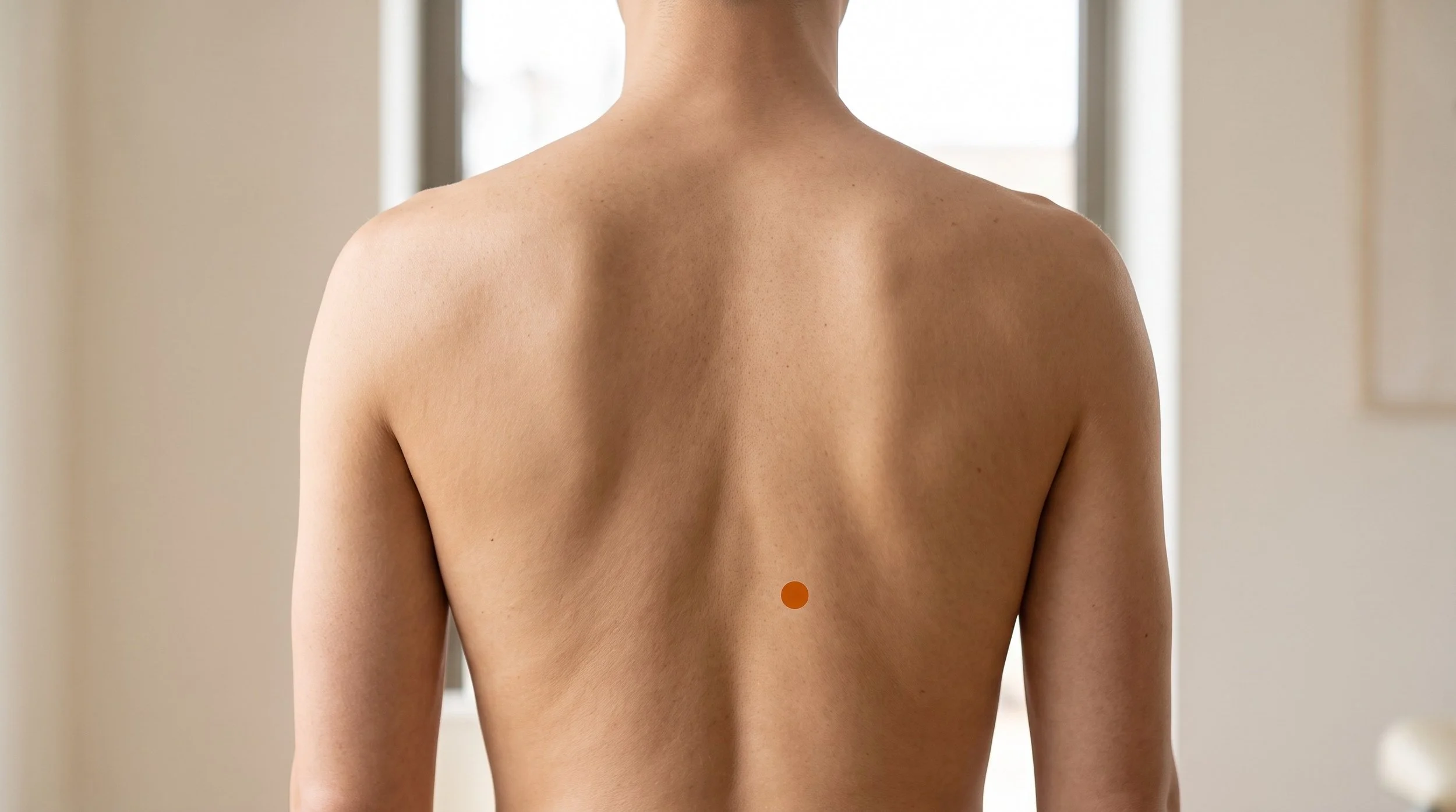
Weiguanxiashu (M-BW-12), whose name is usually rendered as Stomach Controller Lower Shu, is an extra point on the mid-back, 1.5 cun to either side of the lower border of the eighth thoracic spinous process, right on the visible crest of the paraspinal muscles. Most contemporary texts list it under a second name, Yishu, the pancreas shu, and it sits between the diaphragm and Liver back-shu levels on the inner Bladder line. It matters clinically for two reasons.
First, it was recorded very early, in Sun Si-miao's Thousand Ducat Formulas, for the classical wasting and thirsting disorder with dry throat, which is the historical description of what we now call diabetes.
Second, T8 is a segment where paraspinal muscle, rib mechanics, and the sensory supply of the upper abdominal organs all converge, so the weiguanxiashu acupuncture point gives a clinician one location that speaks to mid-back stiffness, rib-side discomfort, and epigastric symptoms at the same time.
- Weiguanxiashu sits 1.5 cun lateral to the lower edge of the T8 spinous process, located at the highest visible point of the paraspinal ridge, so a needle passes through skin, thoracolumbar fascia, the erector spinae columns, and toward the deep segmental multifidus and rotatores (Deadman et al.).
- Classical texts attribute to this point the actions of clearing heat and generating fluids, which is traditional language for a point used with dryness, thirst, and irritable upper digestive symptoms; the classical indication list also includes chest and rib-side pain, epigastric pain, and vomiting (Deadman et al.).
- Neurophysiologically, the point is served by branches of the T8 dorsal ramus, and that same spinal segment receives visceral afferent traffic traveling with the greater splanchnic nerve, which is the anatomical basis for somato-autonomic reflex effects on upper abdominal function (Uchida et al., 2017).
- Needling also recruits the broader analgesic machinery of spinal gating and brainstem descending inhibition described in mechanism reviews (Zhao, 2008), and individual patient data from chronic pain trials suggest acupuncture produces modest but persistent effects over sham and usual care (Vickers et al., 2018).
- The research picture for the metabolic side is cautious rather than settled: meta-analyses of acupuncture as an add-on in type 2 diabetes report improvements in some glycemic measures with limited certainty (Si et al., 2025; Li et al., 2022), which is why we frame this point as support alongside standard medical care and never as a substitute for it.
- De qi here is usually a deep, dull, spreading ache under the shoulder blade region with a sense of heaviness that may travel a rib or two laterally; the needle is angled toward the spine rather than away from it, because the lung sits beneath this level (Deadman et al.; Lin et al., 2019).
Mid-Back Tension That Comes With Bloating, Reflux, or Epigastric Pain?
Patients often arrive telling us their upper stomach symptoms and their stiff mid-back seem to travel together, and the T8 level is one of the places where that pattern shows up under the fingers. We use weiguanxiashu with the neighboring back-shu levels, gentle oblique needling toward the spine, and distal points such as ST36 to address both the muscular and the autonomic side of the complaint. Treatment is always coordinated with the care you already receive from your physician or gastroenterologist. Schedule a visit and we'll map where your tenderness actually sits.
Schedule NowAnatomy of WEIGUANXIASHU: Why the T8 Paraspinal Ridge Is Such an Important Location
This point sits over the thickest portion of the mid-thoracic paraspinal mass, at the level where the eighth thoracic vertebra articulates with its ribs. Working from the surface inward, a needle placed here meets skin and subcutaneous tissue, then thoracolumbar fascia, then the lower fibers of trapezius and the upper spread of the latissimus dorsi aponeurosis, then the long erector spinae columns of iliocostalis and longissimus, and finally the short segmental muscles, multifidus and rotatores, that bridge one or two vertebral levels at a time.
That stack is loaded constantly by desk posture, prolonged sitting, one-sided carrying, and shallow breathing, and the deep segmental layer is a frequent site of taut bands and referred aching across the mid-back (Simons et al., 1999).
The sensory story is what makes this location interesting. The skin and muscle here are supplied by the medial and lateral branches of the T8 dorsal ramus, while the same spinal segments receive visceral afferents that travel with the greater splanchnic nerve from the stomach, duodenum, liver, gallbladder, and pancreas.
Because somatic and visceral inputs converge on shared dorsal horn neurons, upper abdominal irritation can register as mid-back tenderness, and needling the mid-back can in turn modulate autonomic outflow to those same organs, a pathway summarized in reviews of somatoautonomic reflexes in acupuncture (Uchida et al., 2017). Needle stimulation at this depth also engages A-delta and group III afferents that feed spinal inhibitory circuits and brainstem descending pain control (Zhao, 2008), which is part of why segmental needling can ease both muscular tenderness and the guarding that accompanies it.
Deep to the muscle at T8 lies the rib cage, and beneath that the lung. This is why the classical needling convention is so specific: oblique insertion directed toward the spine for roughly 0.5 to 1 cun, or a transverse-oblique insertion of 1 to 1.5 cun along the muscle. Perpendicular needling, or oblique needling angled away from the midline, carries a substantial pneumothorax risk and is avoided (Deadman et al.).
In population level data from Taiwan, pneumothorax after acupuncture was rare, on the order of a few cases per million treatments even when needling was performed over the thorax or neck, with risk concentrated in patients who had underlying lung disease or prior thoracic surgery (Lin et al., 2019). Rarity is not the same as impossibility, so angle, depth, and patient build are all part of the decision here.
Related Back Shu Points Related Pain Finder Upper Back Shoulder ArmWEIGUANXIASHU at a Glance: Classification, Location, and Clinical Use
| Category | Detail |
|---|---|
| Traditional Name | Weiguanxiashu, Stomach Controller Lower Shu, known in most modern texts as Yishu, the pancreas shu |
| Channel Classification | Extra point (M-BW-12), off-channel; positioned on the inner Bladder line at T8, between the diaphragm and Liver back-shu levels |
| Point Categories | No five-shu, luo-connecting, xi-cleft, hui-meeting, or extraordinary vessel designation. It is classified simply as an extra back point, with the traditionally attributed actions of clearing heat and generating fluids (Deadman et al.). |
| Precise Location | On the upper back, 1.5 cun lateral to the lower border of the spinous process of the eighth thoracic vertebra, at the visible highest point of the paraspinal muscles |
| Tissue Stimulated | Skin, thoracolumbar fascia, lower trapezius and latissimus dorsi aponeurosis, iliocostalis and longissimus, and the deep multifidus and rotatores at T8, in a region that neighbors the costal attachments of the diaphragm and the intercostal muscles |
| Needle Depth / Direction | Oblique insertion directed toward the spine 0.5 to 1 cun, or transverse-oblique insertion 1 to 1.5 cun. Perpendicular needling, or oblique needling angled away from the spine, carries a substantial risk of pneumothorax and is not used. |
| De Qi Sensation | A deep, dull, spreading ache with heaviness across the mid-back, sometimes traveling a rib or two laterally or toward the lower scapula; sharp or electric sensations mean the needle is redirected |
| Primary Clinical Uses | Traditionally used for wasting and thirsting disorder with dry throat (the classical description of diabetes, alongside standard medical care), pain of the chest and rib-sides, epigastric pain, and vomiting; used in modern clinics for mid-thoracic paraspinal tension and segmental digestive support |
| Common Point Combinations |
|
The Manual of Acupuncture records that this point first appears in the Thousand Ducat Formulas, where Sun Si-miao recommended it for wasting and thirsting disorder together with the dryness of the throat that accompanied it, treated with a very large course of moxibustion applied both here and at a companion point just below the eighth thoracic spinous process (Deadman et al.). Later tradition assigned it the actions of clearing heat and generating fluids, and broadened its indications to include chest and rib-side pain, epigastric pain, and vomiting.
Modern Chinese texts renamed the same location Yishu, the pancreas shu, and list it inside multi-point groupings for diabetes alongside the Spleen, Kidney, and Triple Burner back-shu levels (Shanghai College of Traditional Chinese Medicine). All of that is traditional attribution rather than a physiological claim, but the pattern is striking: physicians working more than a thousand years before pancreatic function was understood repeatedly returned to the one spinal segment through which the sensory and sympathetic supply of the upper abdominal organs actually passes.
Why WEIGUANXIASHU Is Used for Thirst, Epigastric Pain, and Blood Sugar Support Rather Than Only Back Pain
The short answer is segmental convergence. Sensory nerves from the skin and muscles of the mid-back enter the spinal cord at the same levels that receive afferent traffic from the stomach, duodenum, liver, gallbladder, and pancreas by way of the greater splanchnic nerve. Those inputs share dorsal horn neurons, which is why an irritated upper abdominal organ can produce a band of tenderness across the T7 to T9 paraspinals, and why patients often describe upper stomach symptoms and mid-back tightness as one problem rather than two.
Stimulating the somatic side of that shared circuit can shift autonomic output back toward the viscera, a reflex arc that has been mapped in detail in animal and human work on somatoautonomic responses to needling (Uchida et al., 2017).
On top of that segmental effect, needling recruits general pain modulation. Mechanical stimulation of muscle afferents activates spinal inhibitory interneurons and brainstem descending pathways that use endogenous opioid, serotonergic, and noradrenergic signaling, which reduces the excitability of dorsal horn neurons receiving both muscular and visceral input (Zhao, 2008). Clinically that shows up as less local tenderness, less guarding through the thoracic muscles, and often easier breathing mechanics, since the T8 paraspinals sit right where the diaphragm's crural and costal attachments influence rib motion.
The metabolic question deserves plainer language. Systematic reviews of acupuncture as an adjunct in type 2 diabetes report improvements in measures such as fasting blood glucose and insulin resistance, but effect sizes are modest, trial quality is uneven, and certainty for outcomes like HbA1c remains low (Si et al., 2025; Li et al., 2022). Mechanistic work in functional dyspepsia is somewhat clearer, showing changes in gastric motility, accommodation, gut hormone signaling, and autonomic balance after acupuncture or electroacupuncture (Guo et al., 2020).
So the honest framing is this: yishu pancreas shu is used as supportive care within a comprehensive medical plan, and it may help with symptom burden and mid-back discomfort, but it is not a treatment for diabetes on its own.
What the Research Shows for WEIGUANXIASHU
Almost no trial isolates a single point, and this one is no exception. The studies below test multi-point protocols in which a segmental back point like m-bw-12 would appear as one component among several, usually alongside limb points such as ST36 and SP6 and other back-shu levels. Read them as evidence about acupuncture protocols for a condition, not as evidence about one needle in one location, and note that certainty ratings for the metabolic outcomes remain low to moderate.
| Study | Type | Focus | Key Finding |
|---|---|---|---|
| Si et al., 2025 | Systematic review and meta-analysis (21 RCTs, 2,117 participants) | Acupuncture as an adjunct for clinical and metabolic markers in type 2 diabetes | Pooled data suggested improvements in several glycemic and metabolic measures, though heterogeneity across protocols limits how firmly the results can be applied. |
| Li et al., 2022 | Systematic review and meta-analysis (21 RCTs) with GRADE assessment | Acupuncture added to antidiabetic medication versus medication alone | A small but statistically significant reduction in fasting blood glucose and improved insulin resistance was reported, with effects on HbA1c remaining uncertain and adverse events mild. |
| Guo et al., 2020 | Systematic review of mechanistic and clinical studies | Acupuncture and electroacupuncture in functional dyspepsia | Included studies suggested improvements in gastric motility and accommodation with changes in gastrointestinal hormones and autonomic function, though study quality varied. |
| Uchida et al., 2017 | Narrative review of physiological research | Somatoautonomic reflexes underlying acupuncture and moxibustion effects on visceral function | Somatic stimulation reliably alters autonomic outflow to organs through segmental and supraspinal reflexes, with responses in conscious humans differing at times from anesthetized animal models. |
| Vickers et al., 2018 | Individual patient data meta-analysis (39 trials, about 20,827 patients) | Acupuncture for chronic musculoskeletal, headache, and osteoarthritis pain | Acupuncture was associated with modest benefits over both sham and no-acupuncture controls, with effects that persisted over about a year. |
| Lin et al., 2019 | Population-based cohort study, Taiwan national insurance data | Incidence of iatrogenic pneumothorax following acupuncture | Pneumothorax occurred at a rate of only a few cases per million treatments, with higher risk in patients who had pre-existing lung disease or prior thoracic surgery. |
Looking for Acupuncture Support Alongside Your Metabolic Care?
The weiguanxiashu back point carries a long traditional association with the wasting and thirsting pattern, and modern texts renamed it Yishu, the pancreas shu, for that reason. At Morningside Acupuncture we use it as part of a broader plan that may include BL20, BL21, ST36, and SP6, with realistic expectations set from the current research rather than from promises. Nothing we do replaces medication, monitoring, or nutrition guidance. Book a consultation to see whether acupuncture fits into your existing plan.
Schedule NowWEIGUANXIASHU in the Context of Trigger Point Work
Acupuncture, in our definition, is the use of an acupuncture needle, and that includes the hundreds of needling styles practiced today, dry needling among them. At T8 the classical point and the myofascial target overlap almost perfectly. The deep multifidus and rotatores at this level, along with the overlying longissimus and iliocostalis, are well described sources of local and referred mid-back aching, and thoracic paraspinal taut bands frequently reproduce a patient's complaint on palpation (Simons et al., 1999).
When we needle here for muscular reasons, the technique is the same as when we needle it for traditional reasons: oblique, angled toward the spine, with depth judged from the patient's build.
In practice we rarely treat this level alone. Depending on what palpation reveals, we may add the lower trapezius, the rhomboids, the serratus posterior inferior, the intercostals along the tender rib interspaces, and the costal attachments of the diaphragm in patients whose breathing pattern is contributing to the picture. Distal points such as ST36 or SP6 are often added to broaden the effect beyond the local segment, since the analgesic response to needling involves both segmental gating and descending inhibition rather than a purely local release (Zhao, 2008). Patients typically report a heavy, tired sensation across the mid-back for several hours afterward, followed by easier rotation and deeper breathing.
WEIGUANXIASHU Mid-Back and Digestive Treatment at NYC's Highest-Rated Acupuncture Clinic
Morningside Acupuncture is the highest-rated acupuncture and dry needling clinic in New York City with over 500 five-star Google reviews, and thoracic points like this one are treated with the anatomical care they require. Every session begins with palpation of the paraspinal levels, and needling at T8 is performed obliquely toward the spine with appropriate depth control. You'll always know what is being needled, why, and what to expect afterward. Schedule your appointment and let's get your mid-back and digestion working together again.
Schedule NowFrequently Asked Questions
What does WEIGUANXIASHU feel like when needled?
Most people describe a deep, dull, spreading ache or a sense of pressure and heaviness right beside the spine, sometimes traveling a rib or two out toward the side or down toward the lower shoulder blade. That heavy, radiating quality is the de qi sensation, and it usually settles into a warm, released feeling within a minute or two. Because the needle is angled shallowly toward the spine, the sensation is broad rather than sharp. Any sharp, electric, or breath-catching sensation is a signal to withdraw and redirect immediately, and we act on that without hesitation.
Why needle the mid-back for stomach or blood sugar symptoms instead of the abdomen?
Because the nerves that supply the upper abdominal organs pass through this spinal region. Visceral afferents from the stomach, duodenum, liver, gallbladder, and pancreas travel with the greater splanchnic nerve and enter the cord at roughly the same levels that supply the T8 paraspinal muscles, so both share dorsal horn circuitry. Needling the somatic side of that convergence can influence autonomic output to the viscera through documented somatoautonomic reflexes (Uchida et al., 2017). Abdominal points are still used, and often in the same treatment plan, but the back approach reaches the segment from the other direction and also addresses the muscular tenderness that so often accompanies upper digestive complaints.
Can I press WEIGUANXIASHU myself between sessions?
Yes, with the understanding that acupressure is a comfort measure rather than a treatment for any metabolic condition. Since this location is hard to reach with your own hands, the simplest approach is a tennis ball or lacrosse ball placed against a wall. Stand with the ball just beside your spine at the level of the lower tip of your shoulder blades, roughly a thumb's width and a half out from the midline, then lean back gently until you find the tender spot. Hold steady pressure for 30 to 60 seconds while breathing slowly into your lower ribs, release, then repeat two or three times per side, once or twice daily. Keep the pressure at a level you would call comfortable discomfort, never sharp, and stop if you feel any chest tightness, shortness of breath, or radiating pain. A partner using thumb pressure while you lie face down works equally well.
Is WEIGUANXIASHU safe to needle?
It is safe in trained hands, and it demands respect. The lung sits beneath this level, so the standard technique is oblique insertion directed toward the spine for 0.5 to 1 cun, or a transverse-oblique insertion of 1 to 1.5 cun along the muscle. Perpendicular needling, or oblique needling angled away from the spine, carries a substantial pneumothorax risk and is not appropriate here (Deadman et al.). Large population data show pneumothorax after acupuncture is rare, on the order of a few cases per million treatments, with risk concentrated among patients who have underlying lung disease or a history of thoracic surgery (Lin et al., 2019). We adjust depth for body build, use shorter needles in slim patients, and always ask about lung history before needling the thoracic back.
Where exactly is WEIGUANXIASHU located?
On the upper back, 1.5 cun lateral to the lower border of the spinous process of the eighth thoracic vertebra, which places it on the inner Bladder line between the diaphragm shu at T7 and the Liver shu at T9. The practical way to find it is to locate the visible highest point of the paraspinal muscle ridge at that level, since the point sits on the crest rather than in the groove beside the spine. A common landmark shortcut is to start at the level of the inferior angles of the shoulder blades, which sit near T7, and count down one segment. In clinic we confirm by palpation, because the tender, ropy band at T8 is usually easier to feel than it is to measure.
References
- Deadman, P., Al-Khafaji, M., & Baker, K. (2009). A manual of acupuncture. Journal of Chinese Medicine Publications.
- O'Connor, J., & Bensky, D. (Eds. & Trans.). (1981). Acupuncture: A comprehensive text. Shanghai College of Traditional Medicine. Eastland Press.
- Simons, D. G., Travell, J. G., & Simons, L. S. (1999). Travell & Simons' myofascial pain and dysfunction: The trigger point manual, Vol. 1: Upper half of body (2nd ed.). Williams & Wilkins.
- Zhao, Z. Q. (2008). Neural mechanism underlying acupuncture analgesia. Progress in Neurobiology, 85(4), 355-375. https://doi.org/10.1016/j.pneurobio.2008.05.004
- Vickers, A. J., Vertosick, E. A., Lewith, G., MacPherson, H., Foster, N. E., Sherman, K. J., Irnich, D., Witt, C. M., & Linde, K. (2018). Acupuncture for chronic pain: Update of an individual patient data meta-analysis. Journal of Pain, 19(5), 455-474. https://doi.org/10.1016/j.jpain.2017.11.005
- Uchida, S., Kagitani, F., & Sato-Suzuki, I. (2017). Somatoautonomic reflexes in acupuncture therapy: A review. Autonomic Neuroscience, 203, 1-8. https://doi.org/10.1016/j.autneu.2016.11.001
- Si, Y., Chen, J., Chen, L., Zheng, Y., Qiu, Y., Wang, B., Liang, Y., Zhang, Y., & Chen, Y. (2025). The effect of acupuncture on blood glucose control in patients with type 2 diabetes: A systematic review and meta-analysis of randomized controlled trials. Frontiers in Endocrinology, 16, 1596062. https://doi.org/10.3389/fendo.2025.1596062
- Li, S., Chen, J., Liu, M., Wang, Y., Zhou, X., & Sun, X. (2022). Effect and safety of acupuncture for type 2 diabetes mellitus: A systematic review and meta-analysis of 21 randomised controlled trials. Chinese Journal of Integrative Medicine, 28(5), 463-471. https://doi.org/10.1007/s11655-021-3450-2
- Guo, Y., Wei, W., & Chen, J. D. Z. (2020). Effects and mechanisms of acupuncture and electroacupuncture for functional dyspepsia: A systematic review. World Journal of Gastroenterology, 26(19), 2440-2457. https://doi.org/10.3748/wjg.v26.i19.2440
- Lin, S. K., Liu, J. M., & Hsu, R. J. (2019). Incidence of iatrogenic pneumothorax following acupuncture treatments in Taiwan. Acupuncture in Medicine, 37(6), 332-339. https://doi.org/10.1136/acupmed-2018-011697
Disclaimer: This web site is intended for educational and informational purposes only. Reading this website does not constitute providing medical advice or any professional services. This information should not be used for diagnosing or treating any health issue or disease. Those seeking medical advice should consult with a licensed physician. Seek the advice of a medical doctor or other qualified health professional for any medical condition. If you think you have a medical emergency, call 911 or go to the emergency room. No acupuncturist-patient relationship is created by reading this website or using the information. Morningside Acupuncture PLLC and its employees and contributors do not make any express or implied representations with respect to the information on this site or its use. For any legal interpretation of scope of practice in your state, consult a licensed attorney or regulatory authority.
Read more from our blog