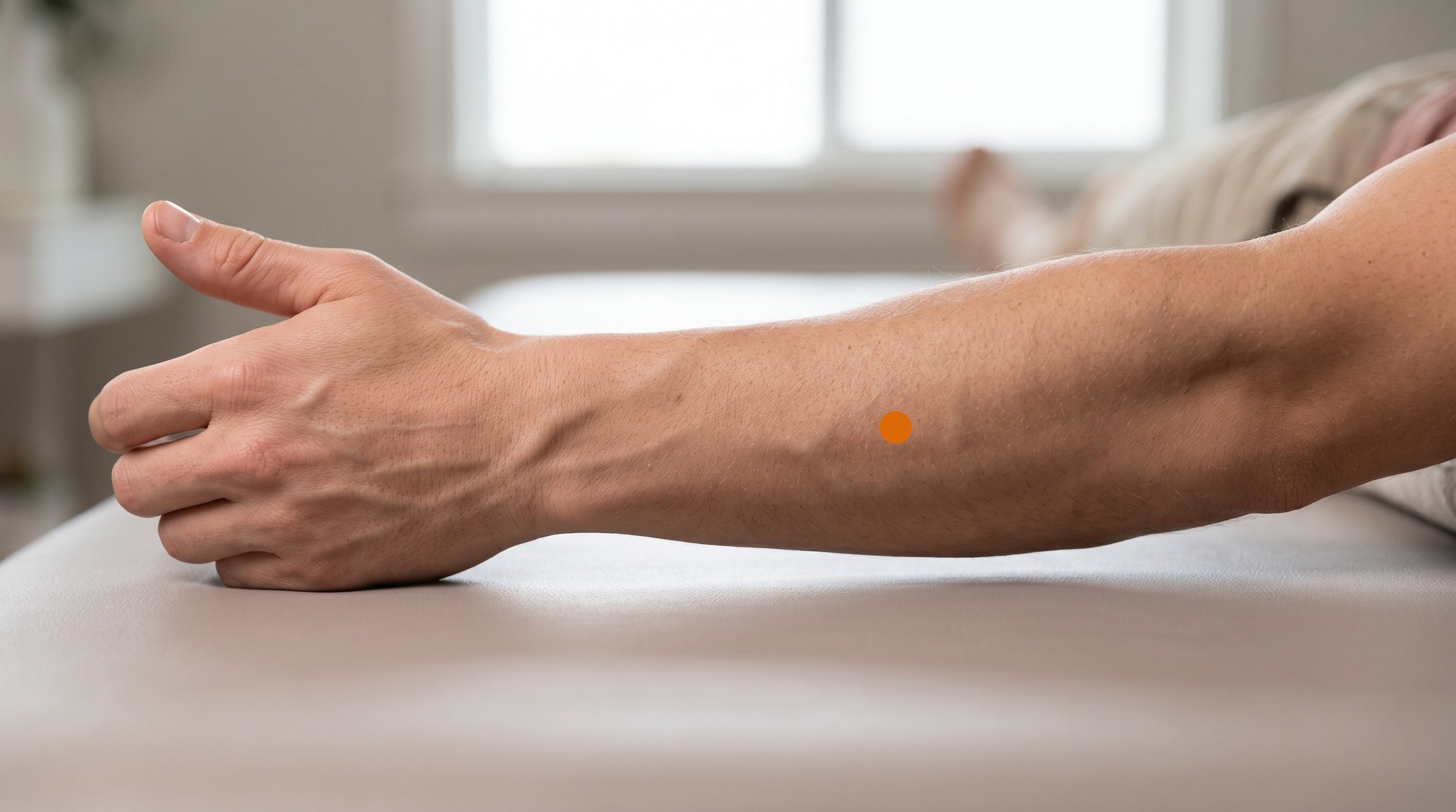
SJ9 Acupuncture Point (Sidu)
The Four Rivers Point of the Extensor Forearm: Anatomy, Mechanism, and Why a Point Near the Elbow Was Traditionally Used for the Throat, Ears, and Jaw
SJ9 (Sidu, "Four Rivers"), also written TE9, sits high on the back of the forearm, in the soft furrow between the radius and the ulna, roughly a third of the way down from the elbow toward the wrist. In modern texts it's located 7 cun proximal to SJ4 on the line running from the wrist crease to the lateral epicondyle, which lands it in the groove between the muscle bellies of extensor digitorum and extensor carpi ulnaris (Deadman et al., 2007). Classical sources give it a narrow and memorable job description: benefiting the throat and the ears.
That makes the te9 acupuncture point one of those distal locations that patients find surprising, because the complaints it was traditionally chosen for (sudden hoarseness, throat tightness, abrupt hearing changes, lower jaw toothache) sit nowhere near the forearm. It also happens to lie in tissue that gets heavily loaded by keyboards, mice, racket sports, and grip work, so in a modern clinic it earns its keep twice: once as a channel point, and once as a musculoskeletal target.
- Location and layers: SJ9 is found in the depression between the radius and ulna, 7 cun above SJ4 along the line to the lateral epicondyle, in the groove separating extensor digitorum from extensor carpi ulnaris (Deadman et al., 2007). Some manuals describe the same spot from the other end, about 5 cun below the olecranon (Kim, 2010).
- Traditional attributions, translated: the classical literature summarizes SJ9's actions as benefiting the throat and ears, with indications clustering into voice and throat problems, sudden ear symptoms, lower jaw toothache, and pain of the forearm (Deadman et al., 2007). In neurophysiological terms those clusters correspond to heterosegmental modulation of cranial nerve territories plus straightforward local treatment of the extensor compartment.
- Nerve story: the needle passes through skin supplied by the posterior antebrachial cutaneous nerve and into muscle supplied by the posterior interosseous nerve, the deep motor branch of the radial nerve carrying roughly C6 to C8 input. Stimulating small-diameter afferents here recruits spinal and brainstem pain-modulating circuits, including opioid, serotonergic, and noradrenergic descending inhibition (Zhao, 2008).
- Research picture: no trial has isolated SJ9, so the evidence is indirect. Reviews of acupuncture for tinnitus and for sudden sensorineural hearing loss report some favorable pooled results but consistently downgrade certainty for bias and small samples (Huang et al., 2021; Zhang et al., 2015; Chen et al., 2019), while individual patient data on chronic pain support modest, durable analgesic effects for multi-point protocols (Vickers et al., 2018).
- Clinical framing: at Morningside we treat SJ9 as a supporting point rather than a headline point. It's most useful stacked with local work (neck, jaw, periauricular, or elbow) and with neighboring channel points such as SJ6 and SJ4, which is exactly how classical formulas used it (Deadman et al., 2007).
- De qi: expect a deep, dull, spreading ache in the mid forearm that often travels toward the wrist or up toward the elbow. A brief electrical flick down the back of the hand can occur if the needle nears the posterior interosseous nerve, and that's a signal to withdraw slightly and redirect rather than push deeper.
Dealing With Ringing Ears, a Hoarse Voice, or Throat Tightness?
Ear and throat complaints rarely respond to one point, and we don't pretend otherwise. Our acupuncturists build treatments that combine local periauricular and cervical points with distal Triple Burner points like sj 9 forearm needling, then layer in manual therapy for the jaw and upper neck muscles that so often feed these symptoms. Sessions are unhurried, we track your response week to week, and we tell you honestly if you aren't improving. Schedule a visit and let's map out a plan.
Schedule NowAnatomy of SJ9: Why the Groove Between the Radius and Ulna Is Such an Important Location
Working from the surface inward, a needle at SJ9 crosses thin skin and subcutaneous fat, then the antebrachial fascia, then enters the intermuscular furrow between extensor digitorum and extensor carpi ulnaris in the upper third of the extensor compartment (Deadman et al., 2007). Deeper still lie the outcropping muscles of the thumb and the extensor pollicis longus, and beneath them the interosseous membrane spanning radius to ulna. This is high-traffic tissue.
Repetitive gripping, mouse and trackpad use, racket and club sports, climbing, and heavy carries all load the finger and wrist extensors eccentrically, and the muscle bellies here frequently become tender, ropey, and reactive well before anyone notices an elbow problem.
The skin over the point is served by the posterior antebrachial cutaneous nerve, a branch of the radial nerve, while the muscles around and beneath it are supplied by the posterior interosseous nerve, which carries roughly C6 to C8 segmental input. That matters for mechanism. Needling recruits group III and group IV afferents, which enter the cervical dorsal horn and converge on wide dynamic range neurons alongside input from other structures sharing those segments, one plausible basis for local and regional pain relief.
The same afferent barrage ascends to the periaqueductal gray and rostral ventromedial medulla, engaging descending inhibition mediated by endogenous opioids, serotonin, and norepinephrine, which is how a needle in the forearm can influence pain reported far from the needle (Zhao, 2008). Local effects matter too: needling produces an axon reflex with vasodilation and increased blood flow in the treated tissue, and in taut, overworked extensors that alone can change how the arm feels.
The deep structure to respect at SJ9 is the neurovascular bundle running along the interosseous membrane, specifically the posterior interosseous nerve and its accompanying vessels. There's no lung, no large superficial artery, and no joint cavity nearby, so the region is forgiving, but a forceful deep thrust into an unyielding membrane is uncomfortable and unnecessary.
Classical needling conventions allow perpendicular insertion, or oblique insertion angled proximally toward the elbow or distally toward the wrist, at 1 to 2 cun (Deadman et al., 2007), while more conservative modern manuals describe 0.5 to 1.0 cun perpendicular and note that moxibustion is applicable here (Kim, 2010).
In practice we choose depth by build and goal: shallower and oblique along the groove for channel work, a little deeper into the muscle belly when the target is a taut band.
Related Extensor Digitorum Trigger Points Related Extensor Carpi Ulnaris Trigger PointsSJ9 (TE9) at a Glance: Classification, Location, and Clinical Use
| Category | Detail |
|---|---|
| Traditional Name | Sidu (Four Rivers), Triple Burner 9, also written TE9 or TB-9 |
| Channel Classification | Ninth point of the Triple Burner (Sanjiao) channel of the arm, on the extensor surface of the forearm (SJ9, also written TE9 or TB9; also called the Triple Energizer, the Triple Heater or Triple Warmer) |
| Point Categories | No five-shu, yuan-source, luo-connecting, xi-cleft, hui-meeting, or extraordinary vessel designation is recorded for this point in the classical sources consulted. It's a regular Triple Burner channel point whose traditional actions are summarized simply as benefiting the throat and ears (Deadman et al., 2007; Kim, 2010). |
| Precise Location | On the dorsal forearm, 7 cun proximal to SJ4 on the line joining SJ4 and the lateral epicondyle of the humerus, in the depression between the radius and the ulna. A practical shortcut: find the midpoint between SJ4 and the lateral epicondyle, then move 1 cun proximally (Deadman et al., 2007). Described from the elbow end, it sits about 5 cun below the olecranon (Kim, 2010). |
| Tissue Stimulated | Skin and antebrachial fascia, then the intermuscular groove between extensor digitorum and extensor carpi ulnaris, with deeper access toward the thumb outcropping muscles and extensor indicis; the posterior interosseous nerve runs deep to the point |
| Needle Depth / Direction | Perpendicular, or oblique proximally toward the elbow or distally toward the wrist, 1 to 2 cun in classical texts; many clinicians work more conservatively at 0.5 to 1.0 cun, and moxibustion is considered applicable (Deadman et al., 2007; Kim, 2010) |
| De Qi Sensation | A deep, heavy, spreading ache in the mid forearm that commonly travels toward the wrist or elbow; a brief electric sensation into the back of the hand suggests proximity to the posterior interosseous nerve and calls for withdrawing and redirecting |
| Primary Clinical Uses | Traditionally used for sudden loss of voice, throat obstruction and sore throat, sudden deafness and tinnitus, toothache of the lower jaw, and pain of the forearm (Deadman et al., 2007); in modern practice, most often as a supporting distal point for ear and throat complaints and as a local point for extensor forearm and lateral elbow pain |
| Common Point Combinations |
|
Deadman, Al-Khafaji and Baker's point compendium presents Sidu with an unusually tight action statement, traditionally attributed as benefiting the throat and the ears, and an indication list to match: sudden loss of voice, obstruction and soreness of the throat, sudden deafness and tinnitus, toothache of the lower jaw, shortness of breath, and pain of the forearm (Deadman et al., 2007). Older commentaries read the name imaginatively, connecting the four great rivers of China with the movement of fluids through the body, though the same sources rank Sidu as a secondary rather than a leading point (Cunningham).
Two classical formulas survive in the record: a pairing with SJ16 for sudden deafness from the Supplementing Life collection, and a five-point grouping with SI5, SJ2, LI1 and LI2 for toothache of the lower jaw from the Thousand Ducat Formulas (Deadman et al., 2007). What's striking is the pattern of urgency. Almost every headline indication uses the word sudden, which suggests the point was reached for in acute, abrupt-onset presentations rather than for slowly accumulating chronic complaints.
Why SJ9 Is Used for Sudden Voice Loss, Ear Symptoms, and Jaw Pain
The honest starting point is that a forearm point cannot share spinal segments with the ear, throat, or jaw. Sensation in those regions travels through cranial nerves (trigeminal, facial, glossopharyngeal, and vagus) into brainstem nuclei, while SJ9's afferents enter the cervical cord around C6 to C8. So whatever SJ9 contributes to head and neck complaints is heterosegmental, meaning it works through convergence and modulation at higher levels rather than through a direct local reflex.
The trigeminocervical complex, where trigeminal input and upper cervical input meet, is one plausible meeting ground, and the brainstem's pain-modulating network is another.
That second route is better characterized. Needle stimulation strong enough to produce de qi recruits small-diameter afferents that drive the periaqueductal gray and rostral ventromedial medulla, releasing endogenous opioids and monoamines that dampen dorsal horn transmission body-wide (Zhao, 2008). Acupuncture also produces measurable autonomic and vascular shifts, which is relevant for patients whose tinnitus, throat tightness, or jaw clenching flares under stress.
None of this makes SJ9 a specific ear treatment. It makes it a plausible contributor within a protocol that also treats the neck, jaw, and periauricular region directly.
For the arm itself, the reasoning is simpler and better supported. SJ9 sits inside the muscle group that actually hurts in lateral elbow pain and extensor overuse, and reviews of acupuncture for lateral epicondylalgia report moderate short-term pain reduction with manual acupuncture, with less consistent findings for electroacupuncture (Navarro-Santana et al., 2021). For jaw complaints, meta-analyses of acupuncture in temporomandibular disorders suggest pain benefit with limited certainty (Park et al., 2023), which fits how we use the point: as one input among several rather than the deciding factor.
What the Research Shows for SJ9 (TE9)
One note on naming before the evidence: in the research literature this point appears as TE9, the WHO standard code, and also as SJ9 or TB9 depending on the authors, so it is worth searching all three if you want to read the studies below in full.
Almost all acupuncture research tests protocols, not single points, so there's no trial that tells you what SJ9 does on its own. What the literature can tell you is whether the conditions SJ9 was traditionally chosen for respond to acupuncture overall, and how confident we should be in those signals. For ear symptoms the answer is mixed and low certainty, for musculoskeletal forearm and jaw pain the answer is cautiously positive but still limited by trial quality, and for chronic pain generally the pooled data are more robust. Read the table below as context for why a clinician might include this point, not as proof that this point is the active ingredient.
| Study | Type | Focus | Key Finding |
|---|---|---|---|
| Huang et al., 2021 | Systematic review and meta-analysis of RCTs | Acupuncture for tinnitus (eight trials, 504 participants) | No significant advantage on the primary visual analogue scale outcome, though tinnitus handicap and severity questionnaire scores favored acupuncture, with low trial quality limiting any firm conclusion. |
| Zhang et al., 2015 | Systematic review and meta-analysis of RCTs | Acupuncture for sudden sensorineural hearing loss (12 trials, 863 patients) | Adding acupuncture to conventional Western medical treatment was associated with better hearing outcomes than conventional treatment alone, but the evidence was graded low to very low. |
| Chen et al., 2019 | Systematic review and meta-analysis of RCTs | Acupuncture for sudden sensorineural hearing loss (20 studies, 1423 cases) | Pooled results favored acupuncture with no signal of harm to liver or kidney function, though most trials came from a single research region and carried bias risk. |
| Navarro-Santana et al., 2021 | Systematic review and meta-analysis | Manual acupuncture and electroacupuncture for lateral epicondylalgia of musculoskeletal origin | Manual acupuncture was associated with moderate short-term reductions in pain intensity, with less consistent effects reported for electroacupuncture. |
| Park et al., 2023 | Systematic review and meta-analysis of RCTs | Acupuncture for temporomandibular disorders | Acupuncture may reduce temporomandibular pain compared with inactive controls, though certainty of evidence was constrained by heterogeneity and risk of bias. |
| Vickers et al., 2018 | Individual patient data meta-analysis (about 21,000 patients) | Acupuncture for chronic musculoskeletal, headache, and osteoarthritis pain | Acupuncture outperformed both sham and no-acupuncture controls, with effects persisting over roughly a year and only modest decay. |
| Zhao, 2008 | Narrative review of mechanism research | Neural pathways underlying acupuncture analgesia | Describes how needle stimulation of small-diameter afferents engages spinal and supraspinal circuits, with endogenous opioid and monoaminergic descending inhibition as central mechanisms. |
Forearm Pain, Grip Weakness, or Stubborn Tennis Elbow?
SJ9 sits right in the extensor compartment that takes the beating from mice, keyboards, rackets, and barbells. We combine sidu acupuncture with dry needling of extensor digitorum, extensor carpi radialis brevis, and extensor carpi ulnaris, along with loading strategies that make the tissue tolerant again. New York hands work hard, and we'd rather rebuild capacity than just chase soreness. Book an evaluation to get started.
Schedule NowSJ9 in the Context of Trigger Point Work
The location of SJ9 overlaps almost perfectly with territory that trigger point clinicians treat every week. Extensor digitorum and extensor carpi ulnaris both harbor taut bands in their proximal thirds, and their referral patterns send pain toward the lateral elbow, the dorsal forearm, the wrist, and sometimes into individual fingers, which can convincingly mimic tendinopathy or nerve entrapment (Simons et al., 1999). When a patient points at the outside of the elbow but the tender bands sit several inches distal, the needle target and the classical point address the same tissue from different traditions.
In practice we don't treat these as separate techniques, because acupuncture simply means using an acupuncture needle, and dry needling is one of hundreds of styles that do so. A typical forearm session at Morningside might include SJ9 and SJ4 along the channel, direct needling of taut bands in extensor digitorum, extensor carpi radialis brevis, and extensor carpi ulnaris, and attention to supinator and the flexor group when grip mechanics are involved.
We then pair the needling with grip and wrist extensor loading, plus workstation and racket or tool adjustments, because relieving a taut band without changing the load that created it usually buys temporary relief only.
SJ9 Ear, Throat, and Forearm Treatment at NYC's Highest-Rated Acupuncture Clinic
Morningside Acupuncture is the highest-rated acupuncture and dry needling clinic in New York City with over 500 five-star Google reviews, and that reputation comes from careful, evidence-informed care rather than one-size-fits-all protocols. Whether triple burner 9 belongs in your treatment for tinnitus support, voice fatigue, jaw pain, or lateral elbow pain, we'll explain what we're doing and why. Every plan includes home strategies so progress holds between visits. Schedule your appointment today.
Schedule NowFrequently Asked Questions
Is SJ9 the same point as TE9 or TB9?
Yes. SJ9, TE9, and TB9 are all codes for the same point, Sidu. SJ stands for San Jiao, the Chinese name of the channel. TE (Triple Energizer) is the WHO standard abbreviation and the one you will see in most Western textbooks and research papers. TB (Triple Burner) and TW (Triple Warmer) are older English renderings of the same name that still appear in many books. You will also come across it written as San Jiao 9 or Triple Energizer 9. Whichever code is used, the location and the uses are the same.
What does SJ9 feel like when needled?
Most people describe a deep, dull, heavy ache that spreads through the mid forearm, often traveling toward the wrist or upward toward the elbow. If the needle finds a taut band in extensor digitorum or extensor carpi ulnaris, you may feel a brief twitch or a cramp-like grab that fades within seconds. A quick electrical zing into the back of the hand can happen if the needle approaches the posterior interosseous nerve, and your acupuncturist should withdraw slightly and redirect if that occurs. Mild post-treatment soreness in the forearm for a day is common and not a problem.
Why would a point on the forearm be used for the throat, ears, or jaw?
Traditionally, points along the Triple Burner channel were used for structures the channel was said to reach, and Sidu's actions were summarized as benefiting the throat and ears (Deadman et al., 2007). Physiologically, the explanation is heterosegmental: the forearm and the ear don't share spinal segments, so the effect isn't a local reflex. Strong needle stimulation recruits small-diameter afferents that engage brainstem pain-modulating systems and produce descending inhibition and autonomic changes that aren't limited to the needled limb (Zhao, 2008). That's a plausible supporting mechanism, not a specific ear treatment, which is why triple burner 9 is used alongside local neck, jaw, and periauricular points rather than instead of them.
Can I press SJ9 myself between sessions?
Yes, and it's an easy point to self-treat because you can see and reach it. Find the bony ridge of the ulna on the back of your forearm, then slide your thumb toward the thumb side until you drop into the soft valley between the two muscle bellies, about a third of the way down from the elbow toward the wrist. Press with your thumb at a firmness of about six or seven out of ten, hold steady for 30 to 60 seconds, then add small circles for another 30 seconds. Repeat two or three times per arm, once or twice daily, and combine it with gentle wrist flexion stretching if the forearm is the main complaint. Stop if you feel numbness, tingling, or electric sensations into the hand, and back off if soreness lingers more than a day.
Is SJ9 safe to needle?
It's a low-risk location in trained hands. There's no lung, no major superficial artery, and no joint cavity nearby, so the main consideration is the posterior interosseous nerve and its vessels running deep between the radius and ulna. Classical texts allow 1 to 2 cun perpendicular or oblique insertion (Deadman et al., 2007), while many clinicians work at 0.5 to 1.0 cun (Kim, 2010), and either approach should be adjusted to your build. Practitioners avoid forcing the needle against the interosseous membrane and redirect if a sharp electric sensation shoots into the hand. Expect the ordinary minor effects of any needling: brief soreness, occasional small bruising, and rarely lightheadedness. Tell your acupuncturist if you take anticoagulants, have known nerve injury or entrapment in that arm, or have had recent forearm surgery.
Where exactly is SJ9 located?
On the back of the forearm, in the depression between the radius and the ulna, 7 cun proximal to SJ4 on the line drawn from SJ4 to the lateral epicondyle of the humerus (Deadman et al., 2007). The quickest way to find it is to locate the midpoint between the wrist point and the lateral epicondyle, then move 1 cun toward the elbow, settling into the groove between the muscle bellies of extensor digitorum and extensor carpi ulnaris. Some texts describe the same location as roughly 5 cun below the olecranon (Kim, 2010). If you flex and extend your fingers while palpating, you'll feel the extensor digitorum belly firm up and the groove become obvious.
References
- Deadman, P., Al-Khafaji, M., & Baker, K. (2009). A manual of acupuncture. Journal of Chinese Medicine Publications.
- Kim, H. (2008). Handbook of Oriental medicine (3rd ed.). Harmony & Balance Press.
- Cunningham, P. M. (2000). Acupuncture points: A practical guide to classical and modern usage. Odyssey Press.
- O'Connor, J., & Bensky, D. (Eds. & Trans.). (1981). Acupuncture: A comprehensive text. Shanghai College of Traditional Medicine. Eastland Press.
- Simons, D. G., Travell, J. G., & Simons, L. S. (1999). Travell & Simons' myofascial pain and dysfunction: The trigger point manual, Vol. 1: Upper half of body (2nd ed.). Williams & Wilkins.
- Zhao, Z. Q. (2008). Neural mechanism underlying acupuncture analgesia. Progress in Neurobiology, 85(4), 355-375. https://doi.org/10.1016/j.pneurobio.2008.05.004
- Vickers, A. J., Vertosick, E. A., Lewith, G., MacPherson, H., Foster, N. E., Sherman, K. J., Irnich, D., Witt, C. M., & Linde, K. (2018). Acupuncture for chronic pain: Update of an individual patient data meta-analysis. Journal of Pain, 19(5), 455-474. https://doi.org/10.1016/j.jpain.2017.11.005
- Huang, K., Liang, S., Chen, L., & Grellet, A. (2021). Acupuncture for tinnitus: A systematic review and meta-analysis of randomized controlled trials. Acupuncture in Medicine, 39(4), 264-271. https://doi.org/10.1177/0964528420938380
- Zhang, X. C., Xu, X. P., Xu, W. T., Hou, W. Z., Cheng, Y. Y., Li, C. X., & Ni, G. X. (2015). Acupuncture therapy for sudden sensorineural hearing loss: A systematic review and meta-analysis of randomized controlled trials. PLoS ONE, 10(4), e0125240. https://doi.org/10.1371/journal.pone.0125240
- Chen, S., Zhao, M., & Qiu, J. (2019). Acupuncture for the treatment of sudden sensorineural hearing loss: A systematic review and meta-analysis. Complementary Therapies in Medicine, 42, 381-388. https://doi.org/10.1016/j.ctim.2018.12.009
- Navarro-Santana, M. J., Sanchez-Infante, J., Gómez-Chiguano, G. F., Cummings, M., Fernández-de-las-Peñas, C., & Plaza-Manzano, G. (2021). Effects of manual acupuncture and electroacupuncture for lateral epicondylalgia of musculoskeletal origin: A systematic review and meta-analysis. Acupuncture in Medicine, 39(5), 405-422. https://doi.org/10.1177/0964528420967364
- Park, E. Y., Cho, J. H., Lee, S. H., Kim, K. W., Ha, I. H., & Lee, Y. J. (2023). Is acupuncture an effective treatment for temporomandibular disorder? A systematic review and meta-analysis of randomized controlled trials. Medicine, 102(38), e34950. https://doi.org/10.1097/MD.0000000000034950
Disclaimer: This web site is intended for educational and informational purposes only. Reading this website does not constitute providing medical advice or any professional services. This information should not be used for diagnosing or treating any health issue or disease. Those seeking medical advice should consult with a licensed physician. Seek the advice of a medical doctor or other qualified health professional for any medical condition. If you think you have a medical emergency, call 911 or go to the emergency room. No acupuncturist-patient relationship is created by reading this website or using the information. Morningside Acupuncture PLLC and its employees and contributors do not make any express or implied representations with respect to the information on this site or its use. For any legal interpretation of scope of practice in your state, consult a licensed attorney or regulatory authority.
Read more from our blog



