SJ13 Acupuncture Point (Naohui)
The Upper Arm Meeting Point at the Posterior Deltoid: Anatomy, Mechanism, and Why SJ13 Earns Its Place in Shoulder and Arm Pain Treatment
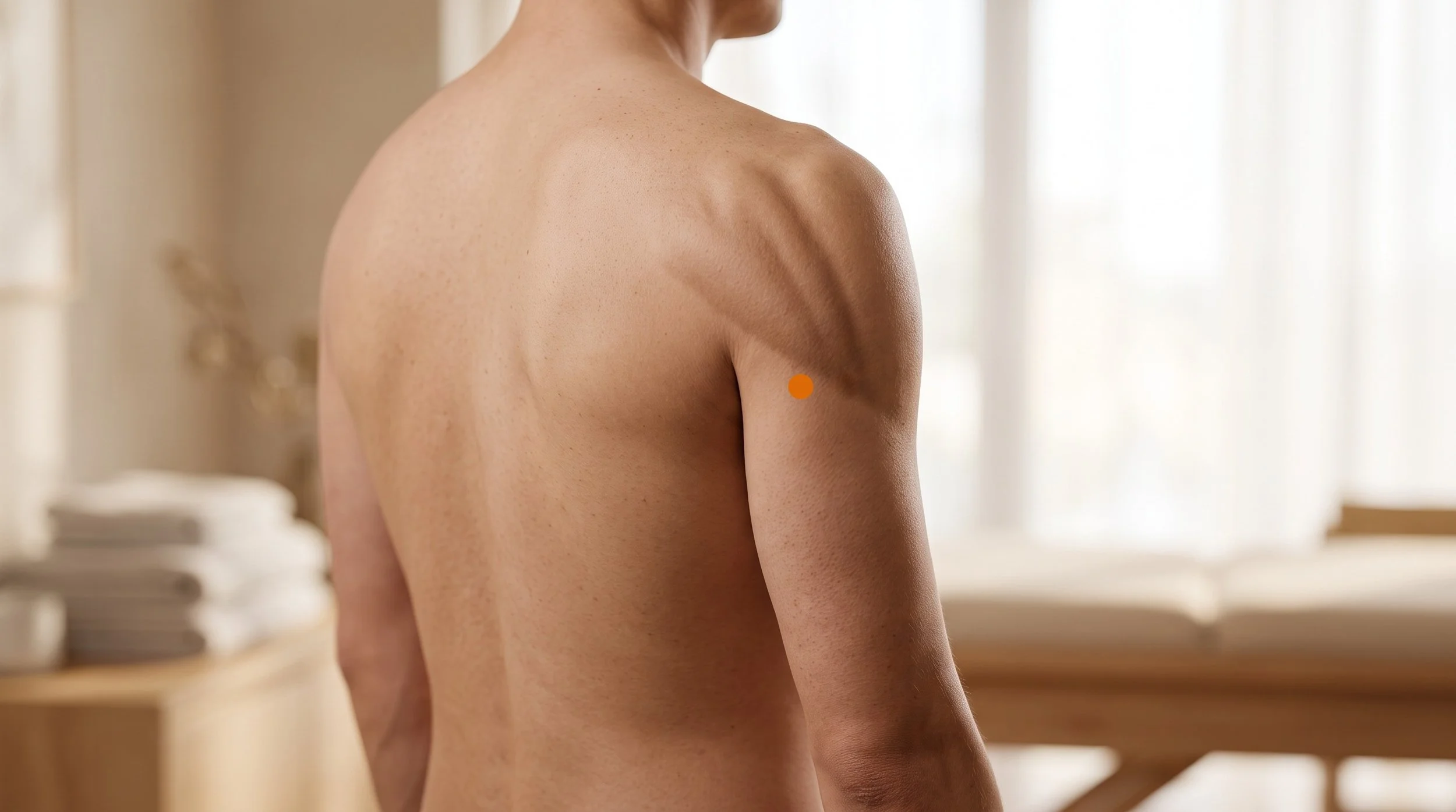
SJ13 (Naohui), also written TE13, often translated as Upper Arm Meeting or Shoulder Convergence, sits high on the back of the upper arm where the rear edge of the deltoid meets the triceps, roughly two thirds of the way from the elbow point SJ10 up toward the shoulder point SJ14. It is classified in the traditional literature as a meeting point of the Triple Burner channel with the Yang Linking vessel, which is one reason older texts credit it with effects well beyond the arm.
In modern practice the te13 acupuncture point is mostly used for something much more concrete: deep, aching upper arm pain, shoulder pain that travels down toward the elbow, and difficulty lifting the arm overhead. It sits directly over tissue that overhead work, carrying, and desk posture tend to overload, which makes naohui a practical target for both classical acupuncture and dry needling approaches.
- Location and layers: SJ13 lies at the posterior border of the deltoid over the triceps, on the line joining SJ14 and the olecranon, with the needle passing through skin and subcutaneous tissue into the groove between the long and lateral heads of the triceps, just behind the shaft of the humerus. Because the two common landmarks (3 cun below SJ14 and the posterior deltoid border) do not always coincide, most texts advise palpating for the most tender spot.
- Traditional categories, translated: classical sources describe naohui acupuncture as regulating qi, transforming phlegm, and freeing the channel to relieve pain. In neurophysiological terms, that maps onto needling a segmentally relevant, often tender muscular site to change local blood flow, alter nociceptor input, and reduce protective muscle guarding around the shoulder (Zhao, 2008).
- Nerve geography: the area is innervated by the posterior brachial cutaneous nerve and muscular branches of the radial nerve, with the radial nerve itself running deeper, and the posterior deltoid just anterior to the point served by the axillary nerve. These share the C5 to C8 root supply of the shoulder girdle, so input at triple burner 13 converges on the same spinal segments that carry shoulder pain (Zhao, 2008).
- Research picture: a Cochrane review of acupuncture for shoulder pain found only limited evidence of small short-term benefit, with too few good trials to draw firm conclusions (Green et al., 2005), while a large individual patient data meta-analysis reported that acupuncture outperformed both sham and no-acupuncture controls for chronic musculoskeletal pain, including shoulder pain (Vickers et al., 2018).
- Clinical framing: no trial has isolated the sj 13 arm point on its own. It is used inside multi-point protocols alongside local shoulder points and distal points, and its value in the treatment room is usually as a tender, reproducible entry into the posterior deltoid and triceps region rather than as a standalone remedy.
- De qi and dosing: needling here typically produces a heavy, spreading ache that can travel toward the elbow or forearm, sometimes with a brief twitch if a taut band in the triceps is engaged (Simons et al., 1999). Perpendicular or oblique insertion of 1 to 2 cun is the conventional depth range in the classical manuals.
Shoulder Pain That Radiates Down Your Arm?
Pain that starts at the shoulder and travels toward the elbow rarely comes from one structure alone. At Morningside Acupuncture we assess the deltoid, triceps, rotator cuff, and cervical contributors, then use SJ13 alongside local shoulder points and trigger point dry needling of the muscles that reproduce your pattern. Treatment is paired with loading and mobility work so gains hold between visits. Schedule an evaluation and we will map where your arm pain is actually coming from.
Schedule NowAnatomy of SJ13: Why the Posterior Deltoid Border Is Such an Important Location
SJ13 sits where the rear edge of the deltoid meets the long and lateral heads of the triceps on the back of the upper arm. Under the skin and a thin subcutaneous layer, the needle enters the muscular groove just posterior to the shaft of the humerus. This is a genuine mechanical crossroads: the posterior deltoid decelerates the arm during throwing and reaching, the triceps long head crosses the shoulder as well as the elbow, and both are loaded heavily by overhead lifting, carrying bags on one side, pressing movements at the gym, and long hours with the arms unsupported at a keyboard.
Palpating along the posterior deltoid border, clinicians frequently find one dense, exquisitely tender spot, which the classical manuals themselves recommend using as the true landmark rather than a fixed measurement.
The nerve geography explains most of what this point does. The skin here is supplied by the posterior brachial cutaneous nerve, the triceps by muscular branches of the radial nerve, and the radial nerve itself runs deeper in the spiral groove region, while the posterior deltoid immediately in front of the point is supplied by the axillary nerve. All of these arise from the same C5 to C8 portion of the brachial plexus that carries sensation from the shoulder joint and capsule.
When a needle stimulates muscle and connective tissue in this territory, the resulting afferent barrage reaches dorsal horn neurons that already receive input from the painful shoulder structures, and that convergence is one of the better-supported explanations for why needling near a painful region can dampen its perceived intensity (Zhao, 2008). Needling also recruits descending inhibitory pathways from the brainstem and triggers local release of vasoactive and analgesic mediators, which may reduce both pain and the muscle guarding that limits overhead reach (Zhao, 2008).
Deeper structures matter for safety. The middle (median) collateral branch of the deep brachial artery and its accompanying veins run in this region, and the radial nerve lies deep to the point as it travels around the humerus. Standard technique is perpendicular or oblique insertion of 1 to 2 cun, with shallower depths used in leaner patients, and the needle angled along the muscle rather than driven hard against bone. A sharp, electric, radiating sensation down the forearm suggests direct nerve contact and should prompt the practitioner to withdraw and redirect. In trained hands the point is well tolerated, and the usual side effects are limited to brief soreness or a small bruise.
Related Best Acupuncture Points For Shoulder Pain Related Acupuncture For Deltoid PainSJ13 (TE13) at a Glance: Classification, Location, and Clinical Use
| Category | Detail |
|---|---|
| Traditional Name | Naohui (Upper Arm Meeting, also translated Shoulder Convergence) |
| Channel Classification | Triple Burner (Sanjiao) channel, point 13; also written TE13 or TB-13 (also called the Triple Energizer, the Triple Heater or Triple Warmer) |
| Point Categories | Meeting (intersection) point of the Triple Burner channel with the Yang Linking vessel (Yang Wei Mai); listed by some sources as an intersection with the Large Intestine channel as well; no five-shu or hui-meeting designation |
| Precise Location | On the back of the upper arm at the posterior border of the deltoid, on the line joining SJ14 (below and behind the acromion) and the olecranon, roughly two thirds of the way up from SJ10 toward SJ14; located in the depression between the long and lateral heads of the triceps, just behind the humeral shaft. Palpate for the most tender point in that region. |
| Tissue Stimulated | Posterior deltoid border and the long and lateral heads of the triceps brachii; overlaps common myofascial targets described on our Triceps Brachii Trigger Points and Deltoid Trigger Points pages |
| Needle Depth / Direction | Perpendicular or oblique insertion, 1 to 2 cun, angled along the muscular groove rather than toward bone; shallower depths in smaller or leaner patients |
| De Qi Sensation | Heavy, dull, spreading ache at the back of the upper arm, often traveling toward the elbow or forearm; a brief involuntary twitch may occur when a taut band in the triceps is engaged |
| Primary Clinical Uses | Upper arm pain, shoulder pain radiating down the arm, difficulty raising or reaching overhead, posterior shoulder tightness; classical texts additionally list goitre, scrofula (neck nodules), eye disorders, chills and fever, and mental-emotional conditions |
| Common Point Combinations |
|
Deadman's point manual presents SJ13 with two traditional actions: regulating qi while transforming phlegm, and freeing the channel to relieve pain. Alongside the expected arm indications (weakness and pain of the shoulder and arm, shoulder swelling that pulls into the scapula, inability to lift the arm), the classical entry also lists goitre, scrofula, alternating chills and fever, eye disease, epilepsy, and mania.
The commentary notes that this point shares its goitre and scrofula indications with a cluster of neighbors, including LU3, LI13, LI14, LI15, and SJ10, and offers partial explanations: both the Triple Burner channel and the Yang Linking vessel pass through the neck, and the Triple Burner was traditionally tied to fluid transformation and the movement of qi. What makes the pattern striking is that the text declines to force a tidy theory, attributing the upper arm cluster's reputation for neck swellings largely to accumulated empirical observation rather than doctrine.
That kind of candor is rare in the classical literature, and it is a useful reminder that traditional indication lists record what practitioners believed they saw, not a tested mechanism.
Why SJ13 Is Used for Shoulder Pain That Radiates Down the Arm
Patients often describe shoulder pain that will not stay in the shoulder. It starts at the joint, then settles into a deep ache in the back of the upper arm, sometimes reaching the elbow. That pattern makes anatomical sense: the shoulder capsule, rotator cuff, posterior deltoid, and triceps long head all send sensory information into the same C5 to C8 spinal segments. Once those segments are sensitized, pain is perceived across the whole territory rather than at its source. SJ13 sits squarely inside that territory, which is why needling it can influence pain that seems to belong to the joint above it (Zhao, 2008).
Two mechanisms are usually invoked. The first is segmental: needling muscle and fascia in a shared segment produces afferent input that modulates dorsal horn processing for that region. The second is systemic: sustained needle stimulation engages descending inhibitory pathways from the periaqueductal gray and rostroventral medulla, along with endogenous opioid release, which reduces pain more broadly (Zhao, 2008). Both effects are dose-dependent and time-limited, which is one reason a course of treatment usually outperforms a single session.
The clinical evidence supports cautious optimism rather than certainty. The individual patient data meta-analysis by Vickers and colleagues found that acupuncture produced statistically significant benefits over both sham and usual care for chronic musculoskeletal pain, including shoulder pain, with effects that persisted over time (Vickers et al., 2018). The dedicated Cochrane review of acupuncture for shoulder pain was more reserved, concluding that the available trials were too few and too small to establish clear benefit beyond the short term (Green et al., 2005). In practice, we treat SJ13 as one useful component of a broader plan rather than as the reason a shoulder gets better.
What the Research Shows for SJ13 (TE13)
One note on naming before the evidence: in the research literature this point appears as TE13, the WHO standard code, and also as SJ13 or TB13 depending on the authors, so it is worth searching all three if you want to read the studies below in full.
No study has tested SJ13 in isolation, and it would be misleading to suggest otherwise. Shoulder pain trials use multi-point protocols in which this point may or may not appear, and dry needling trials target muscles (deltoid, triceps, infraspinatus, upper trapezius) that overlap the same region without using channel nomenclature. The table below summarizes the most relevant reviews for the conditions SJ13 is used to address, and readers should note that several report low or very low certainty evidence.
The honest reading is that needling therapies appear to offer modest short-term pain relief for shoulder problems, that effects are clearest when needling is combined with exercise, and that the contribution of any single point remains untested.
| Study | Type | Focus | Key Finding |
|---|---|---|---|
| Green et al., 2005 | Cochrane systematic review | Acupuncture for shoulder pain in adults | Found only limited evidence of small short-term benefit for pain and function, with too few adequately powered trials to support firm conclusions. |
| Vickers et al., 2018 | Individual patient data meta-analysis | Acupuncture for chronic pain, including musculoskeletal shoulder pain | Acupuncture was superior to both sham and no-acupuncture controls, with benefits that were only modestly reduced at one-year follow-up. |
| Navarro-Santana et al., 2021 | Systematic review and meta-analysis | Trigger point dry needling for nontraumatic shoulder pain of musculoskeletal origin | Reported reductions in pain and related disability compared with comparison interventions, though the certainty of evidence was rated low. |
| Liu et al., 2015 | Systematic review and meta-analysis | Dry needling of myofascial trigger points associated with neck and shoulder pain | Suggested dry needling may relieve trigger point pain in the neck and shoulders over the short and medium term. |
| Zhao, 2008 | Narrative review of mechanisms | Neural basis of acupuncture analgesia | Describes segmental dorsal horn modulation, descending inhibitory control, and endogenous opioid involvement as the principal mechanisms. |
Trouble Raising Your Arm Overhead?
Limited overhead reach is often a mix of joint restriction, guarded muscle, and pain-driven inhibition. We use SJ13 with SJ14 and neighboring arm points to reduce guarding at the posterior deltoid and triceps, then retest range immediately so you can feel what changed. Our practitioners are licensed acupuncturists trained in both classical channel work and modern dry needling. Book a session and let's see how much range we can restore in one visit.
Schedule NowSJ13 in the Context of Trigger Point Work
SJ13 occupies territory that dry needling practitioners already visit regularly. The posterior deltoid and the long and lateral heads of the triceps both harbor taut bands that refer pain in patterns patients recognize: a deep ache at the back of the shoulder, pain spreading down the back of the arm toward the elbow, and occasionally referral into the forearm (Simons et al., 1999).
Because the classical location instruction for naohui is to palpate for the most tender spot along the posterior deltoid border, the point and the myofascial target often turn out to be the same piece of tissue approached with different vocabulary. This is a good example of why we define acupuncture by the tool and the tissue rather than by the theoretical language attached to it.
At Morningside Acupuncture, SJ13 is rarely used alone. A typical session for posterior shoulder and upper arm pain might combine needling at SJ13 and SJ14 with trigger point work in the deltoid, triceps brachii, infraspinatus, and teres minor, plus attention to the upper trapezius and levator scapulae when the neck is contributing. We assess range of motion before and after, use electrical stimulation when tolerance and presentation allow, and finish with loading exercises for the rotator cuff and scapular stabilizers. Needling reduces the pain and guarding that block movement; exercise is what keeps the change.
SJ13 Shoulder and Arm Pain Treatment at NYC's Highest-Rated Acupuncture Clinic
Morningside Acupuncture is the highest-rated acupuncture and dry needling clinic in New York City with over 500 five-star Google reviews. Our team treats shoulder and upper arm pain daily, combining points like SJ13 and SJ14 with precise needling of the deltoid, triceps, and rotator cuff. Every plan includes hands-on assessment, clear expectations, and home exercise so results last. Schedule your first appointment at our Upper West Side clinic today.
Schedule NowFrequently Asked Questions
Is SJ13 the same point as TE13 or TB13?
Yes. SJ13, TE13, and TB13 are all codes for the same point, Naohui. SJ stands for San Jiao, the Chinese name of the channel. TE (Triple Energizer) is the WHO standard abbreviation and the one you will see in most Western textbooks and research papers. TB (Triple Burner) and TW (Triple Warmer) are older English renderings of the same name that still appear in many books. You will also come across it written as San Jiao 13 or Triple Energizer 13. Whichever code is used, the location and the uses are the same.
What does SJ13 feel like when needled?
Most people report a heavy, dull, spreading ache rather than a sharp sting. The sensation often travels a short distance toward the elbow or, less commonly, into the forearm. If the practitioner engages a taut band in the triceps, you may feel a quick involuntary twitch followed by a brief cramping ache that settles within seconds. A sharp, electric, shooting sensation is not the goal and should be reported immediately so the needle can be adjusted. Mild soreness for a day afterward is common and usually resolves on its own.
Why needle the upper arm when the pain is in my shoulder?
Because the shoulder and the upper arm share nerve supply. The posterior deltoid, triceps, rotator cuff, and joint capsule all feed sensory information into the same C5 to C8 spinal segments, so input from the arm reaches the same neurons that carry your shoulder pain (Zhao, 2008). Practically speaking, the tissue at SJ13 is often the part that is genuinely tight and tender even when the joint gets the blame. Treating there can reduce guarding, restore reaching range, and take pressure off structures at the shoulder itself.
Can I press SJ13 myself between sessions?
Yes, and it is easy to reach with the opposite hand. Let the arm hang relaxed, find the back edge of the deltoid where it meets the triceps on the outer-rear upper arm, and slide your fingers down about two thirds of the way from the shoulder toward the elbow until you find the tender, ropy spot. Press with the thumb or two fingers at a firmness you would rate around 5 or 6 out of 10, hold for 30 to 60 seconds, and breathe slowly while the ache eases. Repeat two or three times per side, once or twice a day, then move the arm through a few slow overhead reaches to reinforce the change. Stop if pressure produces numbness, tingling, or sharp radiating pain down the forearm.
Is SJ13 safe to needle?
In trained hands, yes. The point sits over muscle with no lung or major joint cavity beneath it, so the risks that concern practitioners at chest and neck points do not apply here. The relevant structures are the radial nerve running deeper around the humerus and the collateral vessels of the deep brachial artery, both of which are avoided by angling along the muscle at conventional depths of 1 to 2 cun and by adjusting immediately if a patient reports an electric radiating sensation. Expected side effects are limited to temporary soreness, mild bruising, or brief lightheadedness. Tell your practitioner if you take blood thinners, have a bleeding disorder, or have had recent surgery or injections in the shoulder.
Where exactly is SJ13 located?
On the back of the upper arm at the posterior border of the deltoid muscle, along the line drawn from SJ14 (in the depression below and behind the acromion when the arm is raised) down to the olecranon at the elbow, roughly two thirds of the distance up from SJ10 toward SJ14. Anatomically it lies in the groove between the long and lateral heads of the triceps, just behind the shaft of the humerus. Older sources also describe it as about 3 cun below SJ14, but that measurement and the posterior deltoid border do not always land on the same spot, which is why the standard advice is to palpate the area and use the most tender location.
References
- Deadman, P., Al-Khafaji, M., & Baker, K. (2009). A manual of acupuncture. Journal of Chinese Medicine Publications.
- Cheng, X. (Ed.). (1999). Chinese acupuncture and moxibustion (Rev. ed.). Foreign Languages Press.
- O'Connor, J., & Bensky, D. (Eds. & Trans.). (1981). Acupuncture: A comprehensive text. Shanghai College of Traditional Medicine. Eastland Press.
- Cunningham, P. M. (2000). Acupuncture points: A practical guide to classical and modern usage. Odyssey Press.
- Maciocia, G. (2006). The channels of acupuncture: Clinical use of the secondary channels and eight extraordinary vessels. Churchill Livingstone Elsevier.
- Simons, D. G., Travell, J. G., & Simons, L. S. (1999). Travell & Simons' myofascial pain and dysfunction: The trigger point manual, Vol. 1: Upper half of body (2nd ed.). Williams & Wilkins.
- Green, S., Buchbinder, R., & Hetrick, S. (2005). Acupuncture for shoulder pain. Cochrane Database of Systematic Reviews, 2005(2), CD005319. https://doi.org/10.1002/14651858.CD005319
- Vickers, A. J., Vertosick, E. A., Lewith, G., MacPherson, H., Foster, N. E., Sherman, K. J., Irnich, D., Witt, C. M., & Linde, K. (2018). Acupuncture for chronic pain: Update of an individual patient data meta-analysis. Journal of Pain, 19(5), 455-474. https://doi.org/10.1016/j.jpain.2017.11.005
- Navarro-Santana, M. J., Gómez-Chiguano, G. F., Cleland, J. A., Arias-Buría, J. L., Fernández-de-las-Peñas, C., & Plaza-Manzano, G. (2021). Effects of trigger point dry needling for nontraumatic shoulder pain of musculoskeletal origin: A systematic review and meta-analysis. Physical Therapy, 101(2), pzaa216. https://doi.org/10.1093/ptj/pzaa216
- Liu, L., Huang, Q. M., Liu, Q. G., Ye, G., Bo, C. Z., Chen, M. J., & Li, P. (2015). Effectiveness of dry needling for myofascial trigger points associated with neck and shoulder pain: A systematic review and meta-analysis. Archives of Physical Medicine and Rehabilitation, 96(5), 944-955. https://doi.org/10.1016/j.apmr.2014.12.015
- Zhao, Z. Q. (2008). Neural mechanism underlying acupuncture analgesia. Progress in Neurobiology, 85(4), 355-375. https://doi.org/10.1016/j.pneurobio.2008.05.004
Disclaimer: This web site is intended for educational and informational purposes only. Reading this website does not constitute providing medical advice or any professional services. This information should not be used for diagnosing or treating any health issue or disease. Those seeking medical advice should consult with a licensed physician. Seek the advice of a medical doctor or other qualified health professional for any medical condition. If you think you have a medical emergency, call 911 or go to the emergency room. No acupuncturist-patient relationship is created by reading this website or using the information. Morningside Acupuncture PLLC and its employees and contributors do not make any express or implied representations with respect to the information on this site or its use. For any legal interpretation of scope of practice in your state, consult a licensed attorney or regulatory authority.
Read more from our blog



